Skip to content
WAnimals
  • Map
  • Species
  • Parks
  • Diving
Log inCreate account
WAnimals

The guide for travellers and animal lovers: discover, plan and share your wild adventures around the world.

Discover wildlife

  • Species
  • Ecosystems
  • Glossary
  • Tags

Explore places

  • Map
  • Countries
  • Parks
  • Diving

Plan experiences

  • Guides

Learn

  • Blog

Resources

  • Help centre
  • Contact
  • Install the app

Follow us

Account

  • Log in
  • Create account

© 2026 WAnimals. All rights reserved.

About usHow we build our profilesTerms of servicePrivacyLegal notice
MapSpeciesParksDiving
  1. Home
  2. Species
  3. House Cricket

One of the 3 crickets on WAnimals

Insects · Orthoptera · Gryllidae

House Cricket

Acheta domesticus

Not Evaluated

It has not yet been assessed against the IUCN criteria.

Spotted something wrong?

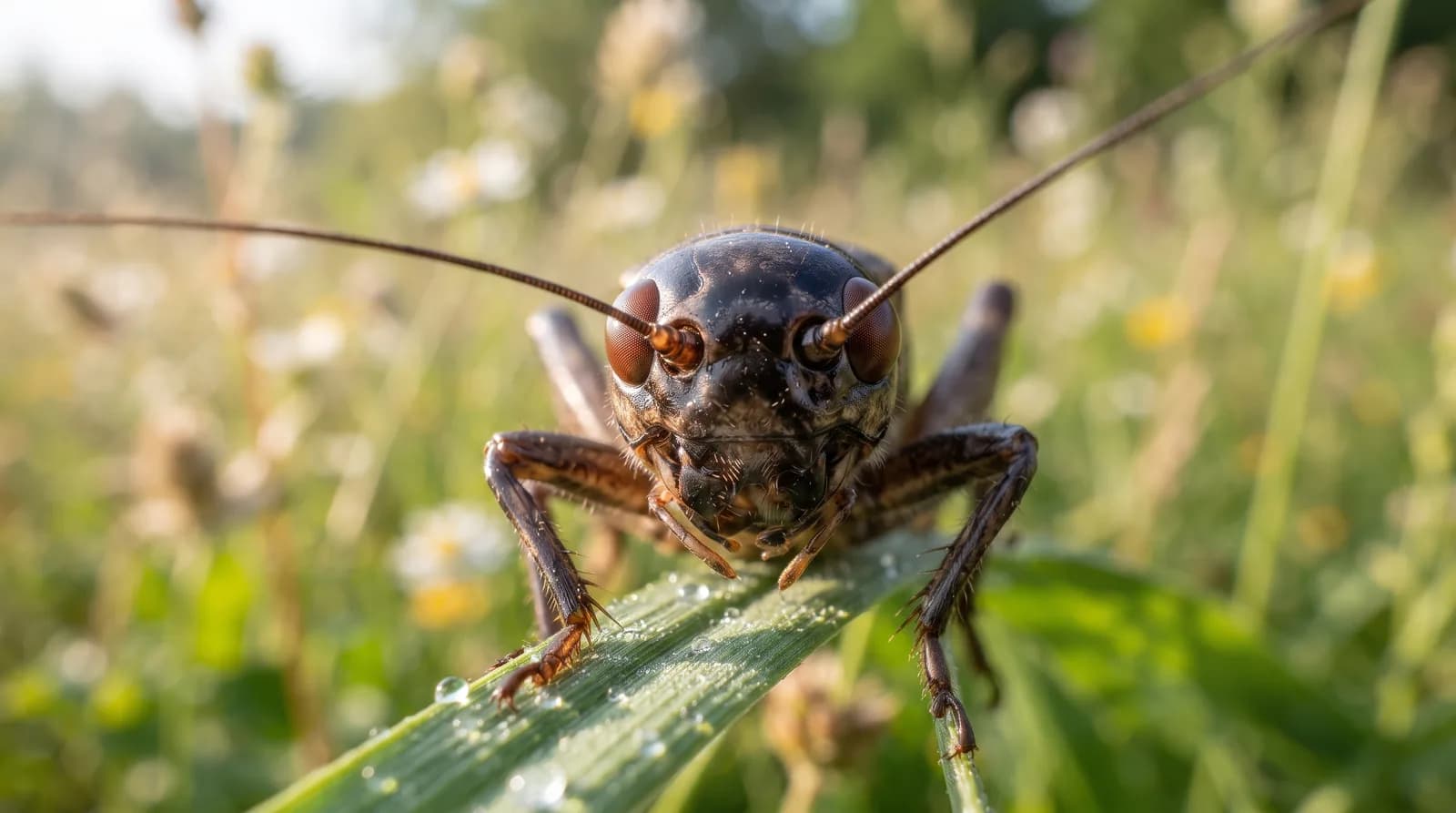
The house cricket is an orthopteran insect probably originating in south-western Asia, but which has spread throughout the world. House crickets are bred commercially as food for pets such as amphibians, arthropods, birds and reptiles, but they can also be kept as pets in their own right, as has been the case in China and Japan.

Size

1.6 cm – 2.1 cm

Life expectancy

1 year

Diet

Omnivore

Combines animal and plant food depending on availability.

Activity

Nocturnal

Active mainly at night.

Social structure

Solitary

Lives and hunts alone, joining others only to breed.

Sighting difficulty

Unknown

Grassland
6countries1same family

Fun facts

  • Only the male sings, rubbing a scraper on one wing against a file on the other; the rate of the song speeds up with temperature so regularly that it can be used to estimate it.
  • Its ears are not on its head but on its front legs, in the form of two tympanic membranes just below the knee.
  • It is one of the four insect species authorised by the European Union as human food, and is farmed industrially for flours and protein bars.
  • It is one of the edible insects authorised in the European Union: the Commission approved its sale frozen, dried and as a powder in 2022, and partially defatted in January 2023.
  • Its protein has an in vitro digestibility of 79 to 93%, comparable to that of conventional animal sources.
  • Intensive rearing has an Achilles heel: cricket densovirus (AdDNV), which has wiped out entire farms in North America and Europe.
  • It can trigger cross-reactions in people allergic to crustaceans and dust mites, because of tropomyosin.
  • It is traditionally eaten in South-East Asia, above all in Thailand.

Life cycle and biology

Skeleton type
Invertebrate - chitin exoskeleton (insect)
Habitat and environment
Heated buildings, refuse tips and human-modified ground
Sexual maturity
The female can mate two days after reaching adulthood and begins to lay around the ninth day; the nymphs go through between 6 and 12 instars depending on the source
Gestation / incubation
The eggs hatch in 1-2 weeks (about 13 days at 30 °C); development from egg to adult takes 40 to 45 days in optimal conditions and up to 200 days at 18 °C
Litter / clutch size
Clutches of 50 to 100 eggs every 2 or 3 days; a mated female can lay close to 3,000 eggs over about 70 days of adult life

Sources consulted: https://es.wikipedia.org/wiki/Acheta_domesticus; Clifford 1990 via guias de cria de grillo domestico; Nature Scientific Reports (mas de 1.500 huevos); ScienceDirect (Hughes 1989); Science Advances, How colonial animals evolve; Wikipedia, Zooid; Clifford 1977 y FAO 2014 via guias de cria de grillo; ficha de identificacion; Ficha de identificacion de Acheta domesticus; Ficha de especie de Acheta domesticus; Clifford 1990 y Nix & Bass 1973 via guias de cria; ficha de especie

Where to find it

Loading map…

Related species

Other species in the catalogue with the most in common with House Cricket — same habitat, park, country, tags or family.

Same taxonomic family
Related to
Related to
Related to
Related to
Related to

Keep exploring

Based on what we already know about house cricket.

Comments

Share an experience, a fun fact or a tip for seeing the house cricket.

Be the first to comment.
See full glossary
This page in other languages: Español · Deutsch · Français · Português · Italiano
See its range on the interactive map→
Field CricketLeast Concern

Field Cricket

Gryllus campestris

Least Concern

House Mouse

Mus musculus

Least Concern

Brown Rat

Rattus norvegicus

Least Concern

Black Rat

Rattus rattus

Common CockchaferNot Evaluated

Common Cockchafer

Melolontha melolontha

Not Evaluated

South American Fire Ant

Solenopsis invicta

CountriesChina
TagsOmnivore
Omnivore
Nocturnal
Colonial
Insect
Grassland
China
Mexico
Netherlands
Spain
Thailand
United States