Skip to content
WAnimals
  • Map
  • Species
  • Parks
  • Diving
Log inCreate account
WAnimals

The guide for travellers and animal lovers: discover, plan and share your wild adventures around the world.

Discover wildlife

  • Species
  • Ecosystems
  • Glossary
  • Tags

Explore places

  • Map
  • Countries
  • Parks
  • Diving

Plan experiences

  • Guides

Learn

  • Blog

Resources

  • Help centre
  • Contact
  • Install the app

Follow us

Account

  • Log in
  • Create account

© 2026 WAnimals. All rights reserved.

About usHow we build our profilesTerms of servicePrivacyLegal notice
MapSpeciesParksDiving
  1. Home
  2. Species
  3. Humboldt Squid

One of the 6 squid on WAnimals
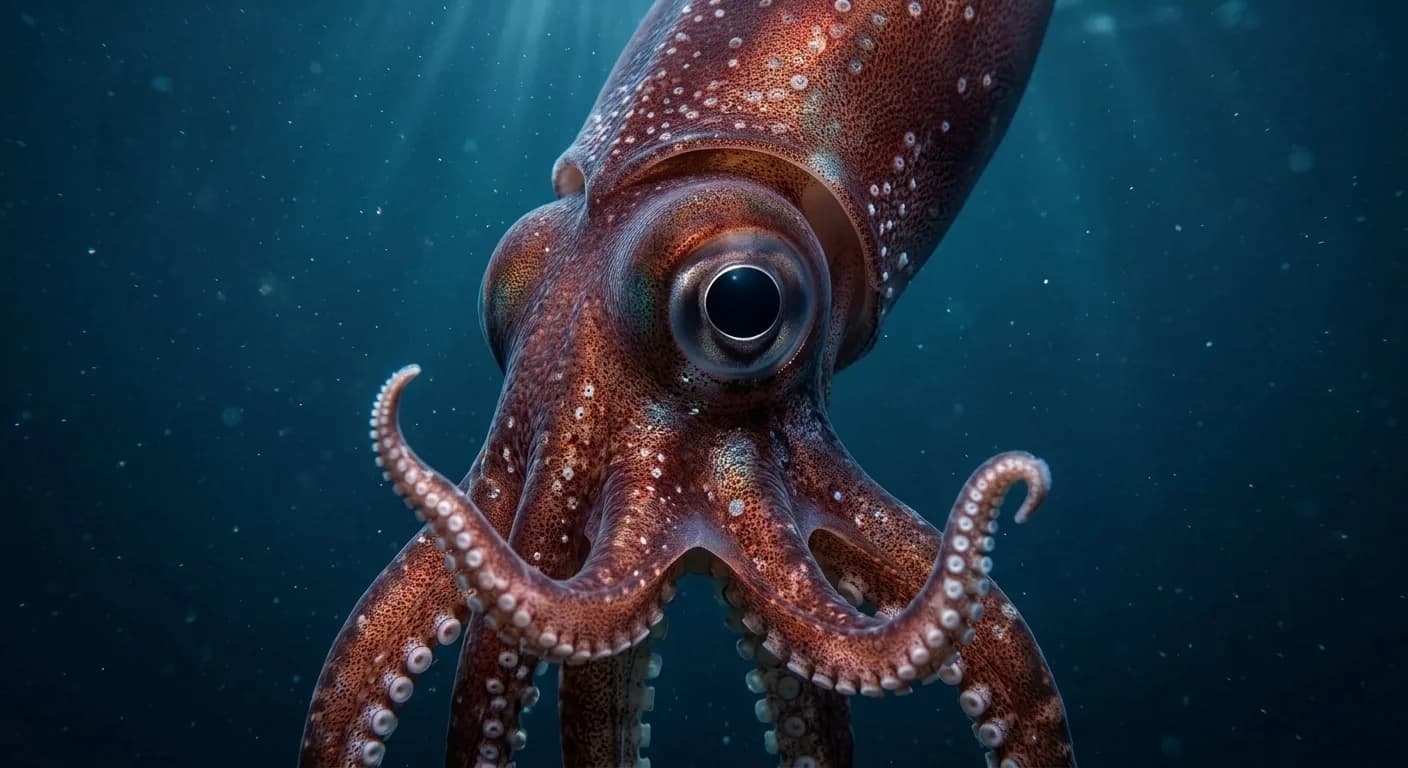
Humboldt Squid (Dosidicus gigas)

Cephalopods · Oegopsida · Ommastrephidae

Humboldt Squid

Dosidicus gigas

Not Evaluated

It has not yet been assessed against the IUCN criteria.

Spotted something wrong?

The Humboldt squid is a large cephalopod mollusc, abundant off the coasts of Peru, Mexico and Chile. Those countries fish it industrially, and it has gained importance in recent years thanks to strong international demand.

Weight

up to 50 kg

Size

up to 1.2 m

Life expectancy

2 years
Diet

Carnivore

Feeds mainly on other animals.

Activity

Nocturnal

Active mainly at night.

Social structure

Colony

Lives in large concentrations, often for breeding reasons.

Sighting difficulty

Unknown

Ocean
13countries17parks15dive sites

AI-generated images: illustrations, not photographs.

Fun facts

  • GeneralIt changes colour in waves of red and white to communicate; it lives only a year or two and grows to 2 m.
  • It is the largest squid in its family and supports one of the largest cephalopod fisheries in the world, above all in Peru, Chile and Mexico.
  • It grows extraordinarily fast: it reaches more than a metre and tens of kilos in little over a year, and dies after breeding.
  • It hunts in large groups and is said to turn cannibal when hooked.
  • Its range has shifted north strikingly: during warm events it has reached Alaska, far beyond its historical range.
  • It tolerates the oxygen minimum zone, where it hunts with almost no competition, suppressing its metabolism while it is there.
  • It flashes rapidly between red and white, which has earned it the name red devil.

Life cycle and biology

Habitat and environment
Ocean waters of the Humboldt Current, 0-1,200 m

Sources consulted: https://es.wikipedia.org/wiki/Dosidicus_gigas

Where to find it

Loading map…

Where to see it

Parks and dive sites where this species has been documented — showing 20 of 32.

Related species

Other species in the catalogue with the most in common with Humboldt Squid — same habitat, park, country, tags or family.

Shares a park
Shares a park
Shares a park
Shares a park
Shares a park
Shares a park

Keep exploring

Based on what we already know about humboldt squid.

Comments

Share an experience, a fun fact or a tip for seeing the humboldt squid.

Be the first to comment.

See full glossary
This page in other languages: Español · Deutsch · Français · Português · Italiano

The pins mark the parks and dive sites where its presence is documented.

See its range on the interactive map→
Galápagos National ParkEcuador
Channel IslandsUnited States
Guadalupe IslandMexico
Revillagigedo ArchipelagoMexico
Cocos IslandCosta Rica
CoibaPanama
ParacasPeru
MachalillaEcuador
Marino BallenaCosta Rica
GorgonaColombia
Ballestas IslandsPeru
Robinson Crusoe Island (Juan Fernández)Chile
Channel Islands National ParkUnited States
La Jolla CoveUnited States
Guadalupe Island (great white shark)Mexico
Cabo Pulmo National ParkMexico
Monterey Bay (Point Lobos)United States
Punta de ChorosChile
Los Islotes (sea lions)Mexico
Puerto Vallarta (Los Arcos)Mexico
See all 17 parks
See all 15 dive sites
South American Fur SealLeast Concern

South American Fur Seal

Arctocephalus australis

Giant Pacific OctopusLeast Concern

Giant Pacific Octopus

Enteroctopus dofleini

Least Concern

Yellow-bellied Sea Snake

Hydrophis platurus

Least Concern

Horn Shark

Heterodontus francisci

Bluntnose Sixgill SharkNear Threatened

Bluntnose Sixgill Shark

Hexanchus griseus

Data Deficient

Pacific Hagfish

Eptatretus stoutii

CountriesMexico
ParksGalápagos National ParkEcuador
TagsCarnivore
Carnivore
Nocturnal
Colonial
Ocean
Mollusc

North America9

South America4

Mexico
United States
Ecuador
Peru
Chile
Colombia
Canada
Costa Rica
El Salvador
Guatemala
Honduras
Mexico
Nicaragua
Panama
United States
Chile
Colombia
Ecuador
Peru