Mammals · Rodentia · Caviidae
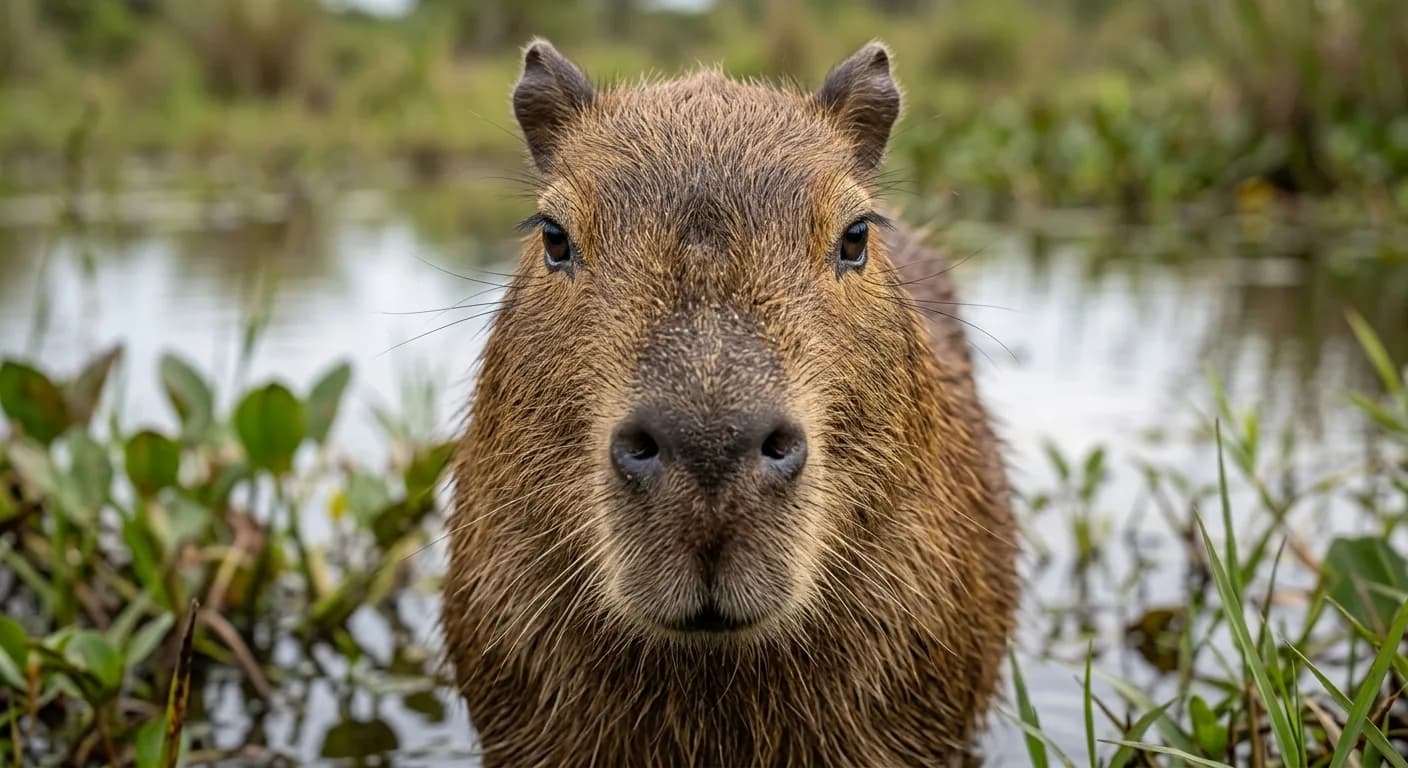
Capybara
Hydrochoerus hydrochaeris
The species is abundant and widely distributed; it faces no significant short-term risk. See full glossary
It is the largest rodent in the world, able to top 65 kg. Its cooperative breeding is exceptional: the young gather in a collective crèche where several adults share the watching and the nursing.
Weight
35 kg – 66 kg
Size
1.1 m – 1.3 m
Lifespan
4 years
Diet
Herbivore
Feeds mainly on plants.
Activity
Irregular activity
Active at irregular times, by day or night depending on circumstances.
Social structure
Herd
Lives in large groups as a strategy against predators.
Sighting difficulty
Easy
Fun facts
- anatomíaIt is the largest rodent in the world, and its eyes, ears and nostrils all sit high on its head, so it can stay almost completely submerged while keeping watch.
Life cycle & biology
- Skeleton type
- Vertebrate - internal bony skeleton (mammal)
- Habitat & environment
- Wooded country close to water throughout South America: rivers, lakes, marshes and wetlands
- Birth weight
- 1.5 kg
- Size at birth
- Extremely precocial — born with its eyes open and a full set of teeth, walking and grazing within hours
- Sexual maturity
- 12-18 months (male) | 7-12 months (female), though effective maturity depends on reaching 30-40 kg rather than on age
- Gestation / incubation
- 150 days (~5 months)
- Litter / clutch size
- 1 to 8 young per litter (most commonly 4-5)
- Lifespan in captivity
- Documented record of up to 12-15.1 years in captivity
Sources consulted: AnAge; USGS Species Profile; Capybara Care Manual; Fishi-pedia; Nature Table; Animal Diversity Web; Animal Spot; SDZWA Library Fact Sheet; Cape May County NJ
Where to find it
See its range on the interactive mapWhere to watch it
Parks and dive sites where this species has been documented.
Related species
Other species in the catalogue with the most in common with Capybara — same habitat, park, country, tags or family.
Water Opossum
Chironectes minimus
Southern Tamandua
Tamandua tetradactyla
Brown-throated Sloth
Bradypus variegatus
Southern Two-toed Sloth
Choloepus didactylus
Seba's Short-tailed Bat
Carollia perspicillata
Keep exploring
Based on what we already know about capybara.
Comments
Share an experience, a fun fact or a tip for seeing the capybara.
Be the first to comment.