Mammals · Carnivora · Canidae
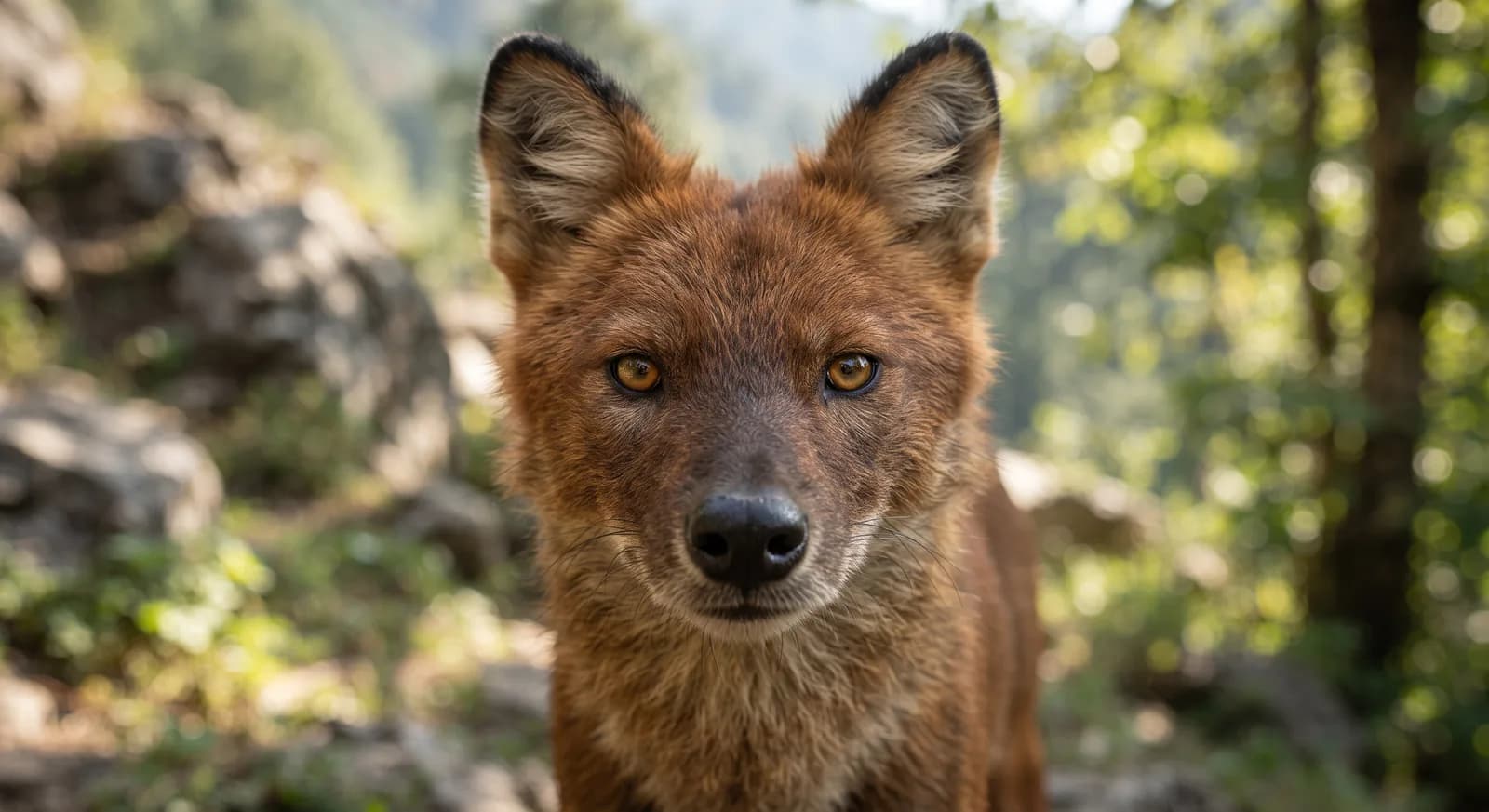
Dhole
Cuon alpinus
It faces a very high risk of extinction in the wild in the near future. See full glossary
It lives in cooperative packs much like the African wild dog's; several adults feed the nursing mother and the pups with regurgitated meat.
Weight
10 kg – 20 kg
Size
90 cm on average
Lifespan
10 years
Diet
Carnivore
Feeds mainly on other animals.
Activity
Diurnal
Active mainly during the day.
Social structure
Hierarchical pack
Lives in an organised hierarchical group, typical of cooperative hunters.
Sighting difficulty
Hard
Fun facts
- Females can have as many as 16 teats, an adaptation to litters that are exceptionally large for a canid.
- It hunts medium-sized hoofed animals such as chital and sambar cooperatively, as a pack.
- It lives in dense forest, alpine grassland and scrub across much of Central, South and South East Asia.
- comunicaciónIt communicates with a distinctive high whistle, quite unlike a wolf's howl, to coordinate the pack in dense woodland.
Life cycle & biology
- Skeleton type
- Vertebrate - internal bony skeleton (mammal)
- Habitat & environment
- Dense forest, alpine grassland and scrub across much of Central, South and South East Asia
- Birth weight
- Born in a burrow near streams or among rocks
- Size at birth
- Born blind and helpless
- Sexual maturity
- ~1 year
- Gestation / incubation
- 60-63 days
- Litter / clutch size
- 1 to 10 pups per litter (average 5-8, up to 8 according to another source)
- Lifespan in captivity
- Documented record of up to 15-16 years
Sources consulted: A-Z Animals; Animal Diversity Web; PBS Nature (Dhole Fact Sheet)
Where to find it
See its range on the interactive mapWhere to watch it
Parques y spots de buceo donde se ha documentado esta especie — se muestran 10 de 11 documentados.
Related species
Other species in the catalogue with the most in common with Dhole — same habitat, park, country, tags or family.
Golden Snub-nosed Monkey
Rhinopithecus roxellana
Javan Surili
Presbytis comata
Southern Pig-tailed Macaque
Macaca nemestrina
Javan Hawk-Eagle
Nisaetus bartelsi
Lion-tailed Macaque
Macaca silenus
Tibetan Fox
Vulpes ferrilata
How to help
The dhole is classified as endangered. Organizations such as UICN, WWF y Wildlife Conservation Society work specifically on its conservation and that of its habitat; looking into their programs is a good starting point if you want to get involved.
It's documented in 8 real protected areas — part of why protecting these places matters for its conservation.
Keep exploring
Based on what we already know about dhole.
Comments
Share an experience, a fun fact or a tip for seeing the dhole.
Be the first to comment.