Cephalopods · Nautilida · Nautilidae
Chambered Nautilus
Nautilus pompilius
It has not yet been assessed against the IUCN criteria. See full glossary
Unlike most cephalopods, which live only a few years and breed once, the nautilus is long-lived and can breed several times.
Size
11.9 cm – 20 cm
Lifespan
20 years
Diet
Carnivore
Feeds mainly on other animals.
Activity
Nocturnal
Active mainly at night.
Social structure
Solitary
Lives and hunts alone, joining others only to breed.
Sighting difficulty
Unknown
Fun facts
- It is one of the few cephalopods that still has an external shell, almost unchanged in 500 million years.
- Unlike other cephalopods, it is long-lived and can breed several times.
- It finds its prey by smell, since its eyesight is rudimentary.
- anatomíaIts logarithmic spiral shell works as a buoyancy chamber, balancing gas and liquid in its internal compartments to control depth.
- historia naturalIt has changed very little in form over the last 500 million years, which is why it is often called a living fossil.
- It is the only living cephalopod with an external shell, and the last representative of a lineage that dominated the seas for hundreds of millions of years.
- Its shell is divided into chambers that it seals off as it grows, and it regulates its buoyancy by adjusting the proportion of gas and liquid inside them through a tube called the siphuncle.
- Its spiral roughly follows a logarithmic progression, and it is one of the shapes most often cited as an example of geometry in nature.
- It has between 60 and 90 tentacles without suckers, which grip by means of sticky grooves, and a primitive eye without a lens that works like a pinhole camera.
- It is long-lived and late-maturing for a cephalopod: it can live twenty years and takes ten or more to mature, against the year or two of an octopus. That makes it very vulnerable to fishing.
- It is intensively exploited for the shell trade, and since 2017 the whole genus has been listed in Appendix II of CITES.
Life cycle & biology
- Skeleton type
- Invertebrate - no internal skeleton, protected by an external calcareous shell divided into chambers
- Habitat & environment
- Deep reefs of the tropical Indo-Pacific, between 100 and 700 metres, rising into shallow water at night to feed
- Birth weight
- Eggs ~3.8 cm long; the newborn's shell ~2.5 cm across
- Size at birth
- Shell ~2.5 cm across on hatching
- Sexual maturity
- 10-20 years (studies give either 10-15 or 15-20 years depending on the population)
- Gestation / incubation
- Approximately 1 year (10-12 months) of egg development
- Litter / clutch size
- 10 to 20 eggs a year, laid one at a time
Sources consulted: Encyclopedia of Life; MarineBio; National Marine Sanctuary Foundation; PMC (Osprey Reef demographics study); Center for Biological Diversity; Aquarium La Rochelle; NOAA Fisheries; ScienceInsights
Where to find it
See its range on the interactive mapWhere to watch it
Parques y spots de buceo donde se ha documentado esta especie — se muestran 17 de 26 documentados.
Related species
Other species in the catalogue with the most in common with Chambered Nautilus — same habitat, park, country, tags or family.
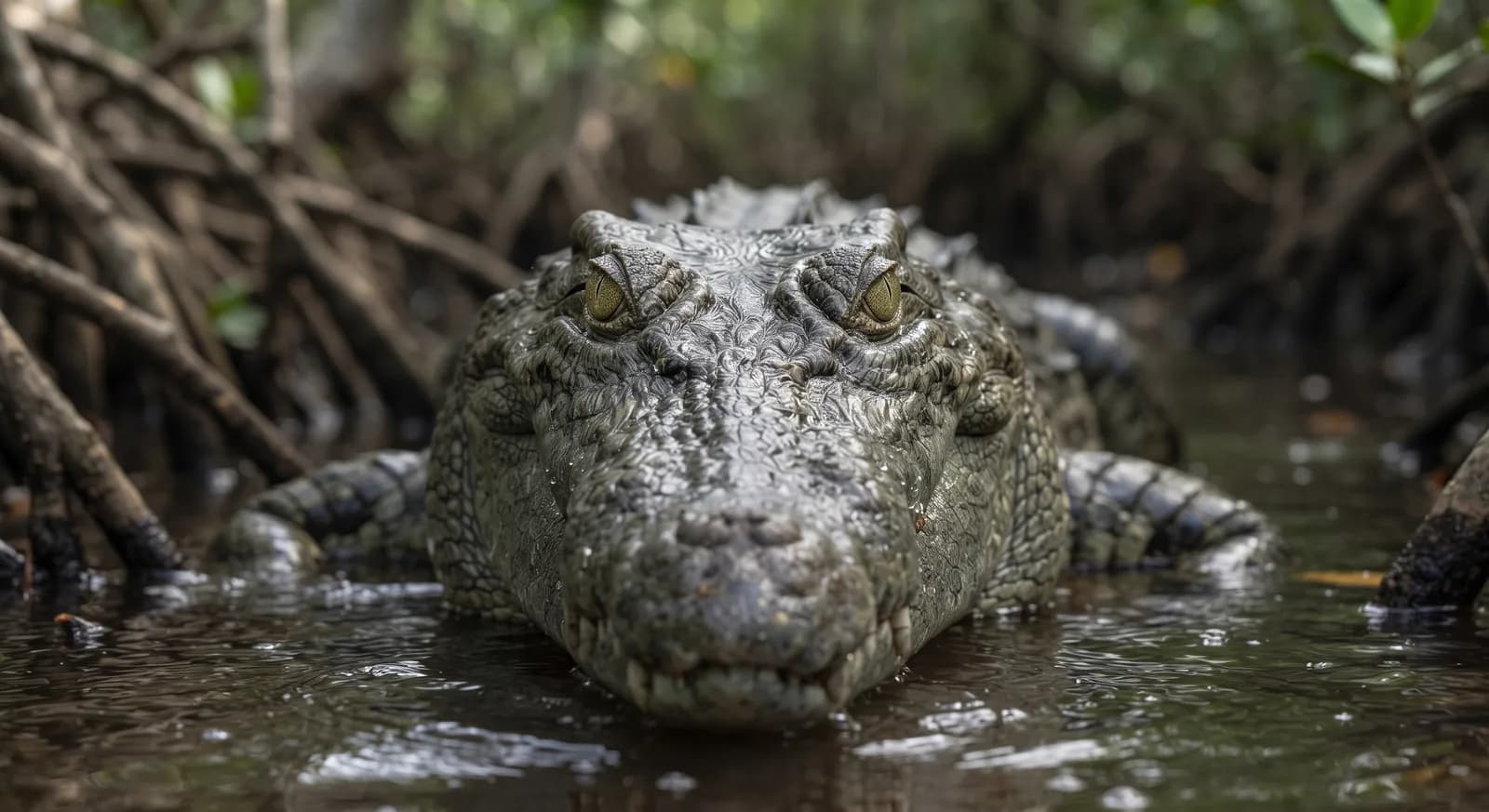 Least Concern
Saltwater Crocodile
Crocodylus porosus
Yellow-bellied Sea Snake
Hydrophis platurus
Red Lionfish
Pterois volitans
Spot-fin Porcupinefish
Diodon hystrix
Geography Cone
Conus geographus
Crown-of-thorns
Acanthaster planci
Keep exploring
Based on what we already know about chambered nautilus.
Comments
Share an experience, a fun fact or a tip for seeing the chambered nautilus.
Be the first to comment.