Bony fish · Perciformes · Toxotidae
Banded Archerfish
Toxotes jaculatrix
The species is abundant and widely distributed; it faces no significant short-term risk. See full glossary
The banded archerfish is a perciform fish of the genus Toxotes. It is silvery in colour and has a dorsal fin set towards the rear. It has distinctive semi-triangular markings along its sides. It is known for its ability to spit a jet of water to knock down its prey. They are found in the waters of the Indo-Pacific and Oceania, generally at river mouths, in mangroves and estuaries. They move between fresh, salt and brackish water over the course of their lives.
Size
15 cm – 30 cm
Diet
Carnivore
Feeds mainly on other animals.
Activity
Diurnal
Active mainly during the day.
Social structure
Colony
Lives in large concentrations, often for breeding reasons.
Sighting difficulty
Easy
Fun facts
- It forms the jet by pressing its tongue against a groove in the roof of its mouth, and controls the speed so that the water bunches into a compact mass just as it reaches the target, multiplying the force of the impact.
- It innately corrects for the refraction of light passing from air into water, which makes the prey appear to be somewhere other than where it really is.
- It learns to shoot by watching other fish do it, and in experiments it has been able to tell individual human faces apart.
- It knocks down insects perched up to three metres above the water, and an adult usually hits with its first shot.
- The power of the jet does not come from its muscles. A kinematic analysis measured some 3,000 watts per kilo at impact, six times more than a vertebrate muscle can deliver. The amplification happens outside the fish: it modulates the speed of the jet so that the water bunches into a single large drop that strikes all at once, the same principle as inkjet printers.
- It corrects for the refraction of light as it passes from water to air. It shoots at an average angle of about 74 degrees above the horizontal, but scores hits between 45 and 110.
- When choosing its prey it rotates its eye so that the image falls on a specific area of the retina, and brings its lips just to the surface before firing.
- It also shoots downwards, underwater, to dig prey out of the sediment.
Life cycle & biology
- Skeleton type
- Vertebrate - internal bony skeleton (fish)
- Habitat & environment
- Mangroves, estuaries and river mouths of the Indo-Pacific
Sources consulted: https://es.wikipedia.org/wiki/Toxotes_jaculatrix
Where to find it
See its range on the interactive mapWhere to watch it
Parques y spots de buceo donde se ha documentado esta especie — se muestran 20 de 43 documentados.
Related species
Other species in the catalogue with the most in common with Banded Archerfish — same habitat, park, country, tags or family.
Moorish Idol
Zanclus cornutus
Spotted Garden Eel
Heteroconger hassi
 Least Concern
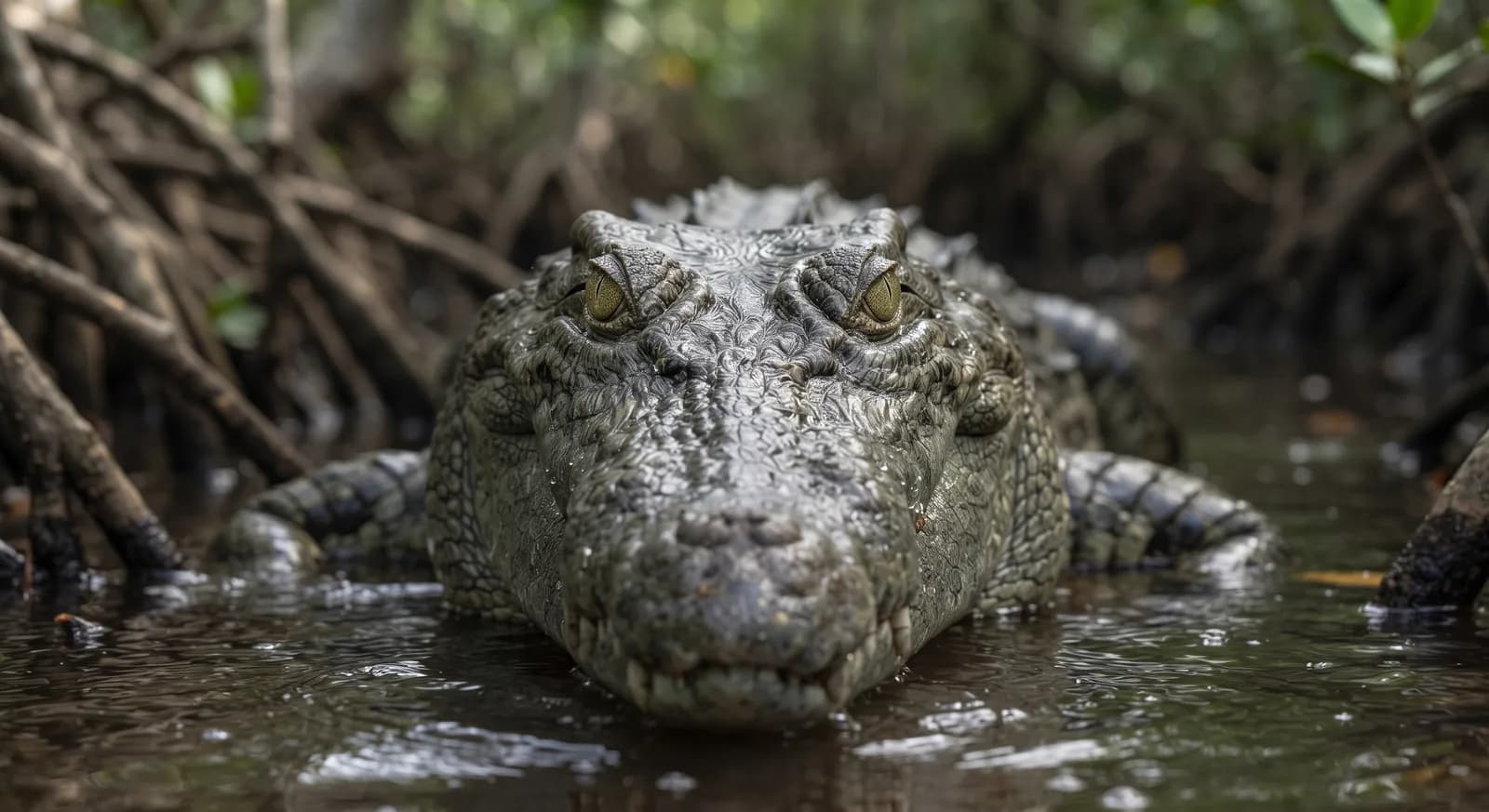
Saltwater Crocodile
Crocodylus porosus
Common Water Monitor
Varanus salvator
Banded Humbug
Dascyllus aruanus
White-spotted Puffer
Arothron hispidus
Keep exploring
Based on what we already know about banded archerfish.
Comments
Share an experience, a fun fact or a tip for seeing the banded archerfish.
Be the first to comment.