One of the 7 octopuses on WAnimals
Cephalopods · Octopoda · Opisthoteuthidae
Dumbo Octopus
Grimpoteuthis discoveryi
The species is abundant and widely distributed; it faces no significant short-term risk. See full glossary
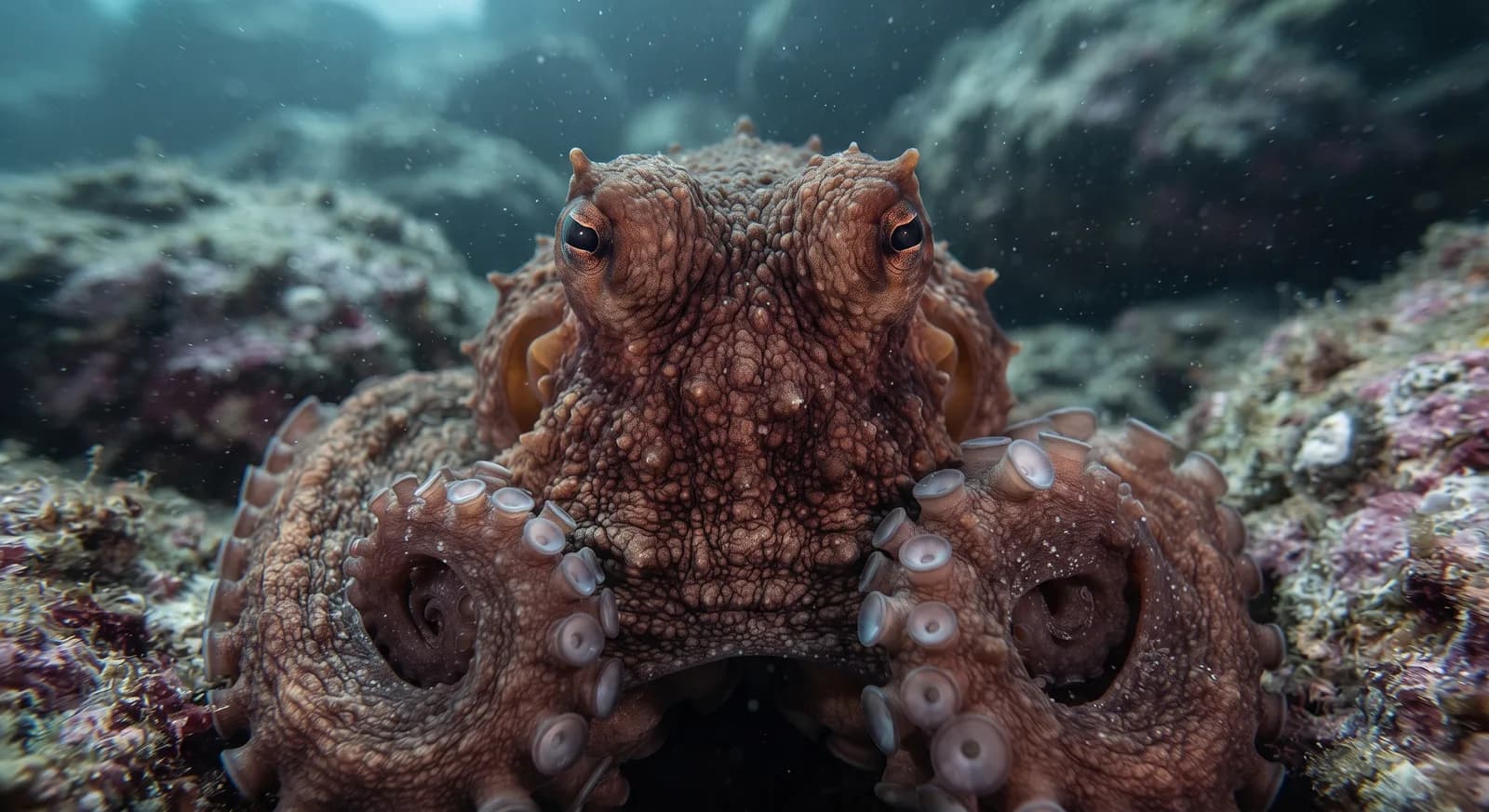
A North Atlantic dumbo octopus, with a gelatinous body and two ear-shaped fins above the head with which it propels itself slowly near the abyssal floor. Its arms are joined by a broad web that it spreads like an umbrella to catch small invertebrates from the bottom.
Size
15 cm – 25 cm
Diet
Carnivore
Feeds mainly on other animals.
Social structure
Solitary
Lives and hunts alone, joining others only to breed.
Sighting difficulty
Easy
Fun facts
- GeneralIt swims by flapping two fins like an elephant's ears; it is the deepest-living octopus known.
- anatomíaIt lives at great depth and moves by flapping a pair of fins on its mantle that recall an elephant's ears, which is where its common name comes from.
- It swallows its prey whole, without tearing it up, which is exceptional among cephalopods.
- The females carry eggs at different stages of development at the same time: on the abyssal floor, where there are no seasons, they can breed at any time of year.
- It is a Dumbo Octopus: its two lateral fins, reminiscent of elephant ears, are its main means of propulsion, something exceptional among octopuses, which usually swim by jet.
- It lives among the deepest cephalopods known: its genus has been recorded at more than 7,000 metres.
- It has no ink sac. At that depth the darkness is total and a cloud of ink would serve no purpose, so the organ has been lost.
- Its arms are joined by a broad web that it spreads like an umbrella, and it swallows its prey whole instead of tearing it apart.
- Almost everything known about the group comes from specimens taken in research trawls and from a few videos shot by underwater vehicles.
- The female carries eggs at different stages of development at the same time and lays them one by one on the seabed or on corals, without caring for them afterwards.
Life cycle & biology
- Skeleton type
- Invertebrate - no rigid skeleton (mollusc)
- Habitat & environment
- Abyssal bottoms (3,000-4,800 m)
Sources consulted: https://en.wikipedia.org/wiki/Grimpoteuthis_discoveryi
Where to find it
See its range on the interactive mapRelated species
Other species in the catalogue with the most in common with Dumbo Octopus — same habitat, park, country, tags or family.
Geography Cone
Conus geographus
 Least Concern
Giant Pacific Octopus
Enteroctopus dofleini
Telescope Octopus
Amphitretus pelagicus
Greater Argonaut
Argonauta argo
Day Octopus
Octopus cyanea
Mimic Octopus
Thaumoctopus mimicus
Keep exploring
Based on what we already know about dumbo octopus.
Comments
Share an experience, a fun fact or a tip for seeing the dumbo octopus.
Be the first to comment.