One of the 12 vipers on WAnimals
Reptiles · Squamata · Viperidae
Desert Horned Viper
Cerastes cerastes
The species is abundant and widely distributed; it faces no significant short-term risk. See full glossary
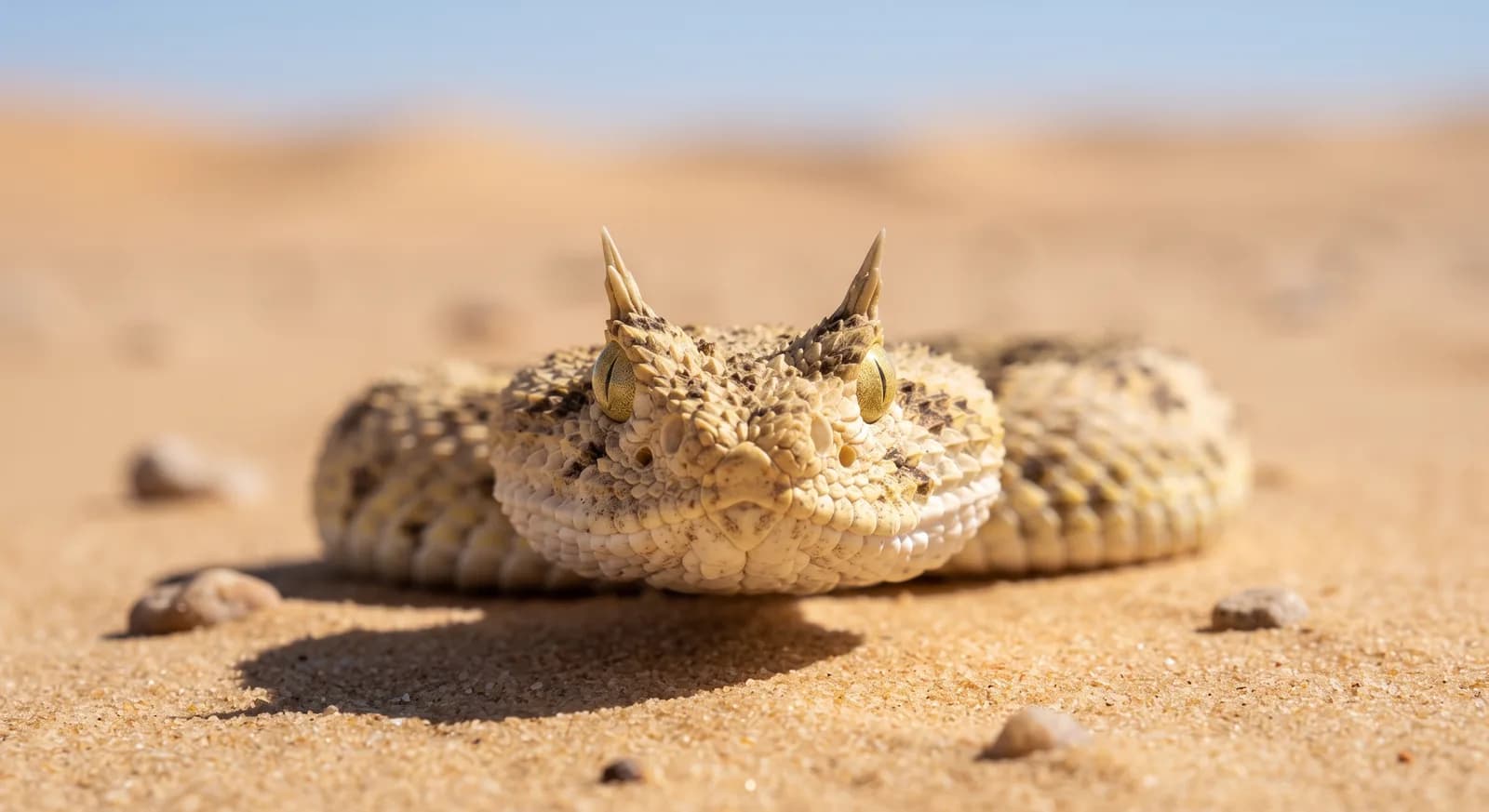
The Saharan horned viper is a horned viper native to the desert regions of North Africa and the Middle East. It is easily recognised by a pair of 'horns' above the eyes, though some specimens lack them. No subspecies are known.
Size
30 cm – 85 cm
Lifespan
15 years
Diet
Carnivore
Feeds mainly on other animals.
Activity
Nocturnal
Active mainly at night.
Social structure
Solitary
Lives and hunts alone, joining others only to breed.
Sighting difficulty
Easy
Fun facts
- It buries itself in the sand within seconds by vibrating its whole body, until only its eyes and horns show: it can spend days like that, invisible, waiting for prey to pass overhead.
- It appears in Egyptian hieroglyphs as the consonantal sign for the letter F, one of the few animals of Ancient Egypt with a hieroglyph of its own in phonetic use.
- The horns, each formed by a modified scale above the eye, appear to shield the eyes from sand, though there are hornless populations living in exactly the same environment.
Life cycle & biology
- Skeleton type
- Vertebrate - internal bony skeleton (reptile)
- Habitat & environment
- Dunes, sandy plains and wadis of the Sahara, the Sahel and the Arabian Peninsula
- Sexual maturity
- 2 years
- Gestation / incubation
- 60 days of incubation
- Litter / clutch size
- 15 eggs
Sources consulted: https://es.wikipedia.org/wiki/Cerastes_cerastes
Where to find it
See its range on the interactive mapWhere to watch it
Parks and dive sites where this species has been documented.
Related species
Other species in the catalogue with the most in common with Desert Horned Viper — same habitat, park, country, tags or family.
Phoorsa
Echis carinatus
 Least Concern
Caracal
Caracal caracal
Sand Cat
Felis margarita
Egyptian Cobra
Naja haje
Desert Monitor
Varanus griseus
Puff Adder
Bitis arietans
Keep exploring
Based on what we already know about desert horned viper.
Comments
Share an experience, a fun fact or a tip for seeing the desert horned viper.
Be the first to comment.