Skip to content
WAnimals
  • Map
  • Species
  • Parks
  • Diving
Log inCreate account
WAnimals

The guide for travellers and animal lovers: discover, plan and share your wild adventures around the world.

Discover wildlife

  • Species
  • Ecosystems
  • Glossary
  • Tags

Explore places

  • Map
  • Countries
  • Parks
  • Diving

Plan experiences

  • Guides

Learn

  • Blog

Resources

  • Help centre
  • Contact
  • Install the app

Follow us

Account

  • Log in
  • Create account

© 2026 WAnimals. All rights reserved.

About usHow we build our profilesTerms of servicePrivacyLegal notice
MapSpeciesParksDiving
  1. Home
  2. Species
  3. Snow Bunting

One of the 5 buntings on WAnimals
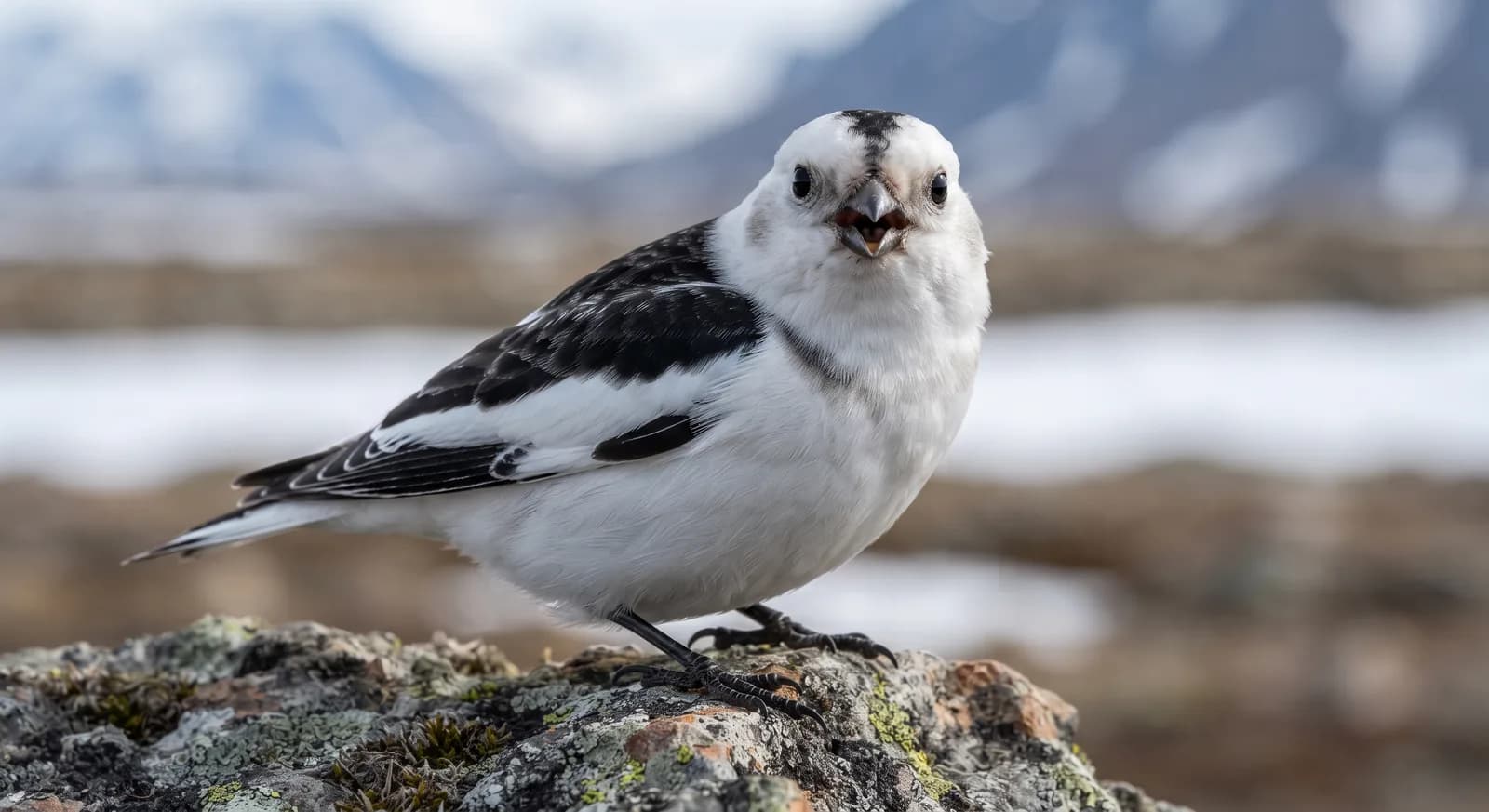
Snow Bunting (Plectrophenax nivalis)

Birds · Passeriformes · Calcariidae

Snow Bunting

Plectrophenax nivalis

Least Concern

The species is abundant and widely distributed; it faces no significant short-term risk.

Spotted something wrong?

The snow bunting is the passerine that breeds furthest north on the planet: there are breeding populations in northern Greenland and on the northernmost Arctic islands. The male in summer is pure black and white, a contrast that makes him unmistakable against snow and rock. It nests in crevices and scree, an essential refuge at those temperatures, and in winter it moves down to coasts and fields across northern Eurasia and North America.

Weight

30 g – 45 g

Size

15 cm – 18 cm

Life expectancy

10 years

Diet

Herbivore

Feeds mainly on plants.

Activity

Diurnal

Active mainly during the day.

Sighting difficulty

Easy

MountainTundraPolar
11countries35parks1same family

AI-generated images: illustrations, not photographs.

Fun facts

  • It is the passerine that breeds furthest north in the world: it has been recorded breeding above 83 degrees north, a few hundred kilometres from the pole.
  • The males arrive on the breeding grounds up to a month before the females, enduring temperatures of thirty degrees below zero, to secure the best crevices to nest in.

Life cycle and biology

Skeleton type
Vertebrate - internal bony skeleton (bird)
Habitat and environment
Arctic tundra, scree and rocky summits; winters on coasts, dunes and fields of northern Eurasia
Sexual maturity
12 months
Gestation / incubation
12 days
Litter / clutch size
5

Sources consulted: https://en.wikipedia.org/wiki/Snow_bunting

Where to find it

Loading map…

The pins mark the parks where its presence is documented.

Where to see it

Parks and dive sites where this species has been documented — showing 10 of 35.

Related species

Other species in the catalogue with the most in common with Snow Bunting — same habitat, park, country, tags or family.

Same taxonomic family
Shares a park
Shares a park
Shares a park
Shares a park
Shares a park

Keep exploring

Based on what we already know about snow bunting.

Comments

Share an experience, a fun fact or a tip for seeing the snow bunting.

Be the first to comment.

See full glossary
This page in other languages: Español · Deutsch · Français · Português · Italiano
See its range on the interactive map→
SarekSweden
PadjelantaSweden
JotunheimenNorway
HardangerviddaNorway
VatnajokullIceland
Thingvellir (Þingvellir)Iceland
Pallas-YllastunturiFinland
Urho KekkonenFinland
CairngormsUnited Kingdom
DenaliUnited States
See all 35 parks
Least Concern

Lapland Longspur

Calcarius lapponicus

Willow PtarmiganLeast Concern

Willow Ptarmigan

Lagopus lagopus

Western CapercaillieLeast Concern

Western Capercaillie

Tetrao urogallus

Least Concern

American Golden Plover

Pluvialis dominica

Least Concern

Sanderling

Calidris alba

Least Concern

Eurasian Siskin

Spinus spinus

CountriesNorway
ParksSarekSweden
TagsHerbivore
Herbivore
Diurnal
Bird
Mountain
Tundra
Polar

Europe7

North America3

Asia1

Norway
Canada
Sweden
Finland
Iceland
United States
Finland
Germany
Iceland
Norway
Poland
Sweden
United Kingdom
Canada
Greenland
United States
Russia