One of the 10 owls on WAnimals
Birds · Strigiformes · Strigidae
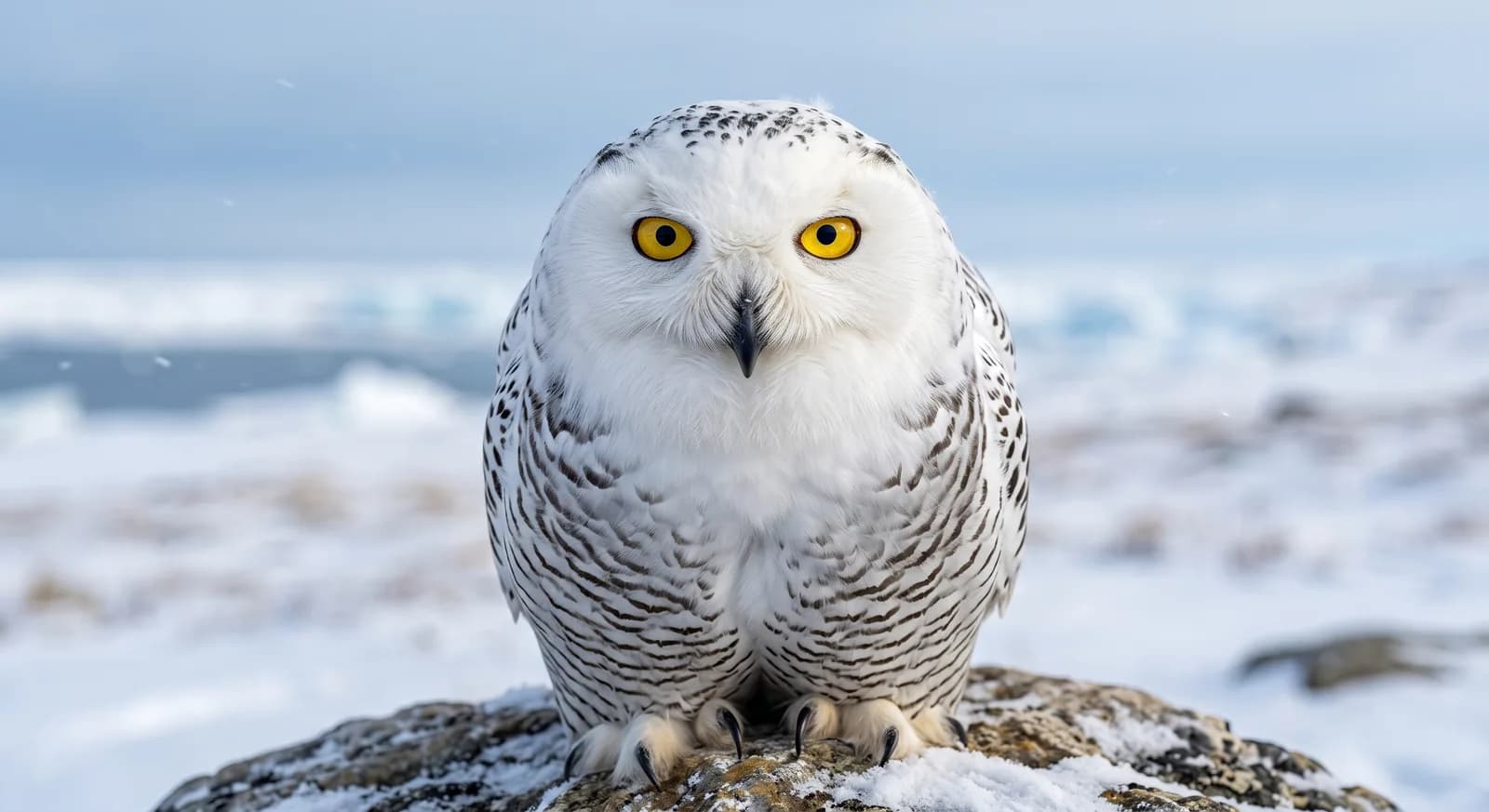
Snowy Owl
Bubo scandiacus
It faces a high risk of extinction in the wild over the medium term. See full glossary
It is the only owl with mostly white plumage, and unlike most owls it is notably active by day through the Arctic summer.
Weight
1.3 kg – 3 kg
Size
52 cm – 71 cm
Lifespan
10 years
Diet
Carnivore
Feeds mainly on other animals.
Activity
Diurnal
Active mainly during the day.
Social structure
Solitary
Lives and hunts alone, joining others only to breed.
Sighting difficulty
Moderate
Fun facts
- Its clutch size swings sharply with the abundance of lemmings, reaching as many as 11 eggs in a boom year.
- It feeds mainly on lemmings and other small rodents, supplemented with waterbirds.
- It lives on the Arctic tundra of North America and Eurasia, moving south in winter.
- reproducciónPlumage colour varies with age and sex, and the whitest males tend to breed most successfully.
- comportamientoUnlike most owls, it also hunts by day in the Arctic, where the sun stays up for almost the whole summer.
- comportamientoIn years when Arctic lemmings are scarce, some populations move hundreds of kilometres south in search of other food, a phenomenon known as an irruption.
Life cycle & biology
- Skeleton type
- Vertebrate - pneumatised bony skeleton (bird)
- Habitat & environment
- Open Arctic tundra while breeding, moving to open fields and coasts at more temperate latitudes in winter
- Birth weight
- 45 grams
- Size at birth
- Semi-altricial, with white down on hatching
- Sexual maturity
- 2 years
- Gestation / incubation
- 31-34 days
- Litter / clutch size
- 3 to 11 eggs per clutch (up to 16 in peak lemming years)
- Lifespan in captivity
- Documented record of up to 28 years in captivity
Sources consulted: AnAge (genomics.senescence.info); Cool Antarctica; Maryland DNR; Animalia.bio; A-Z Animals; Animal Diversity Web; Wikipedia (Snowy owl)
Where to find it
See its range on the interactive mapWhere to watch it
Parks and dive sites where this species has been documented.
Related species
Other species in the catalogue with the most in common with Snowy Owl — same habitat, park, country, tags or family.
Northern Hawk-Owl
Surnia ulula
Great Grey Owl
Strix nebulosa
Short-eared Owl
Asio flammeus
Great Horned Owl
Bubo virginianus
 Vulnerable
Polar Bear
Ursus maritimus
Greenland Shark
Somniosus microcephalus
How to help
The snowy owl is classified as vulnerable. Organizations such as UICN, WWF y Wildlife Conservation Society work specifically on its conservation and that of its habitat; looking into their programs is a good starting point if you want to get involved.
It's documented in 6 real protected areas — part of why protecting these places matters for its conservation.
Keep exploring
Based on what we already know about snowy owl.
Comments
Share an experience, a fun fact or a tip for seeing the snowy owl.
Be the first to comment.