One of the 3 ibexes on WAnimals
Mammals · Artiodactyla · Bovidae
Nubian Ibex
Capra nubiana
It faces a high risk of extinction in the wild over the medium term. See full glossary
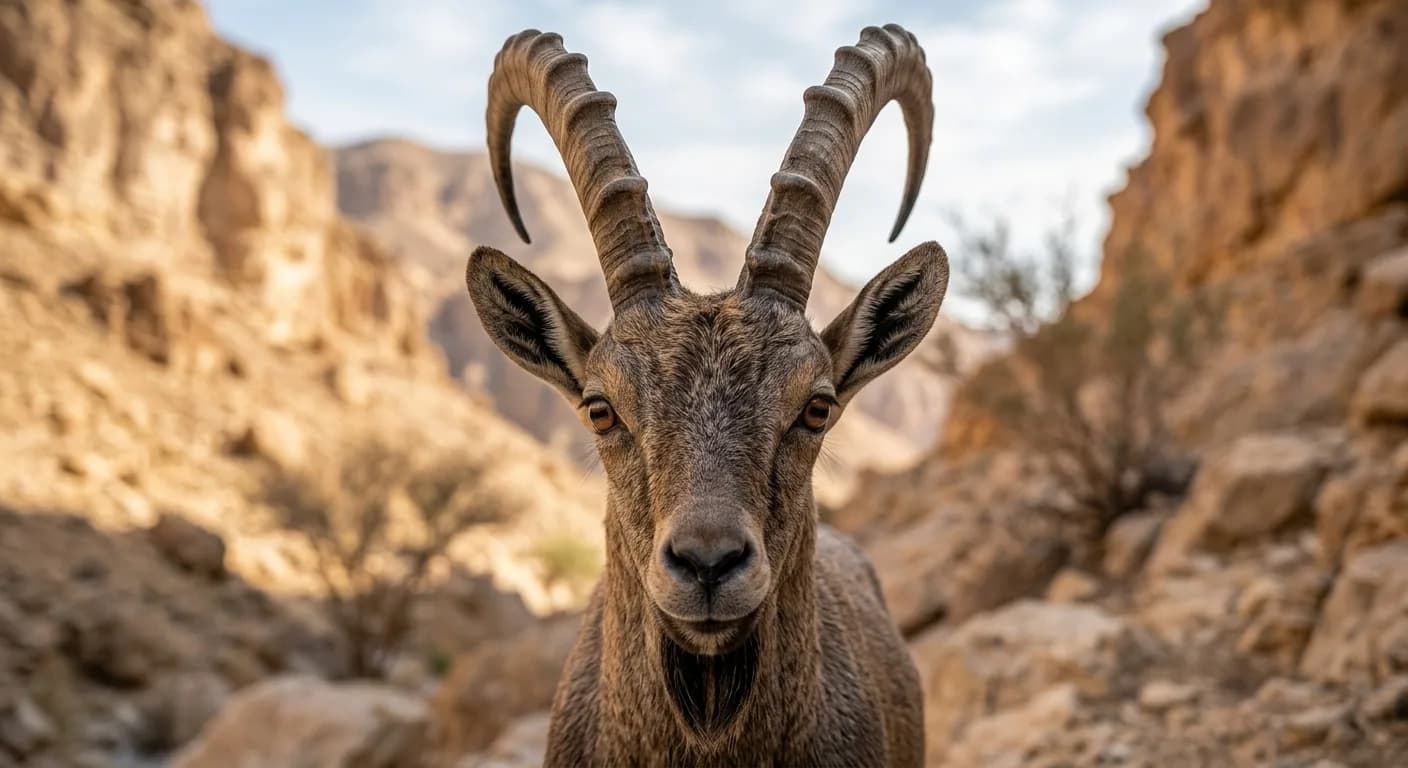
The Nubian ibex is the wild goat of the rocky deserts of the Near East and north-eastern Africa. It is the smallest and palest ibex, an adaptation to extreme heat, and the males carry very long horns, curved backwards and with strongly marked transverse ridges. It lives in arid canyons and cliffs and comes down to water at dawn. Its population is highly fragmented by hunting and by competition with domestic livestock.
Weight
25 kg – 70 kg
Size
1.1 m – 1.3 m
Lifespan
17 years
Diet
Herbivore
Feeds mainly on plants.
Activity
Crepuscular
Active above all at dawn and dusk.
Sighting difficulty
Moderate
Fun facts
- GeneralIt survives in one of the driest habitats any wild goat occupies.
- It has appeared in the petroglyphs of the Negev desert and of Arabia for thousands of years, and is one of the most frequently depicted animals in Near Eastern rock art.
- The males fight by rearing up on their hind legs and dropping forward with their full weight onto their horns, a clash that carries hundreds of metres between the canyon walls.
Life cycle & biology
- Skeleton type
- Vertebrate - internal bony skeleton (mammal)
- Habitat & environment
- Desert mountain cliffs and canyons of north-eastern Africa and the Arabian Peninsula
- Sexual maturity
- 2.2 years
- Gestation / incubation
- 4.9 months
- Litter / clutch size
- 1
Sources consulted: https://es.wikipedia.org/wiki/Capra_ibex_nubiana
Where to find it
See its range on the interactive mapWhere to watch it
Parks and dive sites where this species has been documented.
Related species
Other species in the catalogue with the most in common with Nubian Ibex — same habitat, park, country, tags or family.
Arabian Sand Gazelle
Gazella marica
Arabian Oryx
Oryx leucoryx
 Vulnerable
Takin
Budorcas taxicolor
 Vulnerable
Dorcas Gazelle
Gazella dorcas
 Vulnerable
Goitered Gazelle
Gazella subgutturosa
Urial
Ovis vignei
How to help
The nubian ibex is classified as vulnerable. Organizations such as UICN, WWF y Wildlife Conservation Society work specifically on its conservation and that of its habitat; looking into their programs is a good starting point if you want to get involved.
It's documented in 2 real protected areas — part of why protecting these places matters for its conservation.
Keep exploring
Based on what we already know about nubian ibex.
Comments
Share an experience, a fun fact or a tip for seeing the nubian ibex.
Be the first to comment.