Mammals · Artiodactyla · Bovidae
Urial
Ovis vignei
It faces a high risk of extinction in the wild over the medium term. See full glossary
The urial is a wild sheep of the arid foothills of central and western Asia, between Iran and Ladakh. The males carry horns curving backwards and a spectacular black and white bib falling from the throat to the chest. Unlike the argali it prefers gentle slopes and rolling hills to steeper ground. Competition with domestic livestock for grazing, together with hunting, has fragmented its populations, now reduced to isolated pockets.
Weight
25 kg – 90 kg
Size
1.1 m – 1.5 m
Lifespan
12 years
Diet
Herbivore
Feeds mainly on plants.
Activity
Diurnal
Active mainly during the day.
Sighting difficulty
Moderate
Fun facts
- GeneralIt is regarded as one of the wild ancestors of the domestic sheep.
- It is, along with the mouflon, one of the wild ancestors of the domestic sheep, and in some parts of its range it hybridises with feral sheep.
- Adult males sport a long black bib hanging from the neck, a feature no other wild sheep shares and that makes them unmistakable.
Life cycle & biology
- Skeleton type
- Vertebrate - internal bony skeleton (mammal)
- Habitat & environment
- Gentle slopes and arid mountain foothills of central and western Asia, up to 4,500 metres
- Sexual maturity
- 18 months
- Gestation / incubation
- 5.5 months
- Litter / clutch size
- 1
Sources consulted: https://es.wikipedia.org/wiki/Ovis_vignei
Where to find it
See its range on the interactive mapWhere to watch it
Parks and dive sites where this species has been documented.
Related species
Other species in the catalogue with the most in common with Urial — same habitat, park, country, tags or family.
 Vulnerable
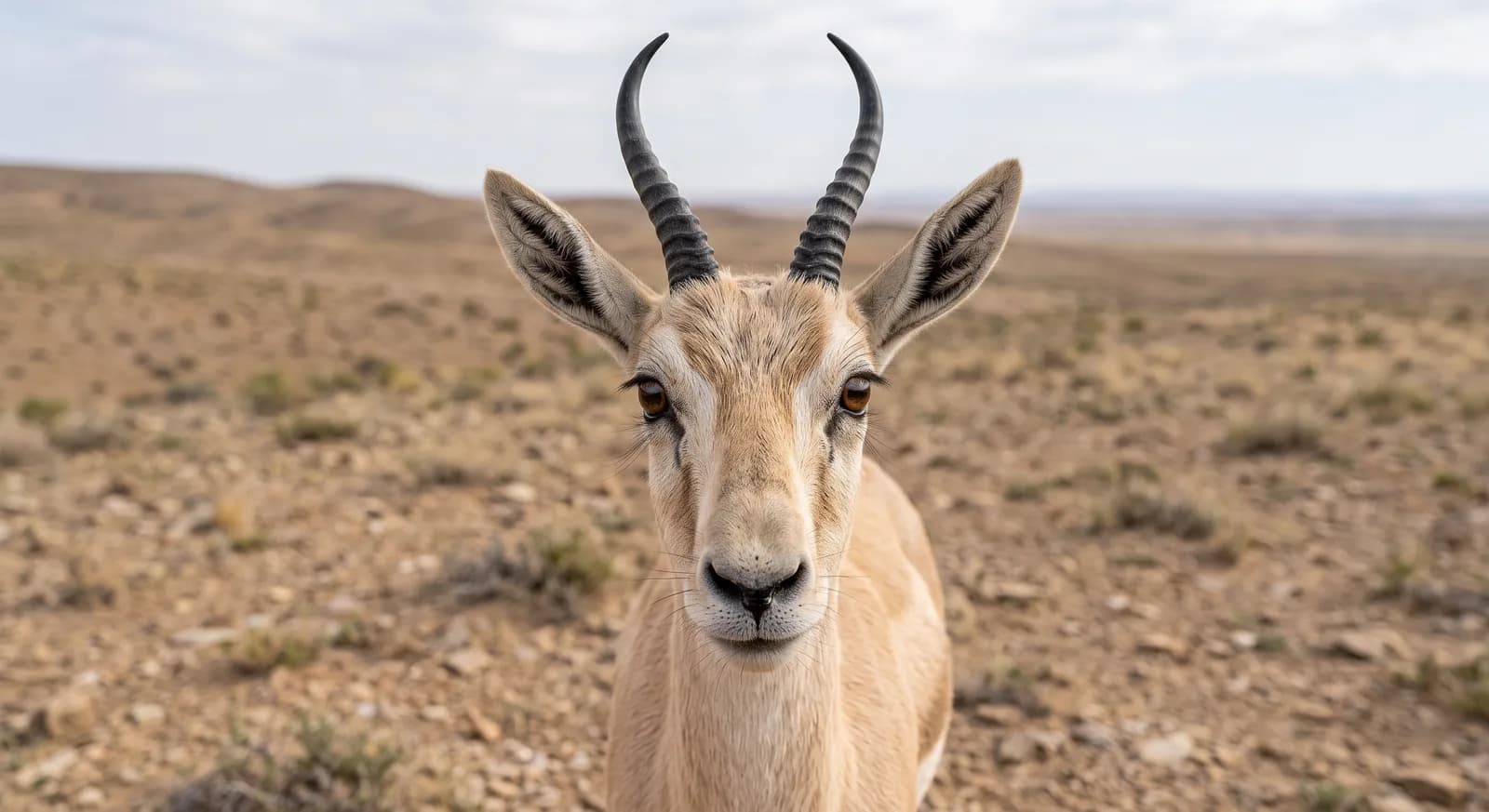
Goitered Gazelle
Gazella subgutturosa
Himalayan Goral
Naemorhedus goral
Markhor
Capra falconeri
Siberian Ibex
Capra sibirica
Long-tailed Goral
Naemorhedus caudatus
 Vulnerable
Takin
Budorcas taxicolor
How to help
The urial is classified as vulnerable. Organizations such as UICN, WWF y Wildlife Conservation Society work specifically on its conservation and that of its habitat; looking into their programs is a good starting point if you want to get involved.
It's documented in 8 real protected areas — part of why protecting these places matters for its conservation.
Keep exploring
Based on what we already know about urial.
Comments
Share an experience, a fun fact or a tip for seeing the urial.
Be the first to comment.