Mammals · Primates · Pitheciidae
White-faced Saki
Pithecia pithecia
The species is abundant and widely distributed; it faces no significant short-term risk. See full glossary
The white-faced saki is a small primate of north-eastern South America, with a long, dense coat that gives it a shaggy look and a thick, bushy tail that is not prehensile. It lives in small family groups in the middle storey of the forest. It is a seed specialist: with its canines and premolars it opens green, woody fruits that no other animal can use, which gives it access to a resource available when ripe fruit is scarce.
Weight
1.5 kg – 2.5 kg
Size
30 cm – 48 cm
Lifespan
20 years
Diet
Herbivore
Feeds mainly on plants.
Activity
Diurnal
Active mainly during the day.
Social structure
In pairs
Usually lives in pairs, sometimes for life.
Sighting difficulty
Easy
Fun facts
- It shows one of the most extreme colour dimorphisms of any primate: the male is black with a brilliant white face and the female greyish brown with a dark face, to the point that for a time they were described as different species.
- It leaps with its hind legs between vertical trunks and can cover more than ten metres in a single bound, which has earned it the local nickname of flying monkey.
Life cycle & biology
- Skeleton type
- Vertebrate - internal bony skeleton (mammal)
- Habitat & environment
- Middle storey of terra firme rainforest and white-sand forest in the Guianas
- Sexual maturity
- 2.1 years
- Gestation / incubation
- 5.2 months
- Litter / clutch size
- 1
Sources consulted: https://www.iucnredlist.org/ | https://animaldiversity.org/ | https://es.wikipedia.org/
Where to find it
See its range on the interactive mapWhere to watch it
Parks and dive sites where this species has been documented.
Related species
Other species in the catalogue with the most in common with White-faced Saki — same habitat, park, country, tags or family.
White Bald-headed Uakari
Cacajao calvus
 Least Concern
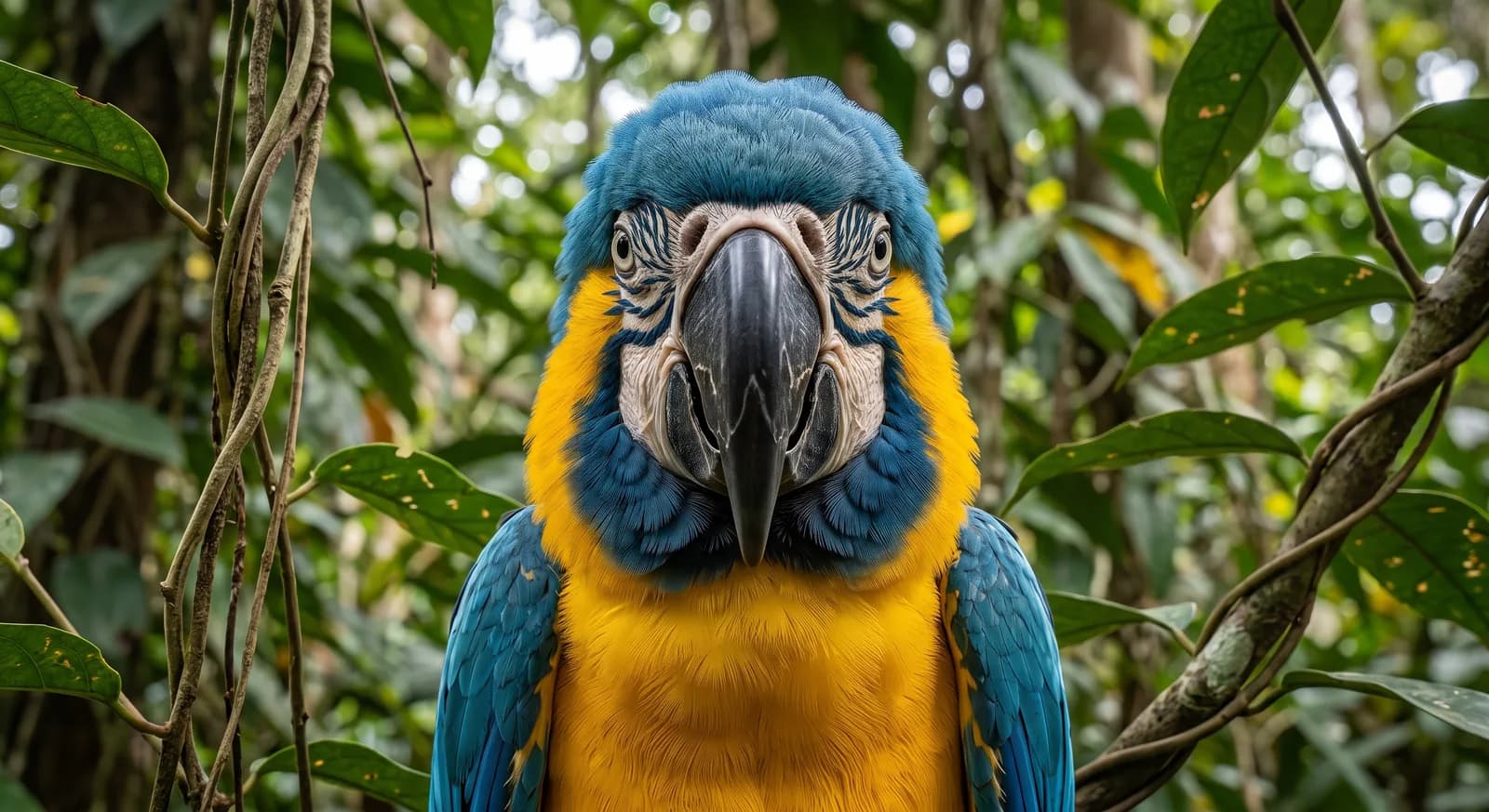
Blue-And-Yellow Macaw
Ara ararauna
Yellow-Crowned Amazon
Amazona ochrocephala
Horned Screamer
Anhima cornuta
Paradise Tanager
Tangara chilensis
Greater Grison
Galictis vittata
Keep exploring
Based on what we already know about white-faced saki.
Comments
Share an experience, a fun fact or a tip for seeing the white-faced saki.
Be the first to comment.