Mammals · Scandentia · Tupaiidae
Mountain Treeshrew
Tupaia montana
The species is abundant and widely distributed; it faces no significant short-term risk. See full glossary
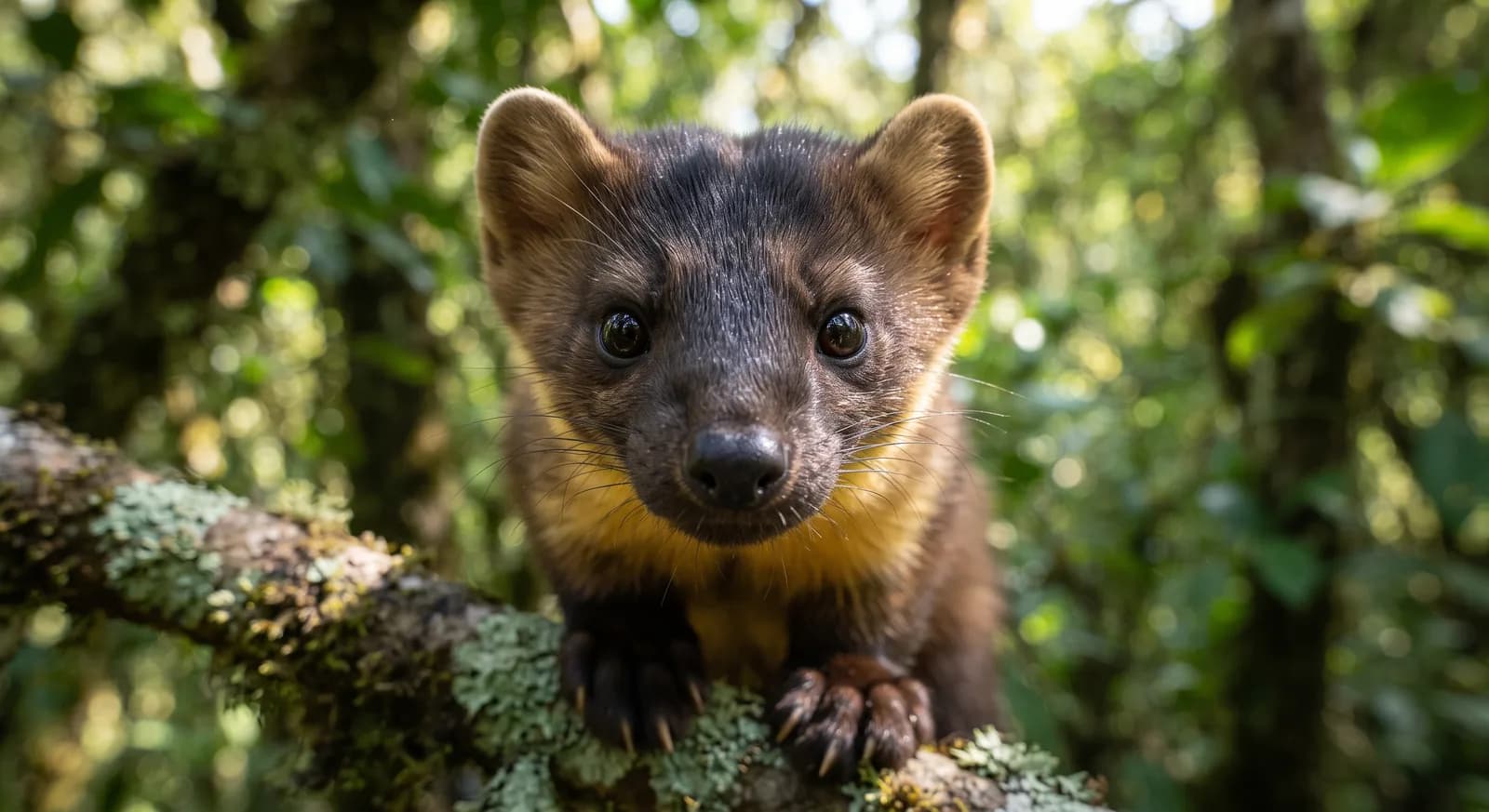
The mountain treeshrew is a small Bornean mammal with the look of a squirrel and a pointed snout, although it is related neither to squirrels nor to shrews: it belongs to the Scandentia, an order of its own that is evolutionarily very close to the primates. It is diurnal, very active, and eats insects, fruit and nectar in the cloud forests of the island's mountains. Its relationship with the carnivorous plant Nepenthes lowii is one of the most curious mutualisms described in recent years.
Weight
150 g – 200 g
Size
16 cm – 20 cm
Lifespan
10 years
Diet
Omnivore
Combines animal and plant food depending on availability.
Activity
Diurnal
Active mainly during the day.
Social structure
In pairs
Usually lives in pairs, sometimes for life.
Sighting difficulty
Easy
Fun facts
- It climbs onto the rim of the pitcher of the carnivorous plant Nepenthes lowii to lick the nectar the plant secretes on the lid, and defecates inside while it feeds: the plant trades insects for nitrogen and the treeshrew gets a reliable source of food.
- Treeshrews have the highest ratio of brain mass to body mass of any mammal, higher even than that of human beings.
Life cycle & biology
- Skeleton type
- Vertebrate - internal bony skeleton (mammal)
- Habitat & environment
- Montane cloud forest of Borneo, above 900 metres of altitude
- Gestation / incubation
- 50 days
- Litter / clutch size
- 2
Sources consulted: https://en.wikipedia.org/wiki/Mountain_treeshrew
Where to find it
See its range on the interactive mapWhere to watch it
Parks and dive sites where this species has been documented.
Related species
Other species in the catalogue with the most in common with Mountain Treeshrew — same habitat, park, country, tags or family.
Common Treeshrew
Tupaia glis
Lesser Treeshrew
Tupaia minor
Short-tailed Gymnure
Hylomys suillus
 Least Concern
Yellow-throated Marten
Martes flavigula
Common Hill Myna
Gracula religiosa
Pallas's Squirrel
Callosciurus erythraeus
Keep exploring
Based on what we already know about mountain treeshrew.
Comments
Share an experience, a fun fact or a tip for seeing the mountain treeshrew.
Be the first to comment.