One of the 17 foxes on WAnimals
Mammals · Carnivora · Canidae
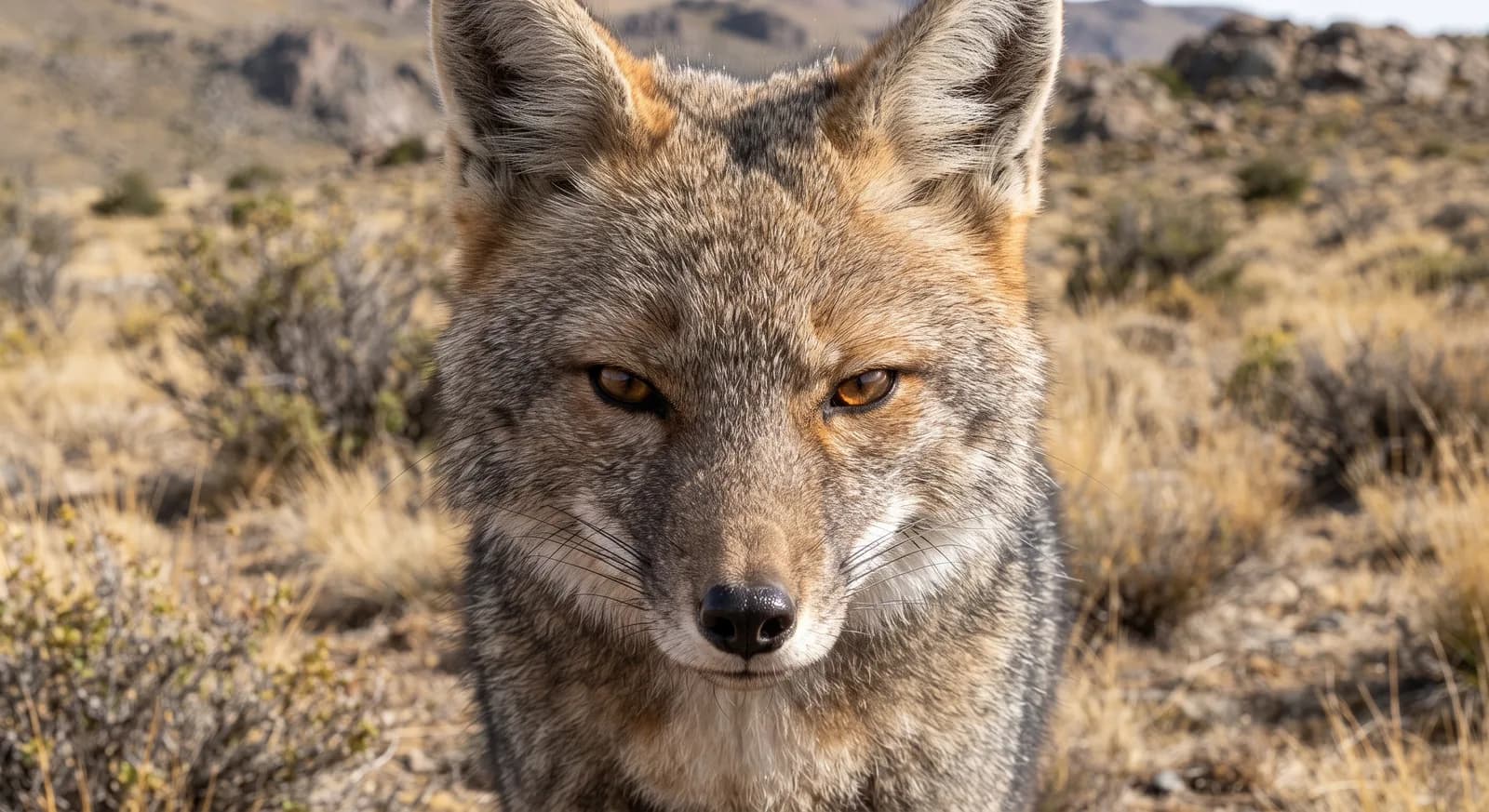
Pampas Fox
Lycalopex griseus
The species is abundant and widely distributed; it faces no significant short-term risk. See full glossary
The chilla, or South American grey fox, is one of the most widespread canids in Chile and Argentina, from the Atacama desert to Tierra del Fuego. It is omnivorous and highly opportunistic: rodents, birds, insects, fruit and carrion. It adapts well to grazing landscapes, which has earned it constant persecution from sheep farmers. In the 1950s it was introduced to Tierra del Fuego to control rabbits, and there it has become a problem for the native wildlife.
Weight
2.5 kg – 5.5 kg
Size
42 cm – 68 cm
Lifespan
10 years
Diet
Omnivore
Combines animal and plant food depending on availability.
Activity
Nocturnal
Active mainly at night.
Social structure
In pairs
Usually lives in pairs, sometimes for life.
Sighting difficulty
Easy
Fun facts
- It was introduced to the Chilean part of Tierra del Fuego in the 1950s to control rabbits and is today an invasive species on that island, a textbook case of badly conceived biological control.
- The South American foxes of the genus Lycalopex are not true foxes: they are more closely related to wolves and dogs than to the foxes of the northern hemisphere.
Life cycle & biology
- Skeleton type
- Vertebrate - internal bony skeleton (mammal)
- Habitat & environment
- Scrub, Patagonian steppe, grassland and forest edge of the southern cone of South America
- Sexual maturity
- 12 months
- Gestation / incubation
- 56 days
- Litter / clutch size
- 4.2 (average)
Sources consulted: https://es.wikipedia.org/wiki/Lycalopex_griseus
Where to find it
See its range on the interactive mapWhere to watch it
Parks and dive sites where this species has been documented.
Related species
Other species in the catalogue with the most in common with Pampas Fox — same habitat, park, country, tags or family.
 Least Concern
Culpeo
Lycalopex culpaeus
Darwin's Fox
Lycalopex fulvipes
Pampas Fox
Lycalopex gymnocercus
Southern Monito del Monte
Dromiciops gliroides
 Least Concern
Puma
Puma concolor
Molina's Hog-nosed Skunk
Conepatus chinga
Keep exploring
Based on what we already know about pampas fox.
Comments
Share an experience, a fun fact or a tip for seeing the pampas fox.
Be the first to comment.