Skip to content
WAnimals
  • Map
  • Species
  • Parks
  • Diving
Log inCreate account
WAnimals

The guide for travellers and animal lovers: discover, plan and share your wild adventures around the world.

Discover wildlife

  • Species
  • Ecosystems
  • Glossary
  • Tags

Explore places

  • Map
  • Countries
  • Parks
  • Diving

Plan experiences

  • Guides

Learn

  • Blog

Resources

  • Help centre
  • Contact
  • Install the app

Follow us

Account

  • Log in
  • Create account

© 2026 WAnimals. All rights reserved.

About usHow we build our profilesTerms of servicePrivacyLegal notice
MapSpeciesParksDiving
  1. Home
  2. Species
  3. Asian Giant Hornet

One of the 2 hornets on WAnimals

Insects · Hymenoptera · Vespidae

Asian Giant Hornet

Vespa mandarinia

Not Evaluated

It has not yet been assessed against the IUCN criteria.

Spotted something wrong?

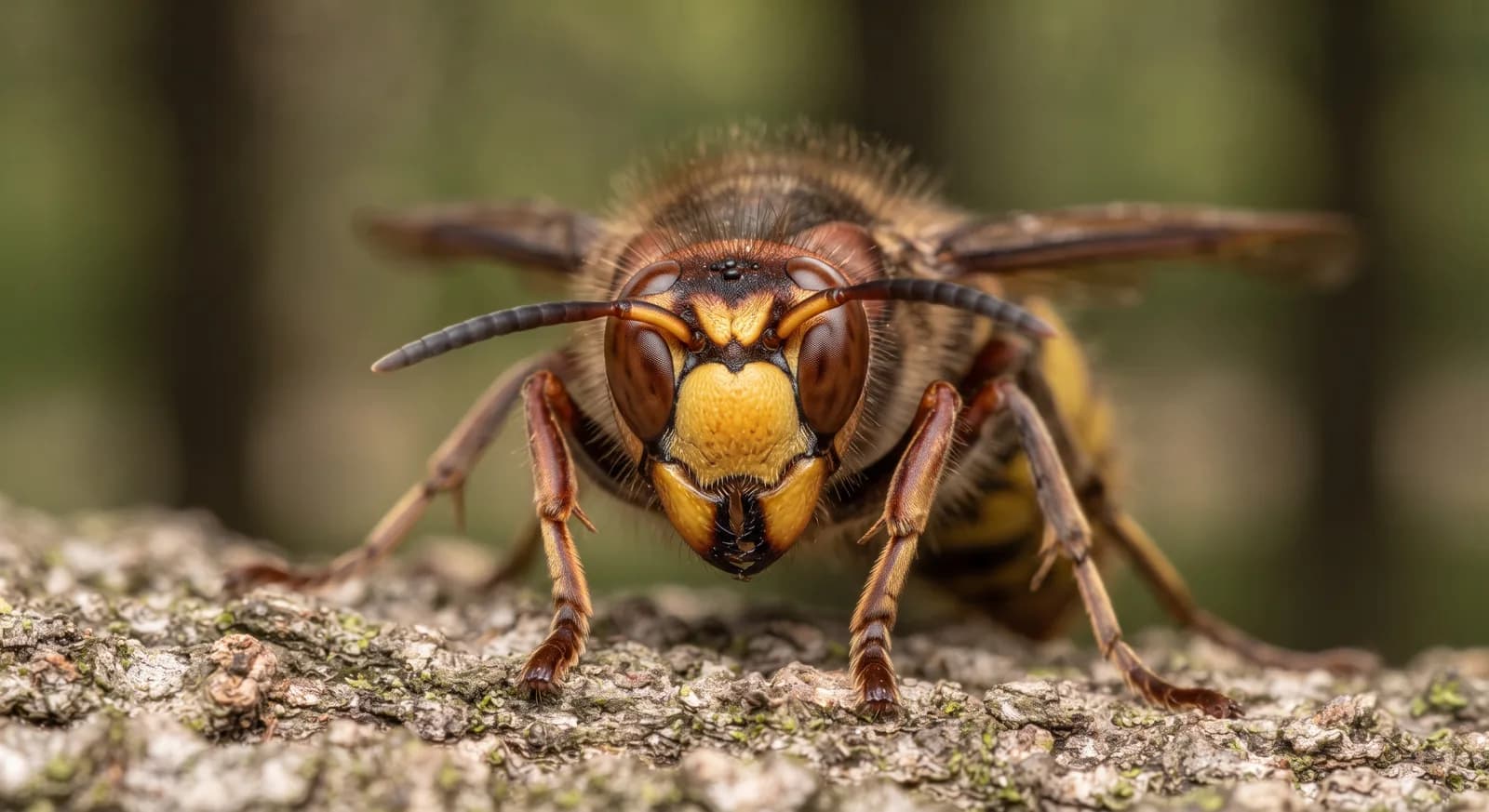
It is the largest hornet in the world, dubbed the "murder hornet" by the press after it turned up in North America in 2019.

Size

2.5 cm – 5 cm

Life expectancy

1 year

Diet

Omnivore

Combines animal and plant food depending on availability.

Activity

Diurnal

Active mainly during the day.

Social structure

Colony

Lives in large concentrations, often for breeding reasons.

Sighting difficulty

Unknown

Temperate forest
15countries3same family

Fun facts

  • A group of hornets can wipe out an entire colony of European honeybees in a few hours.
  • It eats large insects, tree sap and honey.
  • New queens mate in autumn and then hibernate until the following spring.
  • defensaA small group can wipe out an entire honeybee colony in a few hours by decapitating the workers.
  • It is the largest hornet in the world: up to 5 cm in body length and 7.5 in wingspan.
  • It attacks hives in groups. A few dozen hornets can wipe out an entire European honeybee hive in hours, decapitating the workers with their mandibles, and afterwards they carry off the larvae to feed their own brood.
  • The Japanese honeybee, by contrast, knows how to defend itself, and its method is remarkable: it surrounds the scouting hornet in a ball of hundreds of workers and vibrates its flight muscles until the temperature rises to about 46 °C. The hornet dies of heat; the bees can withstand up to 48. It is a thermal execution.
  • The European honeybee has no such defence, which is why commercial Apis mellifera hives are so vulnerable in Asia.
  • Its sting is very painful and its venom contains mandaratoxin; in Japan it is blamed for several dozen deaths a year, almost all from allergic reactions.
  • It was detected in North America in 2019 and triggered an eradication campaign that was declared successful in 2024.

Life cycle and biology

Skeleton type
Invertebrate - chitin exoskeleton (insect)
Habitat and environment
Low mountain forest and temperate country of eastern, southern and South-East Asia; also recorded in the north-western United States
Birth weight
Develops from egg to larva fed by the workers
Size at birth
A larva fed on prey chewed by the workers once the egg hatches
Sexual maturity
The new queens mate in autumn, then hibernate until the following spring
Gestation / incubation
A full cycle from egg to adult of roughly 40 days; the larvae stay in the cell some 18 days as pupae
Litter / clutch size
The founding queen lays some 40 eggs at first; a mature nest may hold as many as 3,000 cells

Sources consulted: Dimensions.com; Glenlivet Wildlife; Oregon State University Extension; EBSCO Research Starters; Invasive.org; A-Z Animals; WaspWorld; UF/IFAS Extension

Where to find it

Loading map…

Related species

Other species in the catalogue with the most in common with Asian Giant Hornet — same habitat, park, country, tags or family.

Same taxonomic family
Related to
Related to
Related to

Keep exploring

Based on what we already know about asian giant hornet.

Comments

Share an experience, a fun fact or a tip for seeing the asian giant hornet.

Be the first to comment.
See full glossary
This page in other languages: Español · Deutsch · Français · Português · Italiano
See its range on the interactive map→
Not Evaluated

Asian Hornet

Vespa velutina

German WaspNot Evaluated

German Wasp

Vespula germanica

HornetNot Evaluated

Hornet

Vespa crabro

Not Evaluated

Hercules Ant

Camponotus herculeanus

Rhesus MonkeyLeast Concern

Rhesus Monkey

Macaca mulatta

Least Concern

Red Junglefowl

Gallus gallus

CountriesBrunei
TagsOmnivore
Omnivore
Diurnal
Colonial
Insect
Temperate forest
Brunei
Cambodia
China
Indonesia
Japan
Laos
Brunei
Cambodia
China
Indonesia
Japan
Laos
Malaysia
Myanmar
Philippines
Singapore
South Korea
Taiwan
Thailand
Timor-Leste
Vietnam