Insects · Hymenoptera · Apidae
Giant Honey Bee
Apis dorsata
It has not yet been assessed against the IUCN criteria. See full glossary
It builds a single massive comb, up to 2 metres across, entirely open to the air on high branches or cliffs, unlike other bees, which nest in sheltered cavities.
Size
up to 3 cm
Lifespan
1 years
Diet
Nectarivore
Feeds mainly on flower nectar.
Activity
Diurnal
Active mainly during the day.
Social structure
Colony
Lives in large concentrations, often for breeding reasons.
Sighting difficulty
Unknown
Fun facts
- When a predator approaches, the workers mount a coordinated defence known as shimmering, a synchronised wave that ripples across the whole comb.
- It feeds on nectar and pollen from a wide range of tropical flowers.
- The whole colony moves on when conditions change, rather than leaving daughter queens behind.
- It does not use cavities: it hangs a single exposed comb, which can measure more than a metre and house tens of thousands of workers.
- It does the Mexican wave. Faced with a wasp or a bird, the workers on the comb's surface raise their abdomens in sequence, producing a wave that sweeps across the whole colony. That rippling flash disorients predators and makes them give up; the phenomenon is called shimmering.
- It is migratory: the whole colony abandons the comb and travels hundreds of kilometres following the blooms, and often returns to the very same site the next season.
- It is highly defensive and its sting is painful; wild-honey gatherers in Nepal and India climb cliffs to harvest its combs, a traditional practice documented for centuries.
- Its honey is gathered from the wild and is the basis of traditional beekeeping across much of South-East Asia.
Life cycle & biology
- Skeleton type
- Invertebrate - chitin exoskeleton (insect)
- Habitat & environment
- Tropical forest and mountain country of South and South East Asia, with exposed nests on high branches or cliffs
- Birth weight
- Egg laid in the exposed comb
- Size at birth
- A larva fed inside the comb cell
- Gestation / incubation
- Complete egg-larva-pupa-adult development over several weeks
- Litter / clutch size
- The queen lays several eggs a day; the whole colony migrates rather than leaving daughter queens behind
Sources consulted: University of Florida Entomology; The Holy Habibee; ScienceDirect Topics; Plantiary; Entomologically.com; arXiv (Varroa epidemiology study)
Where to find it
See its range on the interactive mapWhere to watch it
Parques y spots de buceo donde se ha documentado esta especie — se muestran 10 de 51 documentados.
Related species
Other species in the catalogue with the most in common with Giant Honey Bee — same habitat, park, country, tags or family.
Buff-tailed Bumblebee
Bombus terrestris
Sumatran Orangutan
Pongo abelii
 Endangered
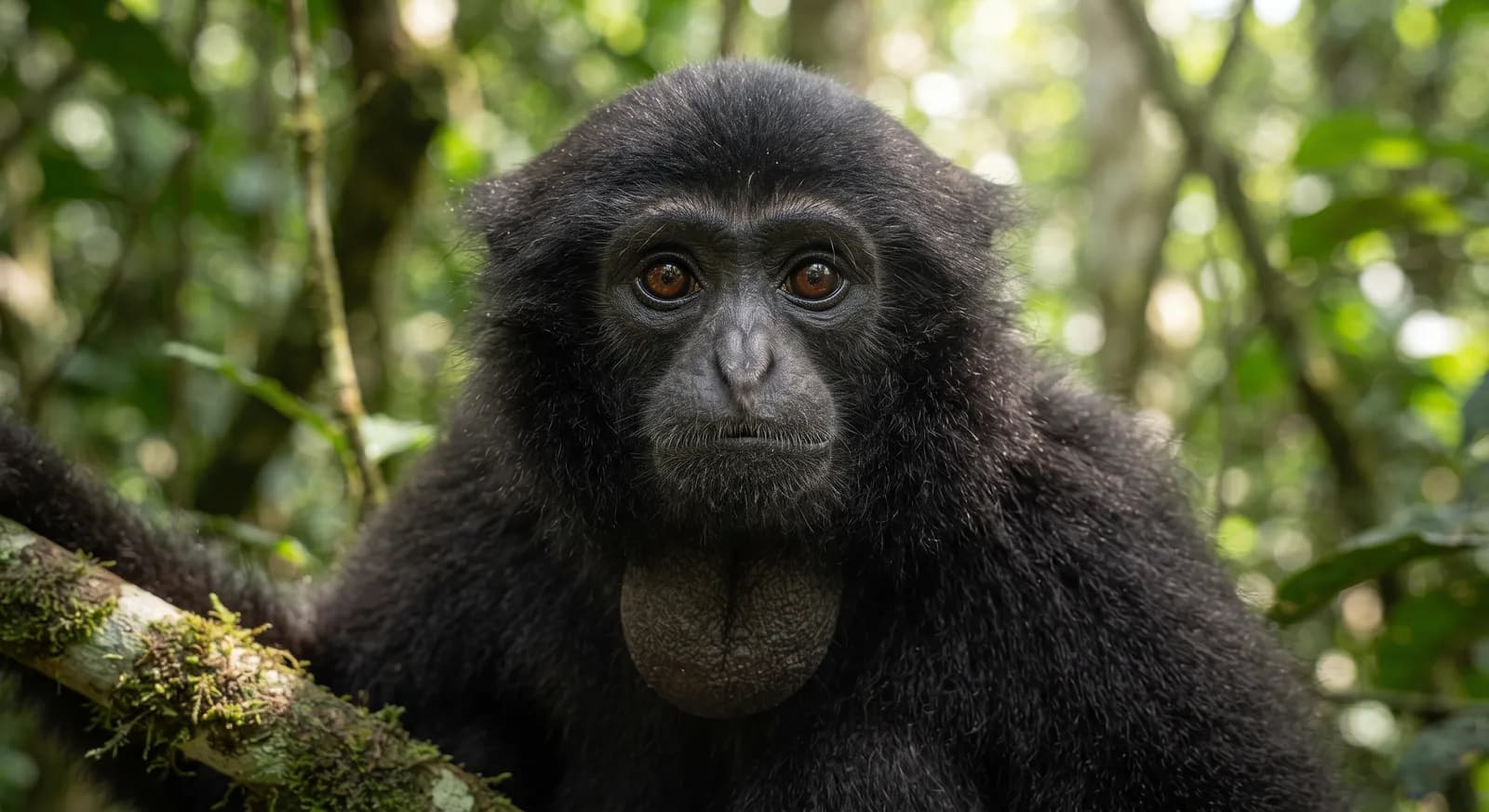
Siamang
Symphalangus syndactylus
Kerengga Ant
Oecophylla smaragdina
Orchid Mantis
Hymenopus coronatus
Little Spiderhunter
Arachnothera longirostra
Keep exploring
Based on what we already know about giant honey bee.
Comments
Share an experience, a fun fact or a tip for seeing the giant honey bee.
Be the first to comment.