One of the 7 octopuses on WAnimals
Cephalopods · Octopoda · Octopodidae
Greater Blue-ringed Octopus
Hapalochlaena lunulata
The species is abundant and widely distributed; it faces no significant short-term risk. See full glossary
The greater blue-ringed octopus is one of the four species of venomous blue-ringed octopus belonging to the family Octopodidae.
Weight
up to 80 g
Size
up to 10 cm
Lifespan
2 years
Diet
Carnivore
Feeds mainly on other animals.
Social structure
Solitary
Lives and hunts alone, joining others only to breed.
Sighting difficulty
Easy
Fun facts
- fisiologíaFor all its small size it produces one of the most potent toxins known in the animal kingdom, able to cause respiratory paralysis in people, and there is no specific antidote.
- It is one of the most toxic marine animals in the world, and it fits in the palm of a hand: it does not exceed 10 cm including the arms and weighs about 80 grams. A single individual carries enough tetrodotoxin to kill several adults.
- Tetrodotoxin is the same neurotoxin found in pufferfish, and it blocks the action potentials of nerves and muscles. There is no antidote.
- It does not make the toxin itself: it is produced by symbiotic bacteria housed in its posterior salivary glands.
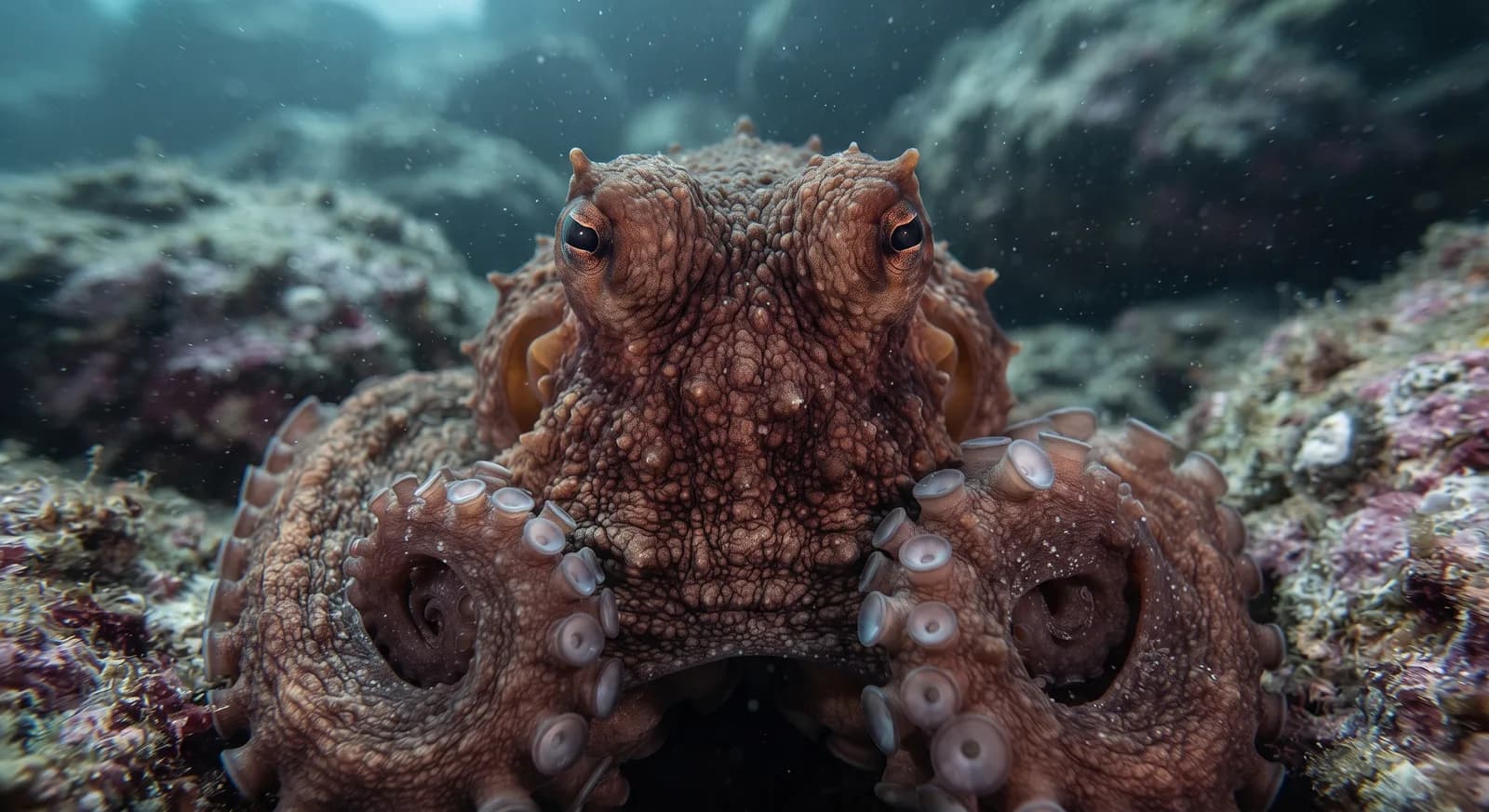
- Its sixty blue rings appear only when it is disturbed, and then they pulse. At rest it is an unremarkable brown octopus.
- In exchange for that chemical defence it lost another: its ink sac has shrunk and it barely uses it.
- The female broods the eggs among her arms and dies when they hatch.
Life cycle & biology
- Habitat & environment
- Intertidal pools and coral reefs of the Indo-Pacific, from Japan to Australia; it hides in crevices, empty shells and tins
Sources consulted: https://es.wikipedia.org/wiki/Hapalochlaena_lunulata
Where to find it
See its range on the interactive mapWhere to watch it
Parques y spots de buceo donde se ha documentado esta especie — se muestran 20 de 143 documentados.
Related species
Other species in the catalogue with the most in common with Greater Blue-ringed Octopus — same habitat, park, country, tags or family.
Day Octopus
Octopus cyanea
Mimic Octopus
Thaumoctopus mimicus
 Least Concern
Giant Pacific Octopus
Enteroctopus dofleini
Geography Cone
Conus geographus
Greater Argonaut
Argonauta argo
Yellow-bellied Sea Snake
Hydrophis platurus
Keep exploring
Based on what we already know about greater blue-ringed octopus.
Comments
Share an experience, a fun fact or a tip for seeing the greater blue-ringed octopus.
Be the first to comment.