Skip to content
WAnimals
  • Map
  • Species
  • Parks
  • Diving
Log inCreate account
WAnimals

The guide for travellers and animal lovers: discover, plan and share your wild adventures around the world.

Discover wildlife

  • Species
  • Ecosystems
  • Glossary
  • Tags

Explore places

  • Map
  • Countries
  • Parks
  • Diving

Plan experiences

  • Guides

Learn

  • Blog

Resources

  • Help centre
  • Contact
  • Install the app

Follow us

Account

  • Log in
  • Create account

© 2026 WAnimals. All rights reserved.

About usHow we build our profilesTerms of servicePrivacyLegal notice
MapSpeciesParksDiving
  1. Home
  2. Species
  3. Moon Crab

One of the 22 crabs on WAnimals
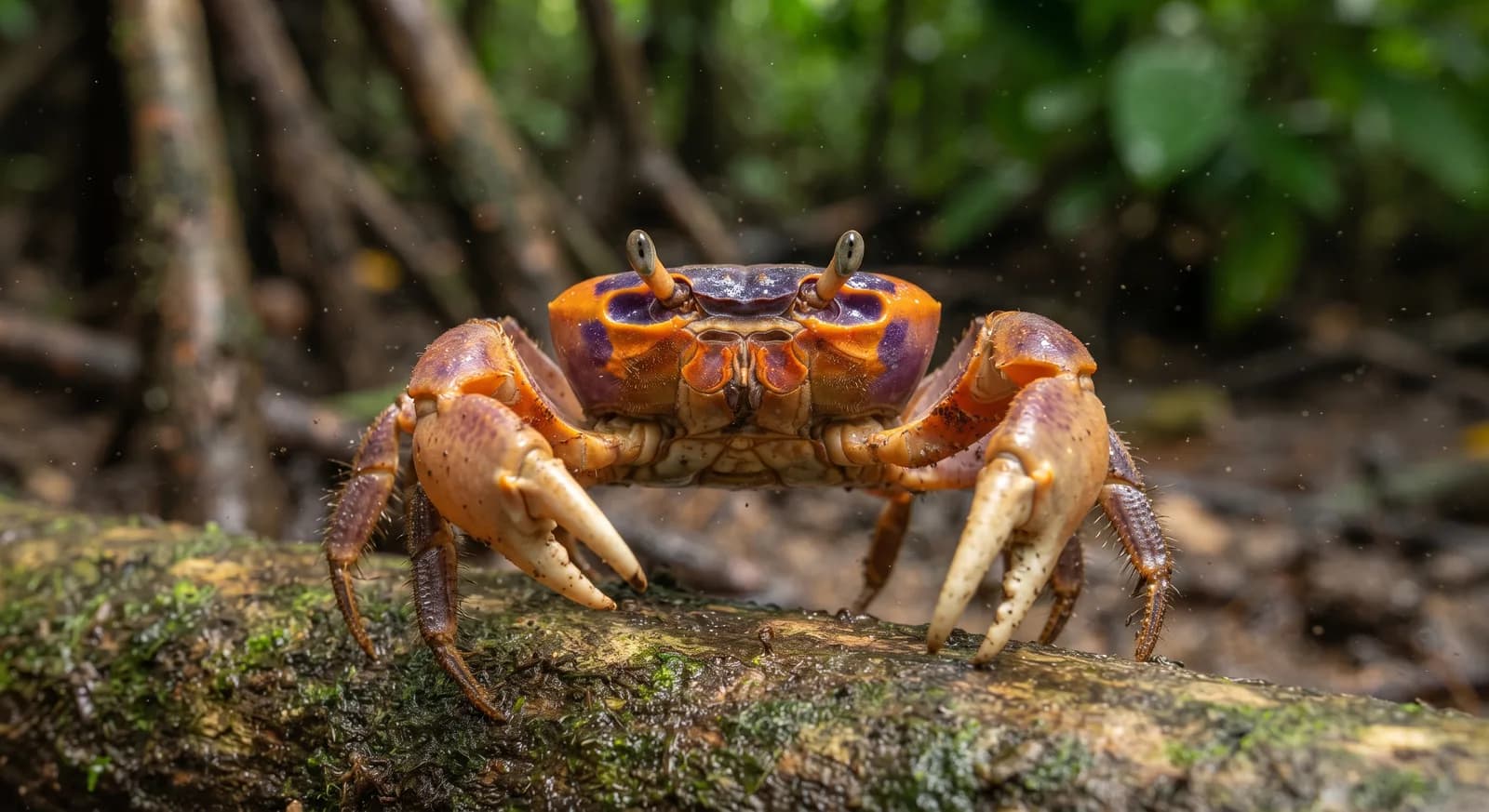
Moon Crab (Gecarcinus quadratus)

Malacostracans · Decapoda · Gecarcinidae

Moon Crab

Gecarcinus quadratus

Not Evaluated

It has not yet been assessed against the IUCN criteria.

Spotted something wrong?

A land crab with a black carapace marked in bright orange or red, which lives in burrows dug into the floor of the Pacific rainforest of Costa Rica and Panama. It is almost entirely terrestrial: it eats leaf litter, seedlings and fallen fruit, and returns to the sea only to release its larvae.

Size

4 cm – 6 cm

Diet

Herbivore

Feeds mainly on plants.

Activity

Nocturnal

Active mainly at night.
Social structure

Colony

Lives in large concentrations, often for breeding reasons.

Sighting difficulty

Unknown

Rainforest
13countries11parks3dive sites2same family

AI-generated images: illustrations, not photographs.

Fun facts

  • Its consumption of leaf litter and seedlings influences which trees manage to germinate, so that a crab shapes the composition of the forest.
  • Its burrows aerate the soil and speed up nutrient recycling in the coastal forest.
  • Although it lives on land, its larvae are marine: the females have to walk down to the shore to release them.
  • Its colours give it its name: a jet-black carapace, legs of intense orange or red, and purple or yellow patches at the joints.
  • It is terrestrial as an adult and lives in the forest, at times quite far from the sea, but it still depends on the ocean: the females make mass migrations to the shore to release their larvae.
  • Its burrows aerate the soil, and its role as a detritivore matters: it consumes leaf litter and seedlings, and influences the composition of the coastal understorey vegetation.
  • It shelters in its burrow by day and comes out at night in search of leaves, which it drags inside.
  • The name Halloween crab comes precisely from the combination of black and orange.
  • It is common in the coastal forests of Costa Rica and Panama, and its migrations are a well-known natural attraction.

Life cycle and biology

Skeleton type
Invertebrate - chitin exoskeleton (crustacean)
Habitat and environment
Coastal rainforest of the Central American Pacific, within a few hundred metres of the sea

Sources consulted: Sherman, trabajos sobre Gecarcinus quadratus; Smithsonian Tropical Research Institute; Organización de Estudios Tropicales

Where to find it

Best time: The rainy season, when they migrate en masse towards the coast to release their larvae

Loading map…

The pins mark the parks and dive sites where its presence is documented.

Where to see it

Parks and dive sites where this species has been documented — showing 13 of 14.

Related species

Other species in the catalogue with the most in common with Moon Crab — same habitat, park, country, tags or family.

Shares a park
Shares a park
Shares a park
Shares a park
Shares a park
Shares a park

Keep exploring

Based on what we already know about moon crab.

Comments

Share an experience, a fun fact or a tip for seeing the moon crab.

Be the first to comment.

See full glossary
This page in other languages: Español · Deutsch · Français · Português · Italiano
See its range on the interactive map→
CorcovadoCosta Rica
Manuel AntonioCosta Rica
CoibaPanama
MachalillaEcuador
Santa RosaCosta Rica
Marino BallenaCosta Rica
UtriaColombia
GorgonaColombia
Cerro HoyaPanama
Área de Conservación GuanacasteCosta Rica
Coiba National ParkPanama
Caño IslandCosta Rica
Machalilla / Isla de la PlataEcuador
See all 11 parks
Humboldt SquidNot Evaluated

Humboldt Squid

Dosidicus gigas

Least Concern

Seba's Short-tailed Bat

Carollia perspicillata

Blue-footed BoobyLeast Concern

Blue-footed Booby

Sula nebouxii

Green TurtleEndangered

Green Turtle

Chelonia mydas

Least Concern

Yellow-bellied Sea Snake

Hydrophis platurus

Not Evaluated

Leaf-cutter Ant

Atta cephalotes

CountriesCosta Rica
ParksCorcovadoCosta Rica
TagsHerbivore
Herbivore
Nocturnal
Colonial
Rainforest
Crustacean

North America10

South America3

Costa Rica
Panama
Colombia
Ecuador
Mexico
Belize
Belize
Bermuda
Costa Rica
Cuba
El Salvador
Guatemala
Honduras
Mexico
Nicaragua
Panama
Colombia
Ecuador
Peru