One of the 3 pheasants on WAnimals
Birds · Galliformes · Phasianidae
Silver Pheasant
Lophura nycthemera
The species is abundant and widely distributed; it faces no significant short-term risk. See full glossary
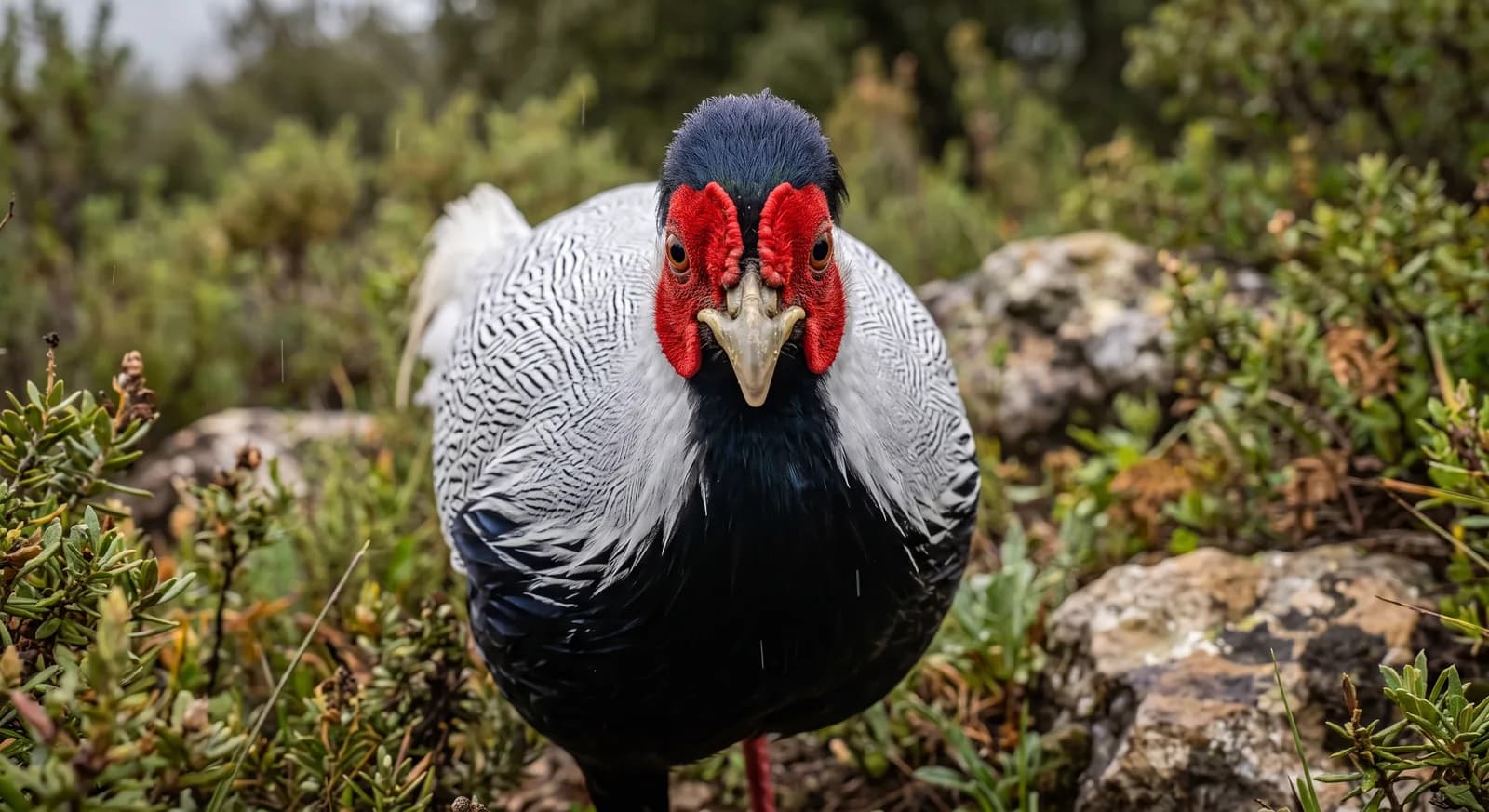
The silver pheasant is one of the most widely kept ornamental birds in the world. The male has a silvery white back and tail finely lined with black, a dark blue belly and intensely red bare facial skin. It lives in montane forest in southern China and the north of South-East Asia, in groups of one male and several females. Its enormous geographical variability has given rise to more than a dozen described subspecies.
Weight
1 kg – 2 kg
Size
70 cm – 1.3 m
Lifespan
15 years
Diet
Omnivore
Combines animal and plant food depending on availability.
Activity
Diurnal
Active mainly during the day.
Sighting difficulty
Easy
Fun facts
- It has been one of the commonest pheasants in aviculture collections worldwide since the 18th century, to the point that feral populations exist in several countries outside its natural range.
- The wild populations vary so much from one mountain range to another that more than a dozen subspecies have been described, some with an almost black rather than silvery back.
Life cycle & biology
- Skeleton type
- Vertebrate - internal bony skeleton (bird)
- Habitat & environment
- Montane forest and bamboo forest of southern China and northern Indochina, between 600 and 2,500 m
- Sexual maturity
- 2 years
- Gestation / incubation
- 26 days of incubation
- Litter / clutch size
- 6 eggs
Sources consulted: https://es.wikipedia.org/wiki/Lophura_nycthemera
Where to find it
See its range on the interactive mapWhere to watch it
Parks and dive sites where this species has been documented.
Related species
Other species in the catalogue with the most in common with Silver Pheasant — same habitat, park, country, tags or family.
Golden Pheasant
Chrysolophus pictus
Black Grouse
Lyrurus tetrix
Red Junglefowl
Gallus gallus
Indian Peafowl
Pavo cristatus
 Least Concern
Rhesus Monkey
Macaca mulatta
Chinese Hwamei
Garrulax canorus
Keep exploring
Based on what we already know about silver pheasant.
Comments
Share an experience, a fun fact or a tip for seeing the silver pheasant.
Be the first to comment.