Species group · Amphibians
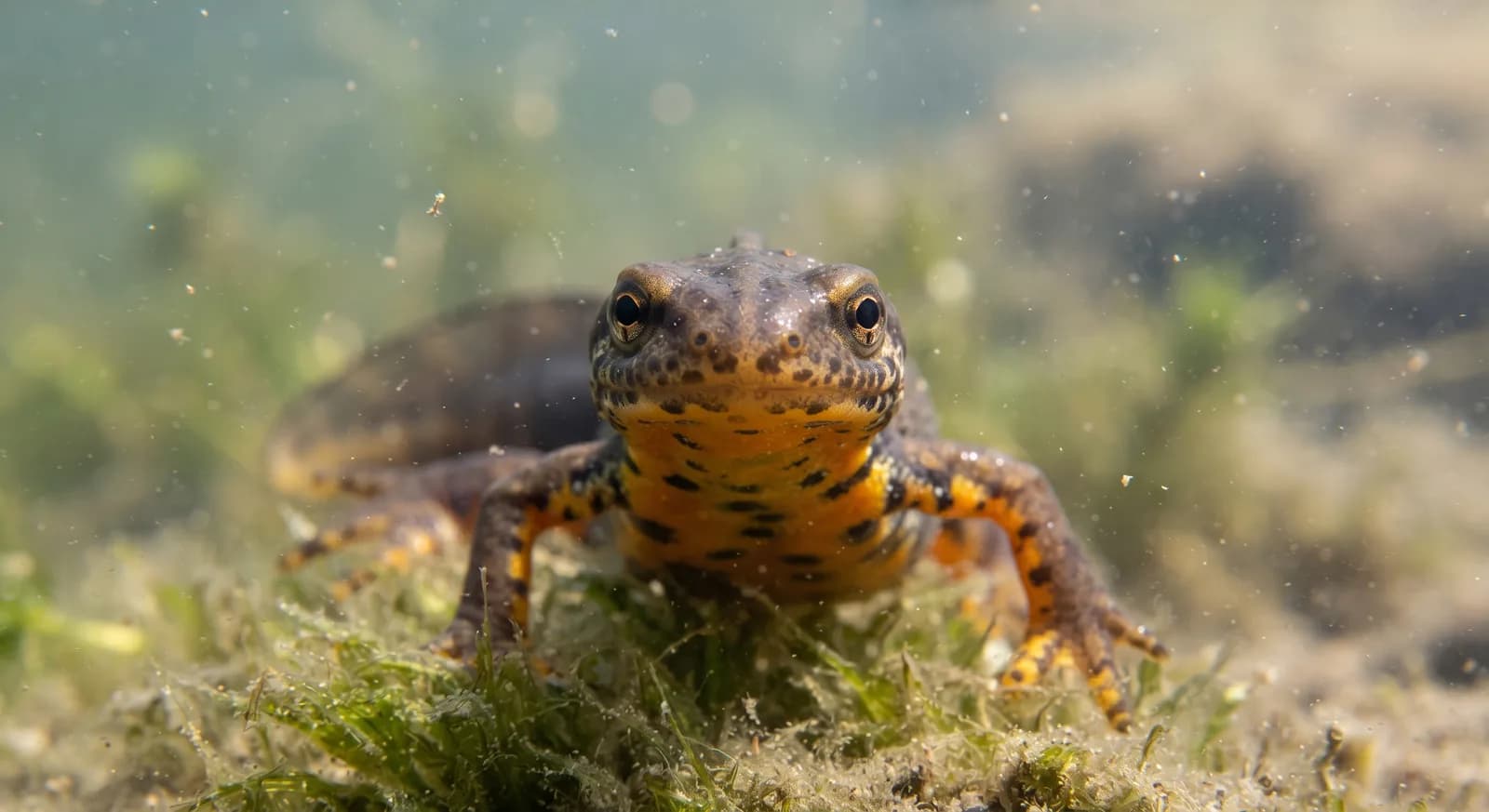
Newts
WAnimals has 10 species of newt, all in the family Salamandridae.
- 10 species
- 1 family
- 63 countries
- 167 parks
- Weight
- 1 g – 3 kg
- Length
- 5 cm – 20 cm
- Lifespan
- 8 – 25 years
Ranges calculated from the entries that record the figure, not from all 10.
All 10 species of newts on WAnimals
Each one has its own full entry. This group does not replace them: it brings them together.
 Least Concern
Alpine Newt
Ichthyosaura alpestris
Eastern Newt
Notophthalmus viridescens
Great Crested Newt
Triturus cristatus
Crocodile Newt
Tylototriton verrucosus
Palmate Newt
Lissotriton helveticus
Smooth Newt
Lissotriton vulgaris
Japanese Fire-bellied Newt
Cynops pyrrhogaster
Pyrenean Brook Salamander
Calotriton asper
Bosca's Newt
Lissotriton boscai
Marbled Newt
Triturus marmoratus
Conservation status
No species documented in this group is genuinely at risk according to the IUCN, with the data available today.
See the global conservation statusWhere they live
Recorded in 63 countries. The ones with the most species in the group:
Where to see them
- Aiguestortes i Estany de Sant Maurici3 species
- Armañón3 species
- Cadí-Moixeró3 species
- Douro Internacional3 species
- Eifel3 species
- Fragas do Eume3 species
- Gorbeia3 species
- Harz3 species
- Montesinho3 species
- Ordesa y Monte Perdido3 species
- Parque Nacional de los Pirineos3 species
- Peak District3 species
- Fathom Five National Marine Park (Tobermory)diving
- Isle Royale National Parkdiving
- Thunder Bay National Marine Sanctuarydiving
- White Star Quarrydiving
Did you know…
The male grows a dorsal crest and vivid colours in the breeding season.
From Alpine Newt
The female wraps each egg individually in the leaves of water plants.
From Alpine Newt
It has established stable introduced populations in the United Kingdom and New Zealand.
From Alpine Newt
It goes through a strikingly coloured juvenile land stage, the eft, before returning to the water as a breeding adult.
From Eastern Newt
It eats aquatic invertebrates, tadpoles and even small newts.
From Great Crested Newt
It is the largest newt in Great Britain, living in large fish-free ponds.
From Great Crested Newt
Its skin produces a milky, acrid secretion that works as a chemical defence against predators.
From Great Crested Newt
Its ribs can pierce its skin: like other newts of its group, when squeezed it pushes the tips of its ribs out through the glandular tubercles on its flanks, which are loaded with toxins, turning them into poisoned needles.
From Crocodile Newt