Bony fish · Perciformes · Scaridae
Queen Parrotfish
Scarus vetula
The species is abundant and widely distributed; it faces no significant short-term risk. See full glossary
Scarus vetula is a fish of the family Scaridae in the order Perciformes. Its teeth are fused into a dental plate.
Size
30 cm – 61 cm
Diet
Herbivore
Feeds mainly on plants.
Activity
Diurnal
Active mainly during the day.
Social structure
Colony
Lives in large concentrations, often for breeding reasons.
Sighting difficulty
Easy
Fun facts
- By grinding up the coral skeleton to digest the algae it produces sand: a single large parrotfish can generate hundreds of kilos of beach sand a year.
- At night it wraps itself in a cocoon of mucus secreted from its mouth, which masks its scent from predators and parasites.
- It is a protogynous hermaphrodite: all are born female, and the dominant individuals turn into males, changing colour completely in the process.
- It sleeps inside a sac of slime. At dusk it slips into a crevice and secretes, from glands behind its gills, a bubble of mucus that envelops it completely within half an hour.
- That cocoon is not just a blanket: it carries antibiotics that kill pathogens specific to parrotfishes and physically blocks blood-sucking parasites. It is built from a mesh of glycoproteins linked by disulphide bridges.
- It makes sand. It scrapes algae and coral with its beak of dental plates, grinds the mixture in its pharyngeal mill and expels the indigestible carbonate: a single parrotfish can produce close to a hundred kilos of sand a year.
- By eating sponges it indirectly protects the corals, which would otherwise be smothered by fast-growing sponge species.
- It is a sequential hermaphrodite: it starts out as a primary-phase female, and some individuals change into terminal-phase males, with a completely different colouration.
- It lives in small, stable groups of three or four females and one dominant supermale.
- It spends up to 90% of the day feeding, and it is not a strong swimmer: it propels itself by rowing with its pectoral fins.
Life cycle & biology
- Skeleton type
- Vertebrate - internal bony skeleton (fish)
- Habitat & environment
- Coral reefs of the Caribbean and the tropical western Atlantic
Sources consulted: https://es.wikipedia.org/wiki/Scarus_vetula
Where to find it
See its range on the interactive mapWhere to watch it
Parques y spots de buceo donde se ha documentado esta especie — se muestran 20 de 106 documentados.
Related species
Other species in the catalogue with the most in common with Queen Parrotfish — same habitat, park, country, tags or family.
Atlantic Spadefish
Chaetodipterus faber
 Least Concern
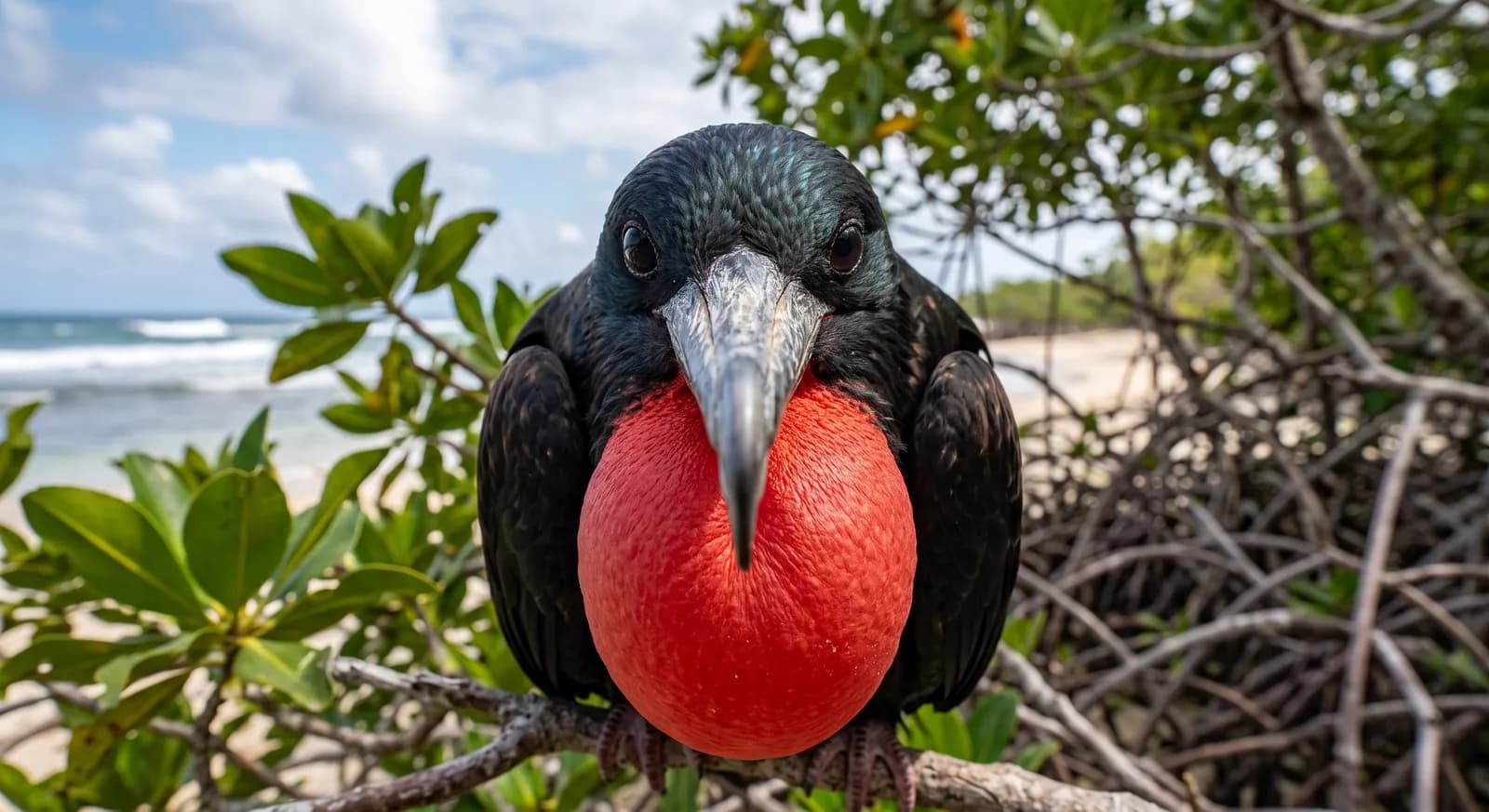
Magnificent Frigatebird
Fregata magnificens
Grey Snapper
Lutjanus griseus
Man-of-war Fish
Nomeus gronovii
Foureye Butterflyfish
Chaetodon capistratus
Red-footed Booby
Sula sula
Keep exploring
Based on what we already know about queen parrotfish.
Comments
Share an experience, a fun fact or a tip for seeing the queen parrotfish.
Be the first to comment.