Skip to content
WAnimals
  • Map
  • Species
  • Parks
  • Diving
Log inCreate account
WAnimals

The guide for travellers and animal lovers: discover, plan and share your wild adventures around the world.

Discover wildlife

  • Species
  • Ecosystems
  • Glossary
  • Tags

Explore places

  • Map
  • Countries
  • Parks
  • Diving

Plan experiences

  • Guides

Learn

  • Blog

Resources

  • Help centre
  • Contact
  • Install the app

Follow us

Account

  • Log in
  • Create account

© 2026 WAnimals. All rights reserved.

About usHow we build our profilesTerms of servicePrivacyLegal notice
MapSpeciesParksDiving
  1. Home
  2. Species
  3. Opossum Shrimp

One of the 8 shrimps on WAnimals

Malacostracans · Mysida · Mysidae

Opossum Shrimp

Mysis relicta

Not Evaluated

It has not yet been assessed against the IUCN criteria.

Spotted something wrong?

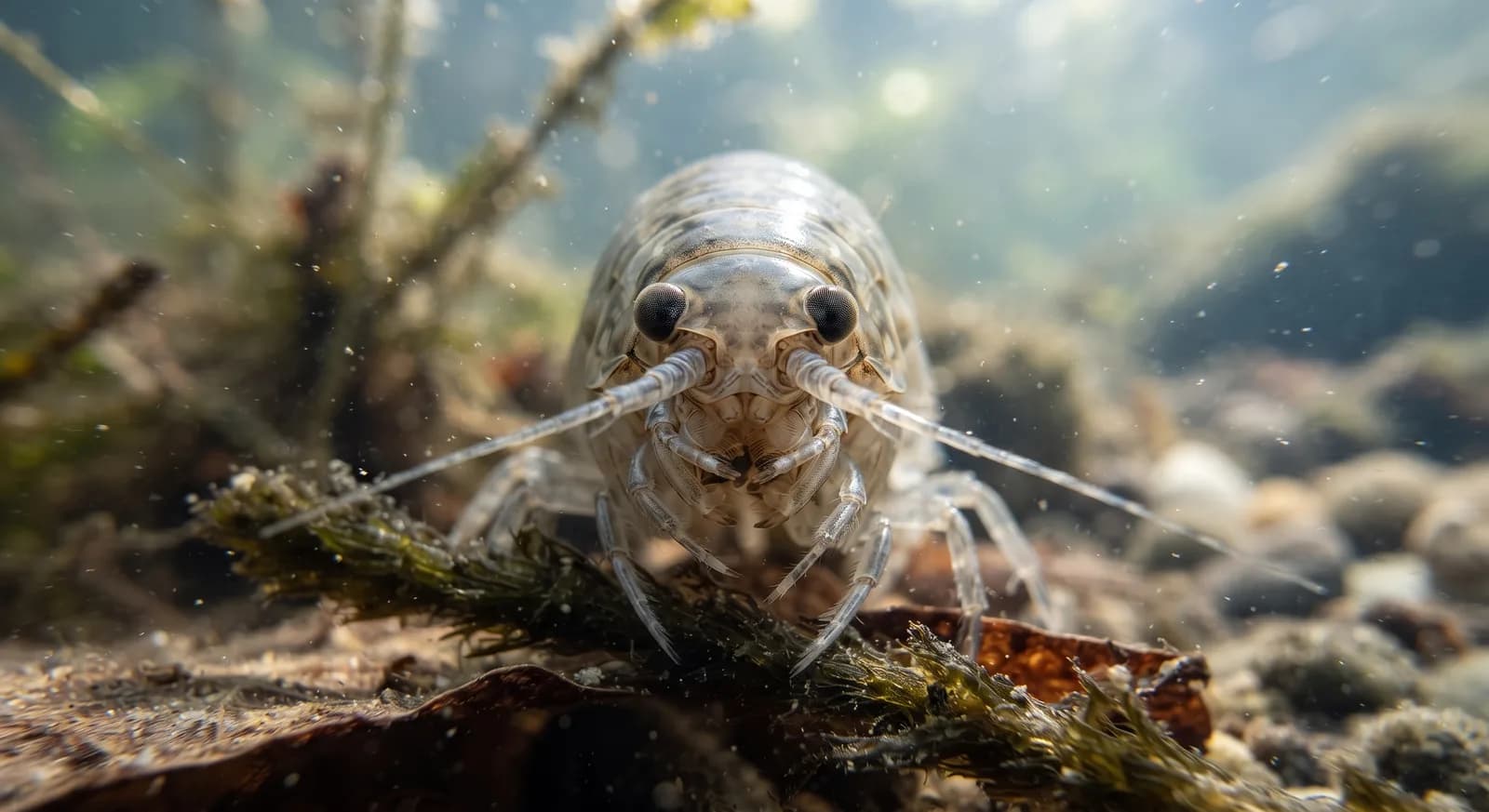
A small translucent crustacean known as the opossum shrimp, a survivor of the last glaciation in the deep lakes of northern Europe and North America. By day it stays near the bottom and by night it rises to feed on zooplankton, completing a daily vertical migration of tens of metres.

Size

1 cm – 2.5 cm

Diet

Omnivore

Combines animal and plant food depending on availability.

Activity

Nocturnal

Active mainly at night.

Social structure

Solitary

Lives and hunts alone, joining others only to breed.

Sighting difficulty

Unknown

Freshwater
16countries

Fun facts

  • It is a glacial relict: it was stranded in inland lakes as the ice retreated, and its populations have been isolated for thousands of years.
  • Its introduction into North American lakes to fatten the salmon had the opposite effect: it ate the zooplankton the salmon depended on and brought about the collapse of the fishery and of the bird populations that lived off it.
  • It is a glacial relict: it was left isolated in cold lakes as the glaciers retreated, cut off from its marine relatives.
  • What was called Mysis relicta for decades turned out to be four distinct species, separated in 2005: M. relicta in northern Europe, M. diluviana in North America, the circumpolar M. segerstralei and M. salemaai in the Baltic.
  • It is called an opossum shrimp for the female's brood pouch, in which she carries the embryos for several weeks.
  • Its introduction into North American lakes between 1949 and the 1980s to feed salmonids went badly wrong: as it shelters on the bottom by day, the fish could not reach it, while it stripped out the zooplankton they lived on. On Flathead Lake, anglers caught 45 tonnes of kokanee salmon in 1985 and none at all in 1987.
  • The collapse ran on up the chain: less zooplankton, fewer forage fish, and with them went the eagles, otters, coyotes and bears.

Life cycle and biology

Skeleton type
Invertebrate - articulated calcareous exoskeleton (crustacean)
Habitat and environment
Deep, cold waters of glacial lakes and cold seas of the northern hemisphere

Sources consulted: Audzijonyte y Väinölä (2005); Lasenby, Northcote y Fürst (1986); Ellis et al. (2011), PNAS; ScienceDirect (Hughes 1989); Science Advances, How colonial animals evolve; Wikipedia, Zooid

Where to find it

Loading map…

Related species

Other species in the catalogue with the most in common with Opossum Shrimp — same habitat, park, country, tags or family.

Related to
Related to
Related to
Related to
Related to
Related to

Keep exploring

Based on what we already know about opossum shrimp.

Comments

Share an experience, a fun fact or a tip for seeing the opossum shrimp.

Be the first to comment.

See full glossary
This page in other languages: Español · Deutsch · Français · Português · Italiano
See its range on the interactive map→
Least Concern

Brown Rat

Rattus norvegicus

Vulnerable

Noble Crayfish

Astacus astacus

Freshwater ShrimpNot Evaluated

Freshwater Shrimp

Gammarus pulex

Least Concern

Pond Loach

Misgurnus anguillicaudatus

Least Concern

Giant River Prawn

Macrobrachium rosenbergii

Least Concern

Camacuto Shrimp

Atya scabra

CountriesBelarus
TagsOmnivore
Omnivore
Nocturnal
Colonial
Freshwater
Crustacean

Europe13

North America2

Asia1

Belarus
Canada
Denmark
Estonia
Finland
Germany
Belarus
Denmark
Estonia
Finland
Germany
Ireland
Latvia
Lithuania
Norway
Poland
Sweden
Ukraine
United Kingdom
Canada
United States
Russia