Skip to content
WAnimals
  • Map
  • Species
  • Parks
  • Diving
Log inCreate account
WAnimals

The guide for travellers and animal lovers: discover, plan and share your wild adventures around the world.

Discover wildlife

  • Species
  • Ecosystems
  • Glossary
  • Tags

Explore places

  • Map
  • Countries
  • Parks
  • Diving

Plan experiences

  • Guides

Learn

  • Blog

Resources

  • Help centre
  • Contact
  • Install the app

Follow us

Account

  • Log in
  • Create account

© 2026 WAnimals. All rights reserved.

About usHow we build our profilesTerms of servicePrivacyLegal notice
MapSpeciesParksDiving
  1. Home
  2. Species
  3. Speckled Sea Louse

One of the 3 isopods on WAnimals
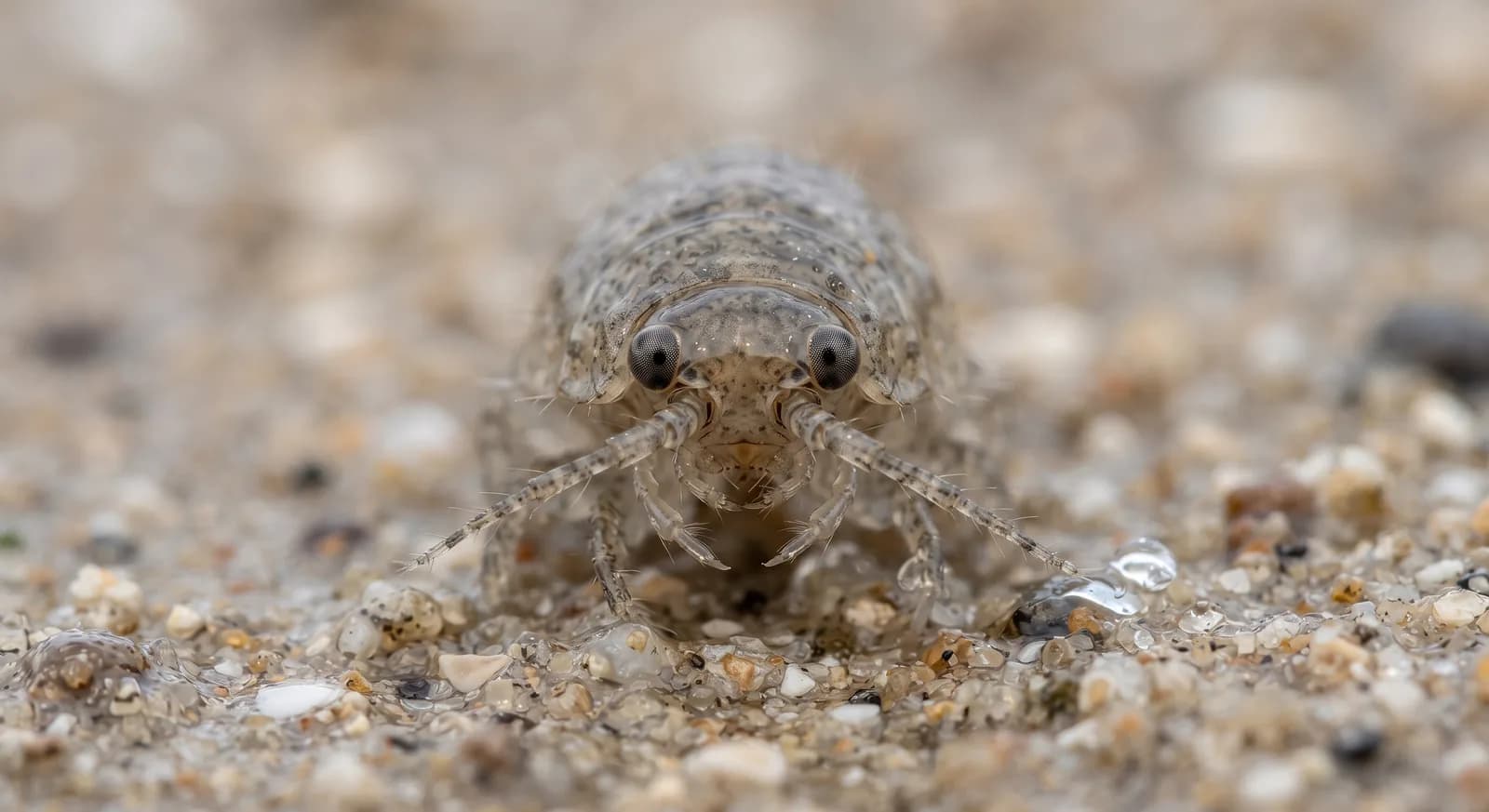
Speckled Sea Louse (Eurydice pulchra)

Malacostracans · Isopoda · Cirolanidae

Speckled Sea Louse

Eurydice pulchra

Not Evaluated

It has not yet been assessed against the IUCN criteria.

Spotted something wrong?

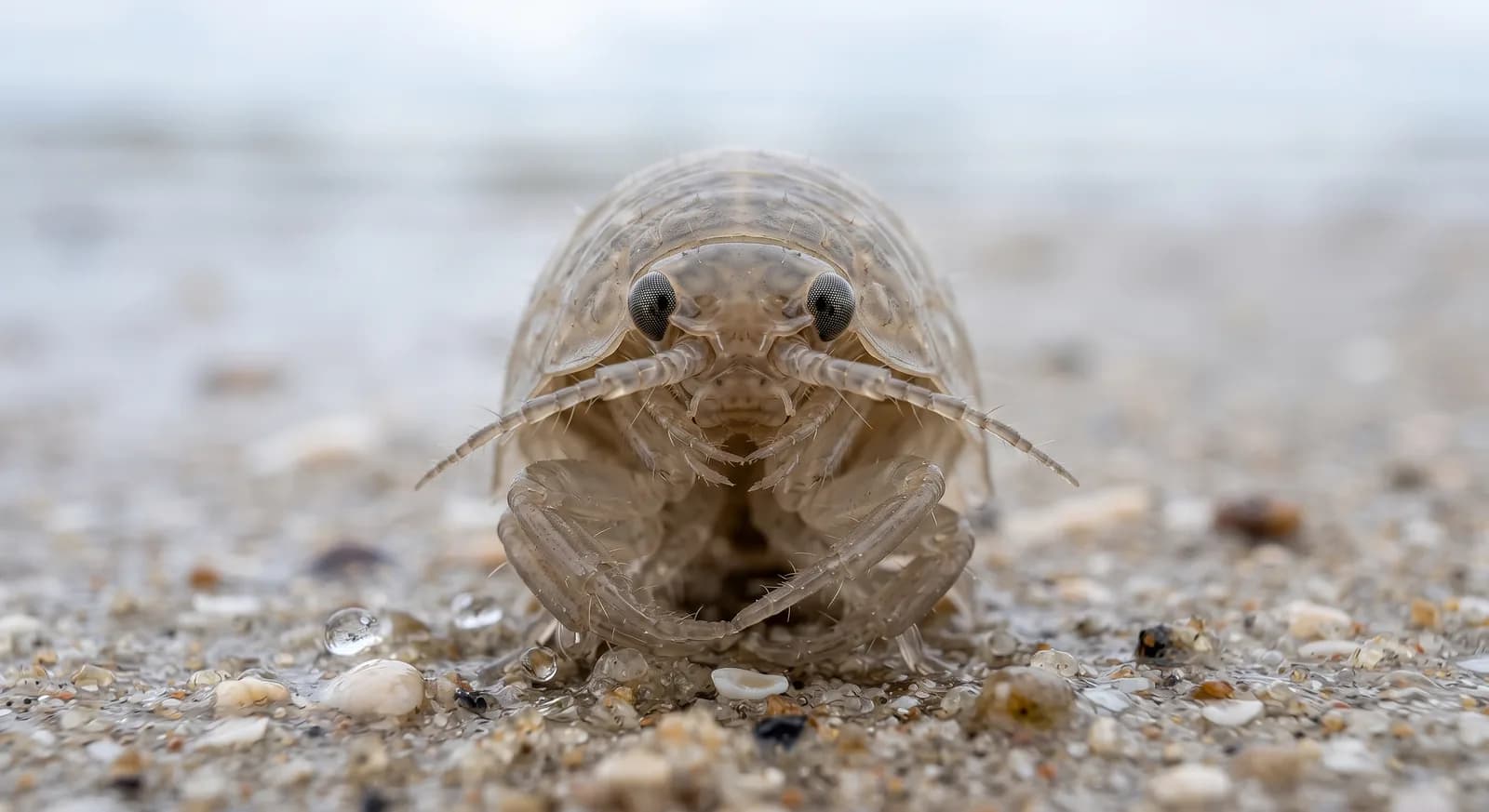
A minute isopod that lives buried in beach sand and which, at every high tide, emerges and swims actively in the water in search of small animals and debris. As the tide falls it buries itself again. It is a key prey for fish and shorebirds.

Size

up to 0.8 cm

Diet

Carnivore

Feeds mainly on other animals.

Activity

Nocturnal

Active mainly at night.
Social structure

Colony

Lives in large concentrations, often for breeding reasons.

Sighting difficulty

Unknown

Ocean
13countries30parks33dive sites1same family

AI-generated images: illustrations, not photographs.

Fun facts

  • It keeps its activity rhythm every 12.4 hours even when isolated in a laboratory without tides: it is one of the classic models for studying the circatidal biological clock.
  • As well as the tidal clock, it changes colour according to the time of day thanks to an independent circadian rhythm.
  • It has a tidal clock of its own: an endogenous circatidal rhythm of about 12.4 hours that brings it out of the sand on the flooding tide, keeps it swimming for five or six hours and sends it back into the sand.
  • That clock settled an old debate. For years it was argued that tidal rhythms were merely a submultiple of the circadian clock; experiments on this species showed that there is a circatidal pacemaker independent of the circadian system.
  • It swims mainly at night, and if turbulence lifts it out of the sand by day it buries itself at once.
  • It reaches densities of more than 1,500 individuals per square metre, and on one beach in south Wales more than 4,000 were recorded.

Life cycle and biology

Habitat and environment
Sand of exposed beaches of the north-eastern Atlantic

Sources consulted: Zhang et al. (2013), Current Biology; Wilcockson et al.; Jones y Naylor (1970); MarLIN

Where to find it

Loading map…

Where to see it

Parks and dive sites where this species has been documented — showing 20 of 63.

Related species

Other species in the catalogue with the most in common with Speckled Sea Louse — same habitat, park, country, tags or family.

Shares a park
Shares a park
Shares a park
Shares a park
Shares a park
Shares a park

Keep exploring

Based on what we already know about speckled sea louse.

Comments

Share an experience, a fun fact or a tip for seeing the speckled sea louse.

Be the first to comment.

See full glossary
This page in other languages: Español · Deutsch · Français · Português · Italiano

The pins mark the parks and dive sites where its presence is documented.

See its range on the interactive map→
Doñana National ParkSpain
CalanquesFrance
Wadden Sea National ParkDenmark
Wadden SeaGermany
Port-CrosFrance
Pembrokeshire CoastUnited Kingdom
NorthumberlandUnited Kingdom
Cabrera ArchipelagoSpain
Ebro DeltaSpain
Cíes IslandsSpain
Scapa FlowUnited Kingdom
Medes IslandsSpain
Cap de CreusSpain
El Hierro / La RestingaSpain
Museo Atlántico (Lanzarote)Spain
Calanques of MarseilleFrance
Scandola Reserve (Corsica)France
Farne IslandsUnited Kingdom
Columbretes IslandsSpain
Formentera (Es Freus)Spain
See all 30 parks
See all 33 dive sites
Not Evaluated

Edible Crab

Cancer pagurus

Common LobsterLeast Concern

Common Lobster

Homarus gammarus

Mauve StingerNot Evaluated

Mauve Stinger

Pelagia noctiluca

Common BrittlestarNot Evaluated

Common Brittlestar

Ophiothrix fragilis

Common Spider CrabNot Evaluated

Common Spider Crab

Maja squinado

Sand HopperNot Evaluated

Sand Hopper

Talitrus saltator

CountriesSpain
ParksDoñana National ParkSpain
TagsCarnivore
Carnivore
Nocturnal
Colonial
Ocean
Crustacean

Europe12

Africa1

Spain
United Kingdom
Portugal
France
Ireland
Denmark
Belgium
Denmark
France
Germany
Iceland
Ireland
Netherlands
Norway
Portugal
Spain
Sweden
United Kingdom
Morocco