Branchiopods · Anostraca · Artemiidae
Brine Shrimp
Artemia salina
It has not yet been assessed against the IUCN criteria. See full glossary
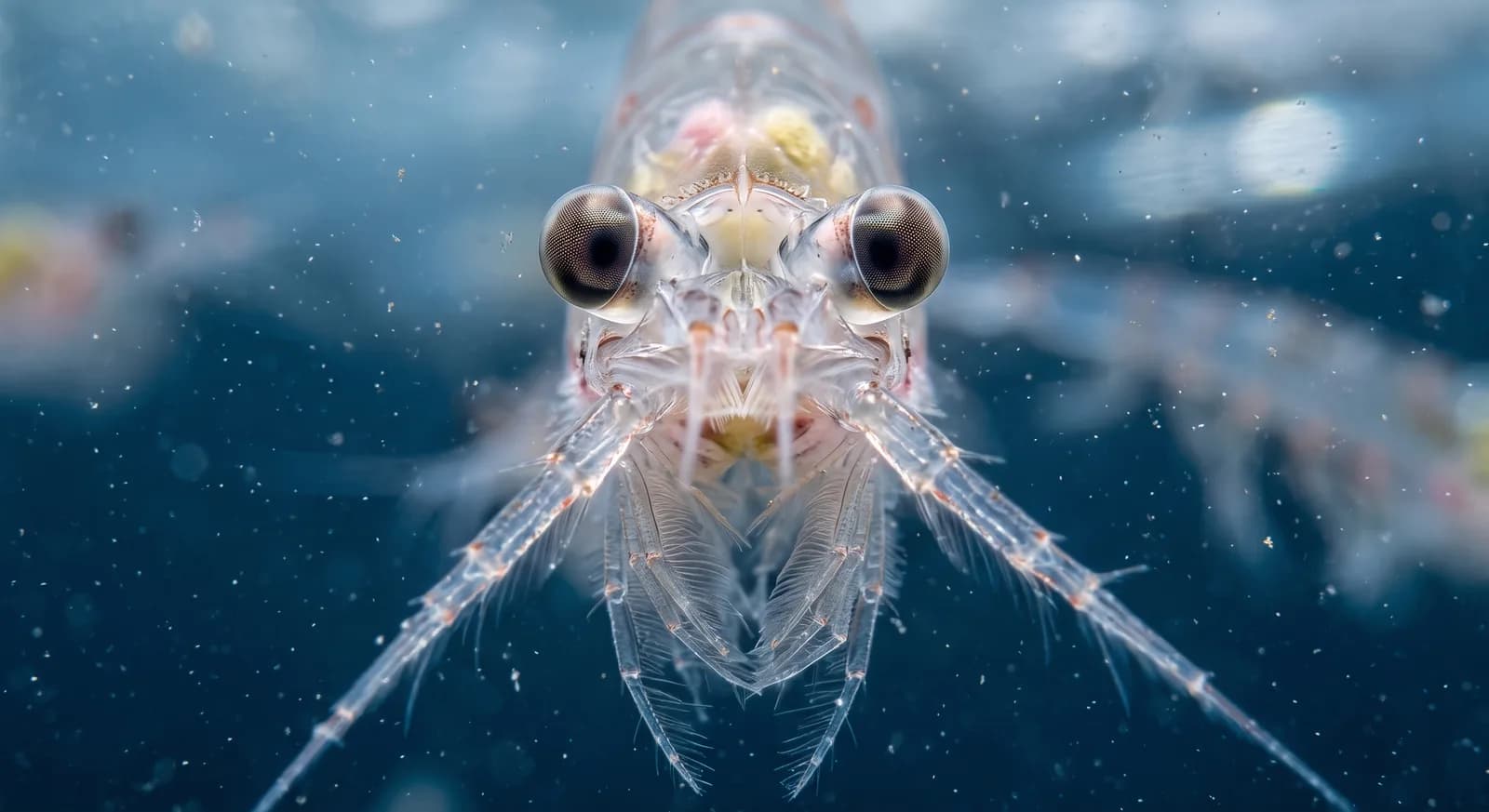
Artemia salina is a branchiopod crustacean of the order Anostraca. It is characteristic of inland brackish waters and its distribution is cosmopolitan.
Size
8 cm – 15 cm
Lifespan
1 years
Diet
Herbivore
Feeds mainly on plants.
Social structure
Colony
Lives in large concentrations, often for breeding reasons.
Sighting difficulty
Unknown
Fun facts
- When conditions worsen it produces diapause cysts that withstand complete desiccation, vacuum and extreme temperatures for years, and hatch as soon as they are placed in salt water.
- Those cysts are sold in sachets and are the basis of Sea-Monkeys, as well as the most widely used live food in the rearing of fish and crustacean larvae.
- Its pink colour comes from the carotenoids of the microalgae it filters, the same pigments that colour the flamingos that feed on it.
- It lives where nothing else can. Its advantage is not competing but tolerating salinities lethal to its predators, which is why it builds up enormous populations in salt pans.
- Its eggs, called cysts, enter diapause and survive for years completely dry. Simply dropping them into salt water hatches them, which has made them the standard live food of aquaculture and of aquariums worldwide.
- That same ability made it famous as a toy: the Sea-Monkeys sold by mail order in the 1960s are brine shrimp.
- It is used as a test organism in ecotoxicology for its ease of culture and its sensitivity to toxins.
- It can reproduce by parthenogenesis, and many populations are entirely female.
- Its pink colour comes from the carotenoids in the microalgae it eats, the same ones that colour the flamingos that feed on it.
Life cycle & biology
- Habitat & environment
- Salt pans, hypersaline lagoons and salt lakes
Sources consulted: https://es.wikipedia.org/wiki/Artemia_salina
Where to find it
See its range on the interactive mapRelated species
Other species in the catalogue with the most in common with Brine Shrimp — same habitat, park, country, tags or family.
Acorn Barnacle
Semibalanus balanoides
Mud Fiddler Crab
Uca pugnax
Queen Parrotfish
Scarus vetula
 Least Concern
Antarctic Krill
Euphausia superba
Common Periwinkle
Littorina littorea
Common Oyster
Ostrea edulis
Keep exploring
Based on what we already know about brine shrimp.
Comments
Share an experience, a fun fact or a tip for seeing the brine shrimp.
Be the first to comment.