One of the 4 insects on WAnimals
Insects · Phasmatodea · Phasmatidae
Giant Leaf Insect
Phyllium giganteum
It has not yet been assessed against the IUCN criteria. See full glossary
The giant leaf insect has a flattened green body that reproduces a leaf with extraordinary fidelity: a central midrib, lateral veins, ragged edges and even brown blotches that mimic dry patches or bites taken by other insects.
Size
8 cm – 11 cm
Diet
Herbivore
Feeds mainly on plants.
Activity
Nocturnal
Active mainly at night.
Social structure
Solitary
Lives and hunts alone, joining others only to breed.
Sighting difficulty
Unknown
Fun facts
- It walks while rocking back and forth to mimic a leaf stirred by the breeze, so that the camouflage does not break down as it moves.
- Only females are known: it reproduces by parthenogenesis, and the unfertilised eggs always give rise to more females.
- Its eggs look like seeds and are dropped to the ground, where they lie for months before hatching, one more layer of camouflage.
- Its mimicry is among the most complete in the animal kingdom: the flattened, broadened body imitates a leaf, with marked venation, irregular edges as if nibbled by insects, and brown patches simulating dry or diseased areas.
- And it adds movement: it sways rhythmically as it walks, imitating a leaf stirred by the breeze.
- It is one of the largest leaf insect species: the female exceeds 10 cm.
- Only females are known. The species is obligately parthenogenetic, and to this day no male has been described with certainty.
- The eggs also imitate seeds, in shape and surface, and are dispersed by falling to the forest floor.
- Its front legs bear flattened, blade-like expansions that complete the outline, so that the silhouette of the whole animal, legs included, looks like a leaf.
Life cycle & biology
- Skeleton type
- Invertebrate - chitin exoskeleton (insect)
- Habitat & environment
- Canopy and understorey of Malaysian rainforest
Sources consulted: Hennemann et al., revisiones de Phylliidae; Phasmid Study Group; Museo de Historia Natural de Londres
Where to find it
See its range on the interactive mapWhere to watch it
Parques y spots de buceo donde se ha documentado esta especie — se muestran 10 de 40 documentados.
Related species
Other species in the catalogue with the most in common with Giant Leaf Insect — same habitat, park, country, tags or family.
Sunda Flying Lemur
Galeopterus variegatus
 Endangered
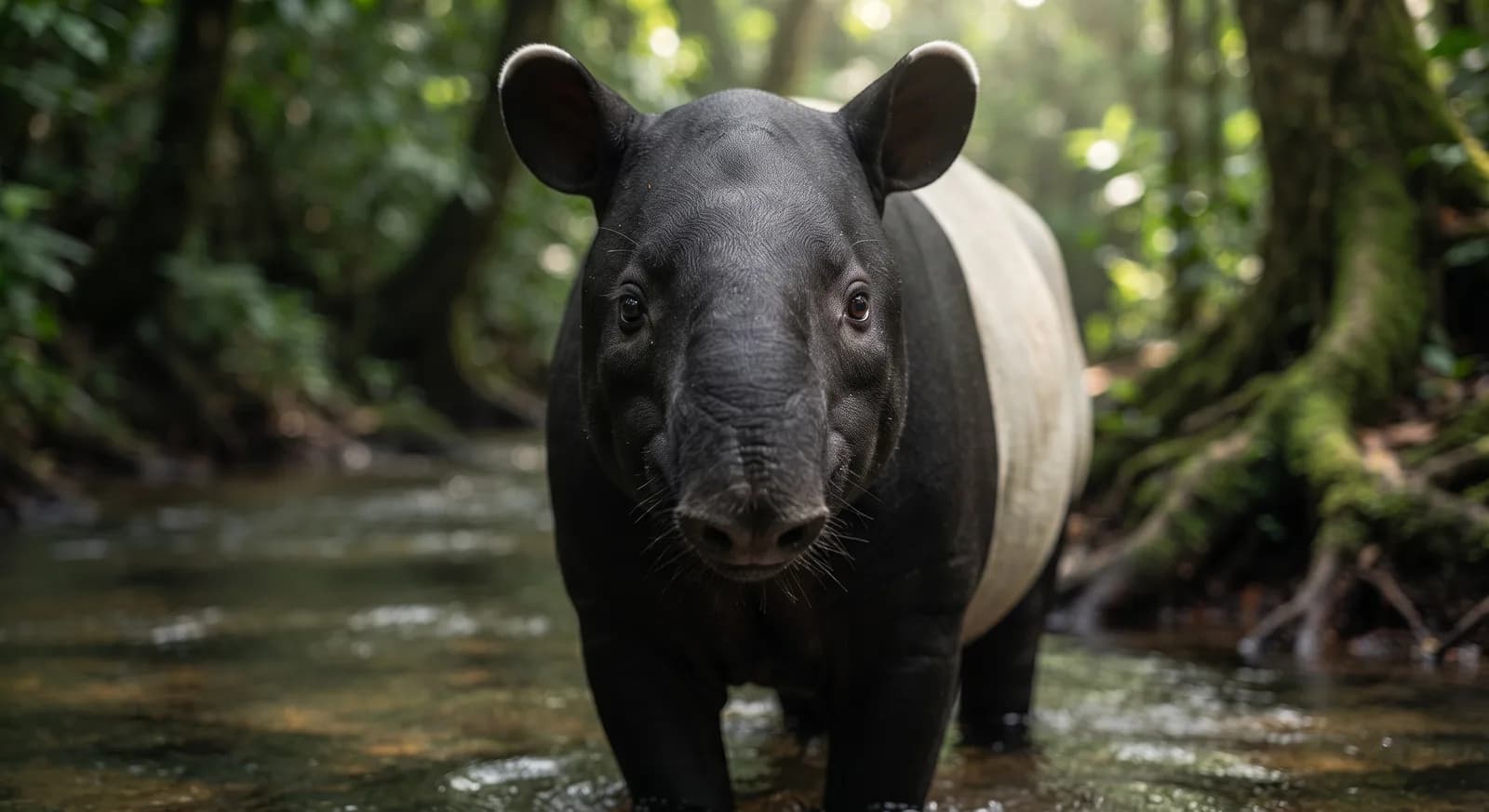
Malayan Tapir
Tapirus indicus
Atlas Moth
Attacus atlas
Giant African Snail
Lissachatina fulica
Jungle Nymph
Heteropteryx dilatata
Keep exploring
Based on what we already know about giant leaf insect.
Comments
Share an experience, a fun fact or a tip for seeing the giant leaf insect.
Be the first to comment.