One of the 15 butterflies on WAnimals
Insects · Lepidoptera · Saturniidae
Atlas Moth
Attacus atlas
It has not yet been assessed against the IUCN criteria. See full glossary
The atlas moth is a ditrysian lepidopteran of the family Saturniidae. It is the largest representative of the family and the largest moth in the world in terms of total wing area. Its wingspan is also among the greatest, at 25 to 30 cm. Female specimens are larger and stronger than males. The lepidopteran with the greatest wingspan is the white witch.
Size
20 cm – 30 cm
Lifespan
1 years
Diet
Herbivore
Feeds mainly on plants.
Activity
Nocturnal
Active mainly at night.
Social structure
Solitary
Lives and hunts alone, joining others only to breed.
Sighting difficulty
Unknown
Fun facts
- récordIt has one of the largest wing areas of any moth or butterfly in the world, and the adults have no working mouthparts, so they do not feed during their short adult life.
- The tips of its forewings reproduce a snake's head with remarkable fidelity, eye and snout included, and the moth waves them when it feels threatened.
- Its cocoon yields a brown, tough and highly valued silk, fagara silk, which in India is gathered by hand.
- It is one of the largest moths in the world: up to 25 or 26 cm in wingspan, and one of the largest wing areas of any lepidopteran, above 160 cm².
- Only the white witch, Thysania agrippina, surpasses it in wingspan, reaching some 31 cm.
- The adult does not feed. Its mouthparts are atrophied and it lives for barely a week or two on the fat stored up as a caterpillar.
- That is precisely why it flies little: moving such enormous wings costs a great deal of energy, and it prefers to stay close to where it emerged from the cocoon.
- The tips of the forewings mimic a snake's head, complete with the pattern and the curve of the snout. In Hong Kong its Cantonese name literally means snake's head moth.
- The caterpillar reaches 11.5 cm, is green with soft blue protuberances, and is covered in a white waxy bloom.
- The male can detect a female's pheromones from kilometres away with his feathery antennae.
Life cycle & biology
- Skeleton type
- Invertebrate - chitin exoskeleton (insect)
- Habitat & environment
- Tropical and subtropical rainforest of southern and South-East Asia
Sources consulted: https://es.wikipedia.org/wiki/Attacus_atlas
Where to find it
See its range on the interactive mapWhere to watch it
Parques y spots de buceo donde se ha documentado esta especie — se muestran 10 de 21 documentados.
Related species
Other species in the catalogue with the most in common with Atlas Moth — same habitat, park, country, tags or family.
Sunda Flying Lemur
Galeopterus variegatus
 Endangered
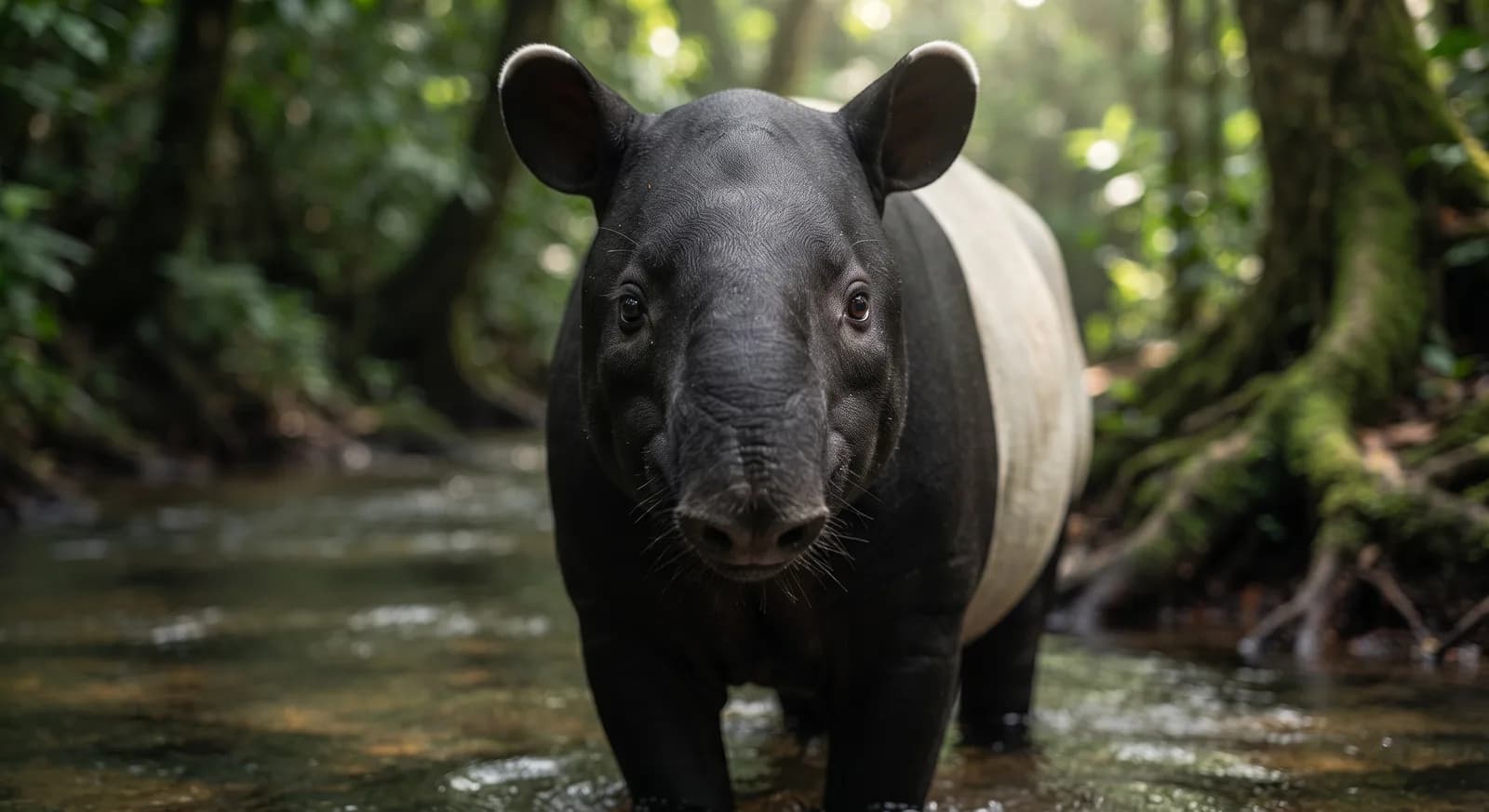
Malayan Tapir
Tapirus indicus
Giant Leaf Insect
Phyllium giganteum
Giant African Snail
Lissachatina fulica
Jungle Nymph
Heteropteryx dilatata
Keep exploring
Based on what we already know about atlas moth.
Comments
Share an experience, a fun fact or a tip for seeing the atlas moth.
Be the first to comment.