Bivalves · Ostreida · Pinnidae
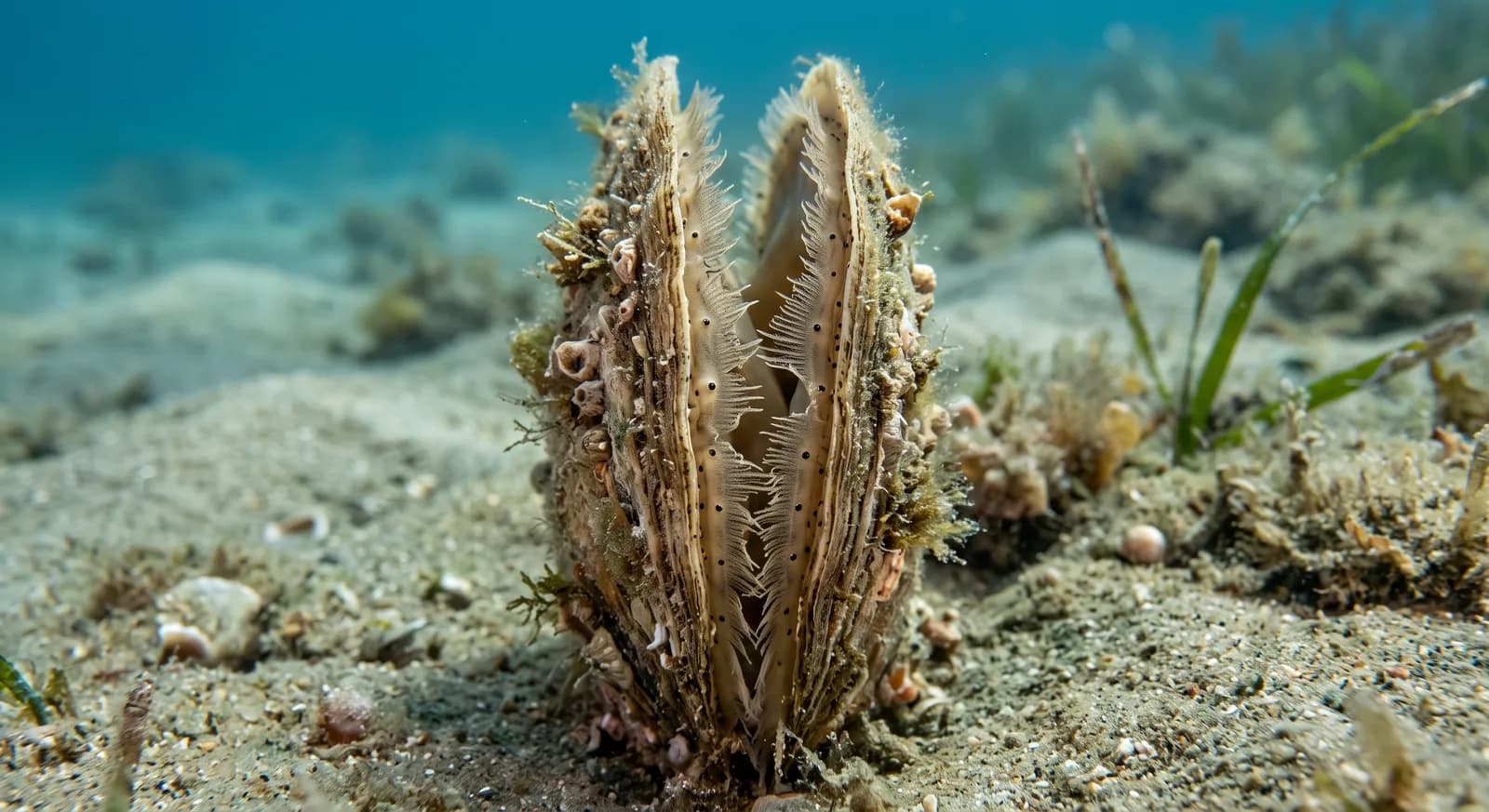
Fan Mussel
Pinna nobilis
It faces an extremely high risk of imminent extinction in the wild. See full glossary
The fan mussel is a bivalve mollusc of the family Pinnidae endemic to the Mediterranean Sea. It can reach 120 cm in length and live for more than 20 years. It is set vertically into the seabed and usually lives in seagrass meadows of Posidonia oceanica and Cymodocea nodosa. It also occurs on sandy bottoms wherever there is hard substrate to which it can attach its byssus. It is usually dark in colour, and up to a third of its length is buried.
Size
up to 1.2 m
Lifespan
45 years
Social structure
Solitary
Lives and hunts alone, joining others only to breed.
Sighting difficulty
Very hard
Fun facts
- conservaciónIt is one of the largest bivalve molluscs in the Mediterranean, and its populations have collapsed over the past decade because of a parasite that has caused mass mortality right across the sea.
- It is the largest bivalve endemic to the Mediterranean and one of the largest in the world: it reaches 120 cm.
- Since the autumn of 2016 it has suffered a mass mortality caused by the parasite Haplosporidium pinnae, with outbreaks reaching 100 % mortality within a few months. In 2019 it was moved to the Critically Endangered category.
- It is considered functionally extinct across most of its range: a survey of 800 km of Italian coast in 2022 did not find a single living individual.
- Its last refuges are brackish coastal lagoons. In the Thau lagoon, in southern France, a population of more than 100,000 individuals survives at densities of up to 511 animals per 100 m².
- Its byssus filaments were woven into sea silk, a legendary golden cloth that barely any craftswomen are still able to work.
- It is protected by the Barcelona Convention and by European legislation.
Life cycle & biology
- Skeleton type
- Invertebrate - external calcareous bivalve shell (mollusc)
- Habitat & environment
- Posidonia meadows and soft Mediterranean bottoms between 0.5 and 60 m, anchored upright in the sediment by the narrow end of the shell; today its last healthy populations are in brackish lagoons
Sources consulted: https://en.wikipedia.org/wiki/Pinna_nobilis
Where to find it
See its range on the interactive mapWhere to watch it
Parques y spots de buceo donde se ha documentado esta especie — se muestran 20 de 85 documentados.
Related species
Other species in the catalogue with the most in common with Fan Mussel — same habitat, park, country, tags or family.
Common Guitarfish
Rhinobatos rhinobatos
Murex
Bolinus brandaris
Blue Glaucus
Glaucus atlanticus
 Not Evaluated
Common Octopus
Octopus vulgaris
 Not Evaluated
Common Cuttlefish
Sepia officinalis
Olive Chiton
Chiton olivaceus
How to help
The fan mussel is classified as critically endangered. Organizations such as UICN, WWF y Wildlife Conservation Society work specifically on its conservation and that of its habitat; looking into their programs is a good starting point if you want to get involved.
It's documented in 13 real protected areas — part of why protecting these places matters for its conservation.
Keep exploring
Based on what we already know about fan mussel.
Comments
Share an experience, a fun fact or a tip for seeing the fan mussel.
Be the first to comment.