Skip to content
WAnimals
  • Map
  • Species
  • Parks
  • Diving
Log inCreate account
WAnimals

The guide for travellers and animal lovers: discover, plan and share your wild adventures around the world.

Discover wildlife

  • Species
  • Ecosystems
  • Glossary
  • Tags

Explore places

  • Map
  • Countries
  • Parks
  • Diving

Plan experiences

  • Guides

Learn

  • Blog

Resources

  • Help centre
  • Contact
  • Install the app

Follow us

Account

  • Log in
  • Create account

© 2026 WAnimals. All rights reserved.

About usHow we build our profilesTerms of servicePrivacyLegal notice
MapSpeciesParksDiving
  1. Home
  2. Species
  3. Lowland Paca
Lowland Paca (Cuniculus paca)

Mammals · Rodentia · Cuniculidae

Lowland Paca

Cuniculus paca

Least Concern

The species is abundant and widely distributed; it faces no significant short-term risk.

Spotted something wrong?

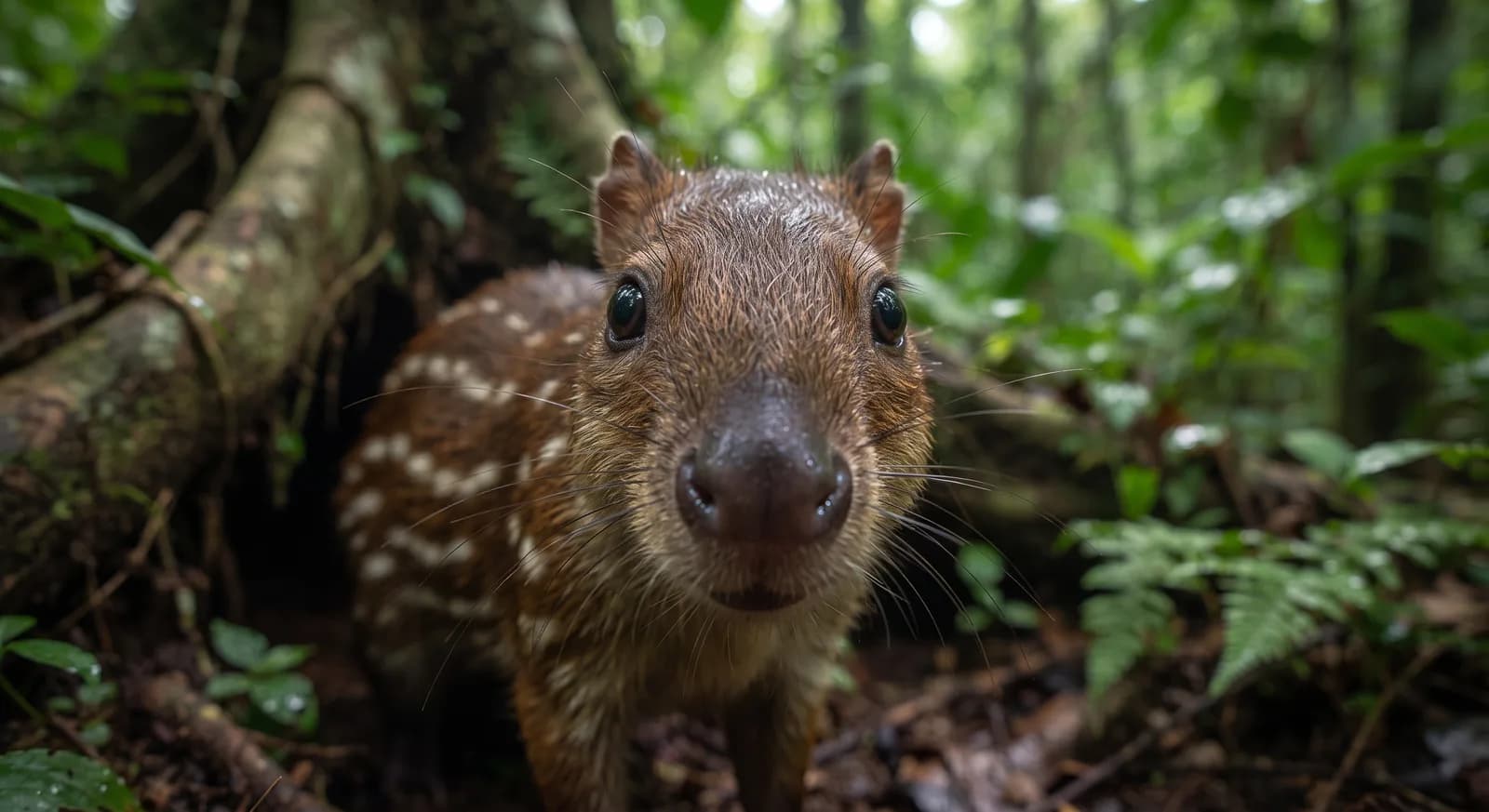
The lowland paca, also known by many regional names, is a hystricomorph rodent of the family Cuniculidae. It lives near watercourses in tropical forests, from southern Mexico and Central America through to Paraguay and north-eastern Argentina. The genus has one other member, the mountain paca, which inhabits Andean montane and foothill forests in Venezuela, Colombia, Ecuador, Peru and Bolivia. It is listed as Least Concern given its wide distribution, its presumed large population, the existence of a number of protected areas, and because its population is unlikely to decline at anything like the rate that would qualify it for a threatened category. Local extinctions have nonetheless occurred in the south-east of its range, through habitat destruction. In south-eastern Mexico it is hunted and eaten, and the hunting is often excessive at certain times and in certain regions.

Weight

6 kg – 14 kg

Size

60 cm – 80 cm

Life expectancy

16 years

Diet

Herbivore

Feeds mainly on plants.

Activity

Nocturnal

Active mainly at night.

Social structure

In pairs

Usually lives in pairs, sometimes for life.

Sighting difficulty

Easy

RainforestFreshwater
20countries6parks

AI-generated images: illustrations, not photographs.

Fun facts

  • It has hollow, enlarged zygomatic arches that work as resonating chambers: it can produce a low growl surprisingly powerful for its size, a bony structure unique among mammals.
  • When chased it heads straight for water and dives: it can stay submerged for several minutes and surface on a different bank.

Life cycle and biology

Skeleton type
Vertebrate - internal bony skeleton (mammal)
Habitat and environment
Rainforest and gallery forest near watercourses, from Mexico to Paraguay
Sexual maturity
12 months
Gestation / incubation
3.8 months
Litter / clutch size
1

Sources consulted: https://es.wikipedia.org/wiki/Cuniculus_paca

Where to find it

Loading map…

The pins mark the parks where its presence is documented.

Where to see it

Parks and dive sites where this species has been documented.

Related species

Other species in the catalogue with the most in common with Lowland Paca — same habitat, park, country, tags or family.

Shares a park
Shares a park
Shares a park
Shares a park
Shares a park
Shares a park

Related guides

Keep exploring

Based on what we already know about lowland paca.

Comments

Share an experience, a fun fact or a tip for seeing the lowland paca.

Be the first to comment.

See full glossary
This page in other languages: Español · Deutsch · Français · Português · Italiano
See its range on the interactive map→
CalakmulMexico
Sumidero CanyonMexico
TikalGuatemala
Maya Biosphere ReserveGuatemala
Cerro Azul MeambarHonduras
Cockscomb BasinBelize
Least Concern

Water Opossum

Chironectes minimus

Least Concern

Brown-throated Sloth

Bradypus variegatus

Least Concern

Hoffmann's Two-toed Sloth

Choloepus hoffmanni

Least Concern

Jamaican Fruit-eating Bat

Artibeus jamaicensis

Least Concern

Seba's Short-tailed Bat

Carollia perspicillata

Least Concern

Greater Bulldog Bat

Noctilio leporinus

Where to see Lowland Paca6 places
CountriesGuatemala
ParksCalakmulMexico
TagsHerbivore
Herbivore
Nocturnal
In pairs
Rainforest
Freshwater
Mammal

South America11

North America9

Guatemala
Mexico
Belize
Honduras
Argentina
Bolivia
Argentina
Bolivia
Brazil
Colombia
Ecuador
French Guiana
Guyana
Paraguay
Peru
Suriname
Venezuela
Belize
Costa Rica
El Salvador
Guatemala
Honduras
Mexico
Nicaragua
Panama
Trinidad and Tobago