Skip to content
WAnimals
  • Map
  • Species
  • Parks
  • Diving
Log inCreate account
WAnimals

The guide for travellers and animal lovers: discover, plan and share your wild adventures around the world.

Discover wildlife

  • Species
  • Ecosystems
  • Glossary
  • Tags

Explore places

  • Map
  • Countries
  • Parks
  • Diving

Plan experiences

  • Guides

Learn

  • Blog

Resources

  • Help centre
  • Contact
  • Install the app

Follow us

Account

  • Log in
  • Create account

© 2026 WAnimals. All rights reserved.

About usHow we build our profilesTerms of servicePrivacyLegal notice
MapSpeciesParksDiving
  1. Home
  2. Species
  3. Weevil

One of the 2 weevils on WAnimals

Insects · Coleoptera · Curculionidae

Weevil

Anthonomus grandis

Not Evaluated

It has not yet been assessed against the IUCN criteria.

Spotted something wrong?

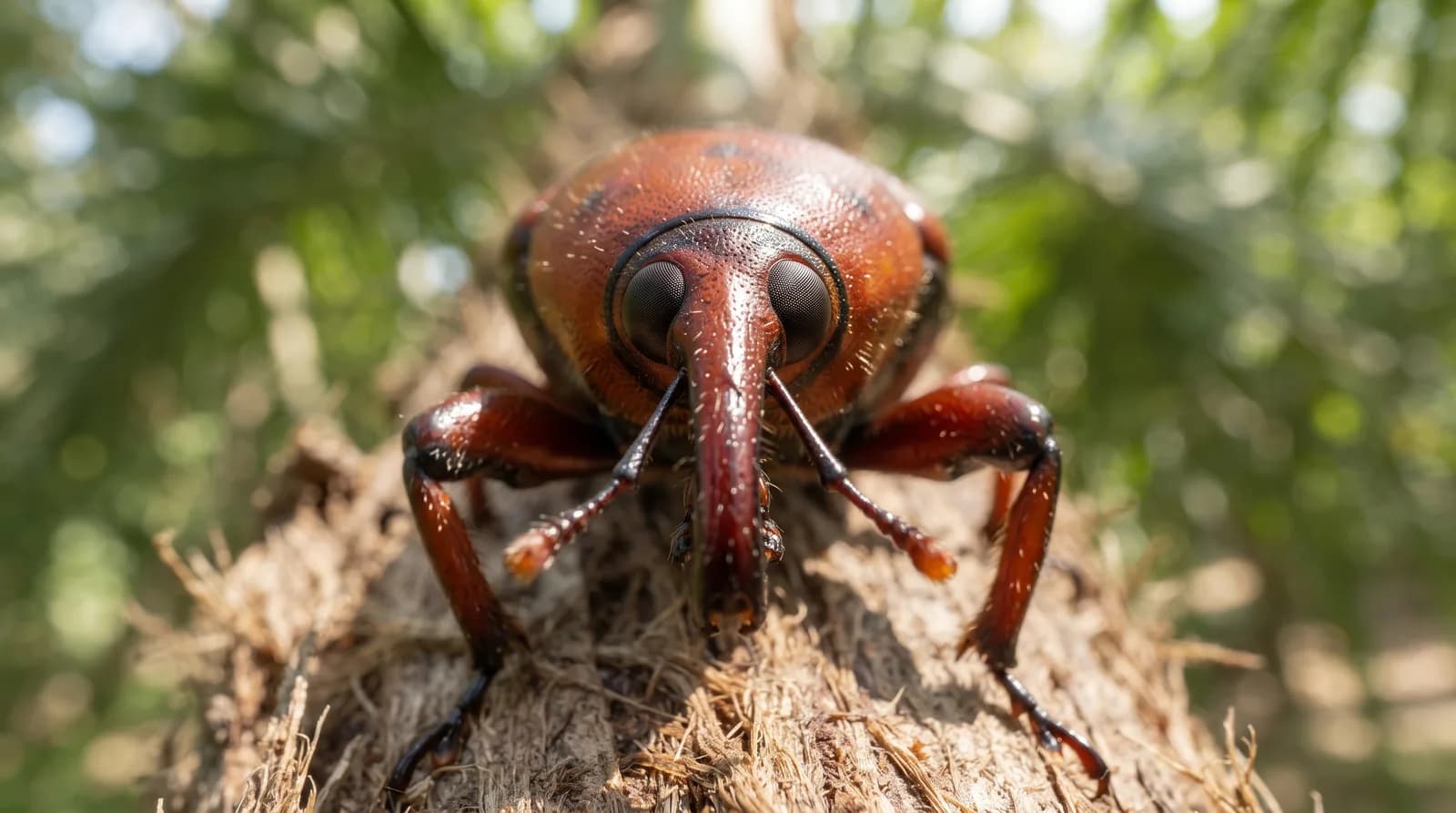
The boll weevil is a beetle some six millimetres long that feeds on the buds and flowers of cotton. It is believed to be native to Central America, from where it migrated to the United States by way of Mexico in the late nineteenth century, and by the 1920s it had already infested every cotton-growing area in the United States, seriously affecting the industry and the people who worked in the American South. During the late twentieth century it became a major pest in South America. Since 1978, the Boll Weevil Eradication Program in the United States has allowed cotton growing to resume on its full scale across many areas.

Size

0.4 cm – 0.8 cm

Diet

Herbivore

Feeds mainly on plants.

Activity

Diurnal

Active mainly during the day.

Social structure

Solitary

Lives and hunts alone, joining others only to breed.

Sighting difficulty

Unknown

Grassland
18countries2same family

Fun facts

  • The town of Enterprise, Alabama, raised a monument in its honour in 1919: the pest forced farmers to diversify into peanuts and they fared far better than they had with cotton.
  • A decades-long eradication programme based on pheromone traps and coordinated treatments has removed it from almost all of the United States, one of the few cases of a pest eradicated at continental scale.
  • The adults overwinter hidden in the leaf litter at the field margins and reappear with the following crop.
  • It is the most destructive agricultural pest in the history of the United States. It entered from Mexico around 1892 through Brownsville, Texas, and in the five years following contact, cotton production would fall by around 50% in each affected area.
  • Its cumulative impact has been put at more than 16 billion dollars up to 2009, around 91 billion adjusted to current prices.
  • It changed the social history of the South: it ruined hundreds of landowners and pushed sharecroppers and labourers to leave for the north, in what is known as the Great Migration.
  • And it has a monument. In 1919 the townspeople of Enterprise, Alabama, put up a statue in its honour, thanking it for forcing them to abandon the cotton monoculture and switch to peanuts. It is the world's first monument dedicated to an agricultural pest.
  • The national eradication programme, begun in 1978, has eliminated it from almost the entire country; it holds out only in the lower Rio Grande valley, in Texas, and in northern Tamaulipas.
  • A single pair can leave two million descendants in one season.
  • Despite forty years of almost exclusive use of malathion in the eradication programme, it remains susceptible to that insecticide, something exceptional.

Life cycle and biology

Skeleton type
Invertebrate - chitin exoskeleton (insect)
Habitat and environment
Cotton crops and wild cottons
Size at birth
The larva is a white legless grub with a brown head that reaches about 12 mm before pupating inside the flower bud
Sexual maturity
The newly emerged adult feeds for about five days before mating; six to ten generations are completed a year depending on the region
Gestation / incubation
The eggs hatch in 2-5 days; the larva goes through four instars in 7-18 days and the pupa lasts 4 to 10 days; the full cycle ranges from 16 days at 32 °C to 46 days at 18 °C
Litter / clutch size
About 200 eggs per female over 10-12 days, with a recorded maximum of 251 at 25 °C; she normally lays a single egg per flower bud and seals the entrance with a mixture of faeces and secretion

Sources consulted: https://es.wikipedia.org/wiki/Anthonomus_grandis; Bugwoodwiki, Anthonomus grandis grandis; NCBI PMC10380894; LSU AgCenter, ficha Boll weevil; NCBI PMC10380894, tabla de vida en Brasil; Animal Diversity Web; Texas A&M, guia de insectos; Animal Diversity Web, Anthonomus grandis; IUCN GISD, ficha Anthonomus grandis; Bugwoodwiki

Where to find it

Best time: It overwinters in diapause in the leaf litter and returns to the cotton fields between March and July, with the emergence peak in late May

Loading map…

Related species

Other species in the catalogue with the most in common with Weevil — same habitat, park, country, tags or family.

Same taxonomic family
Related to
Related to
Related to
Related to

Keep exploring

Based on what we already know about weevil.

Comments

Share an experience, a fun fact or a tip for seeing the weevil.

Be the first to comment.
See full glossary
This page in other languages: Español · Deutsch · Français · Português · Italiano
See its range on the interactive map→
Red Palm WeevilNot Evaluated

Red Palm Weevil

Rhynchophorus ferrugineus

Not Evaluated

Granary Weevil

Sitophilus granarius

Vulnerable

Gopher Tortoise

Gopherus polyphemus

MonarchNot Evaluated

Monarch

Danaus plexippus

Red AdmiralLeast Concern

Red Admiral

Vanessa atalanta

SwallowtailLeast Concern

Swallowtail

Papilio machaon

CountriesArgentina
TagsHerbivore
Herbivore
Diurnal
Solitary
Insect
Grassland

North America12

South America6

Argentina
Belize
Bolivia
Brazil
Colombia
Costa Rica
Belize
Costa Rica
Cuba
Dominican Republic
El Salvador
Guatemala
Haiti
Honduras
Mexico
Nicaragua
Panama
United States
Argentina
Bolivia
Brazil
Colombia
Paraguay
Venezuela