Skip to content
WAnimals
  • Map
  • Species
  • Parks
  • Diving
Log inCreate account
WAnimals

The guide for travellers and animal lovers: discover, plan and share your wild adventures around the world.

Discover wildlife

  • Species
  • Ecosystems
  • Glossary
  • Tags

Explore places

  • Map
  • Countries
  • Parks
  • Diving

Plan experiences

  • Guides

Learn

  • Blog

Resources

  • Help centre
  • Contact
  • Install the app

Follow us

Account

  • Log in
  • Create account

© 2026 WAnimals. All rights reserved.

About usHow we build our profilesTerms of servicePrivacyLegal notice
MapSpeciesParksDiving
  1. Home
  2. Species
  3. Red Palm Weevil

One of the 2 weevils on WAnimals

Red Palm Weevil (Rhynchophorus ferrugineus)

Insects · Coleoptera · Curculionidae

Red Palm Weevil

Rhynchophorus ferrugineus

Not Evaluated

It has not yet been assessed against the IUCN criteria.

Spotted something wrong?

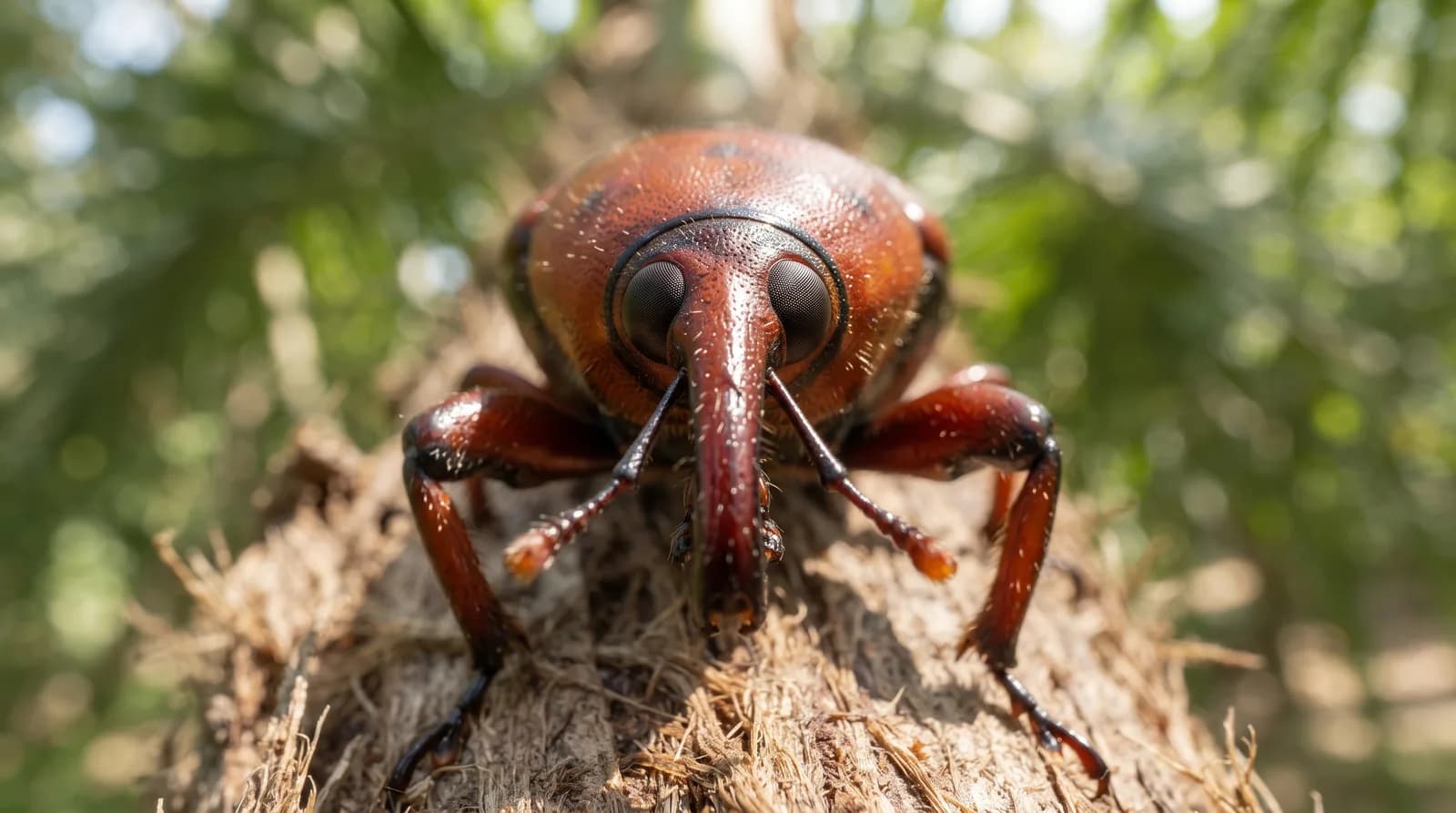
The red palm weevil is a beetle of the weevil family, native to tropical Asia. It is a large weevil, between two and five centimetres long, of a rusty red colour that makes it very distinctive.

Size

2 cm – 5 cm

Life expectancy

1 year

Diet

Herbivore

Feeds mainly on plants.

Activity

Diurnal

Active mainly during the day.

Social structure

Solitary

Lives and hunts alone, joining others only to breed.

Sighting difficulty

Unknown

Grassland
42countries2same family

AI-generated images: illustrations, not photographs.

Fun facts

  • By the time the visible symptoms appear, with the central leaves drooping or the crown collapsed, the palm is usually already lost: the larvae have been at work inside it for months.
  • One early-detection technique is to listen inside the trunk with acoustic sensors, because the sound of the larvae chewing is audible with the right equipment.
  • It has transformed the townscape of many Mediterranean cities and forced the felling of century-old palms all along the Spanish coast.
  • It reached Spain in 2005 and has killed tens of thousands of palms, above all Canary Island date palms and date palms, along the entire Mediterranean coast.
  • The damage is invisible until it is irreversible: the larva feeds on the inside of the trunk and the heart of the palm, and by the time the crown begins to droop the tree can no longer be saved.
  • A single palm can harbour hundreds of larvae at once.
  • It spread through the trade in transplanted adult palms, which travelled from one country to another already infested.
  • It is detected with traps baited with aggregation pheromone combined with plant bait, and also with acoustic methods: microphones that pick up the sound of the larvae gnawing inside the trunk.
  • In the Canary Islands its arrival amounted to a plant-health emergency because of the risk to the Canary Island date palm, which is endemic and a symbol of the archipelago.

Life cycle and biology

Skeleton type
Invertebrate - chitin exoskeleton (insect)
Habitat and environment
Palms, especially Canary Island and date palms
Size at birth
Creamy white egg, glossy and oval; the larva is legless and pear-shaped, with a brown head and thirteen segments, and bores galleries that can reach a metre
Sexual maturity
The final-instar larva pupates inside an elongated cocoon made of fibres from the palm itself, and the adult stays inside it for about another ten days before leaving
Gestation / incubation
The eggs hatch between 1 and 6 days; larval development lasts 40 to 60 days (84.6 on an artificial diet) and the pupa 20 to 30 days; the full cycle closes in 70-120 days
Litter / clutch size
More than 200 eggs per female over a life that can exceed four months; in the laboratory a mean fecundity of 211 eggs per female was measured. They are laid one by one in holes the female bores with her rostrum at the base of the palm fronds

Sources consulted: https://es.wikipedia.org/wiki/Rhynchophorus_ferrugineus; Bio-ecologia del picudo rojo (Generalitat Valenciana); estudio de cria en dieta artificial (Universidad de Almeria); Sistema Nacional de Vigilancia y Monitoreo de plagas; estudios de cria del picudo rojo en Espana; Koppert; Koppert, ficha Picudo rojo
Where to find it

Best time: The symptoms are not apparent until months after colonisation, by which time the palm is already severely damaged; in the Mediterranean basin its preferred host is Phoenix canariensis

Loading map…

Related species

Other species in the catalogue with the most in common with Red Palm Weevil — same habitat, park, country, tags or family.

Same taxonomic family
Related to
Related to
Related to
Related to

Keep exploring

Based on what we already know about red palm weevil.

Comments

Share an experience, a fun fact or a tip for seeing the red palm weevil.

Be the first to comment.

See full glossary
This page in other languages: Español · Deutsch · Français · Português · Italiano
See its range on the interactive map→
Not Evaluated

Weevil

Anthonomus grandis

Not Evaluated

Granary Weevil

Sitophilus granarius

Vulnerable

Gopher Tortoise

Gopherus polyphemus

Sacred ScarabNot Evaluated

Sacred Scarab

Scarabaeus sacer

Seven-spotted Lady BeetleNot Evaluated

Seven-spotted Lady Beetle

Coccinella septempunctata

MonarchNot Evaluated

Monarch

Danaus plexippus

CountriesAlgeria
TagsHerbivore
Herbivore
Diurnal
Solitary
Insect
Grassland

Asia25

Europe8

Africa5

North America3

Oceania1

Algeria
Aruba
Bahrain
Bangladesh
China
Croatia
Bahrain
Bangladesh
China
India
Indonesia
Iran
Iraq
Israel
Japan
Jordan
Kuwait
Lebanon
Malaysia
Myanmar
Oman
Pakistan
Philippines
Qatar
Saudi Arabia
Sri Lanka
Syria
Thailand
Türkiye
United Arab Emirates
Vietnam
Croatia
Cyprus
France
Greece
Italy
Malta
Portugal
Spain
Algeria
Egypt
Libya
Morocco
Tunisia
Aruba
Curaçao
United States
Papua New Guinea