Skip to content
WAnimals
  • Map
  • Species
  • Parks
  • Diving
Log inCreate account
WAnimals

The guide for travellers and animal lovers: discover, plan and share your wild adventures around the world.

Discover wildlife

  • Species
  • Ecosystems
  • Glossary
  • Tags

Explore places

  • Map
  • Countries
  • Parks
  • Diving

Plan experiences

  • Guides

Learn

  • Blog

Resources

  • About us
  • How we build our profiles
  • Help centre
  • Contact
  • Install the app

Follow us

Account

  • Log in
  • Create account

© 2026 WAnimals. All rights reserved.

Terms of servicePrivacyCookiesLegal notice
MapSpeciesParksDiving
  1. Home
  2. Species
  3. Sacred Scarab

One of the 24 beetles on WAnimals
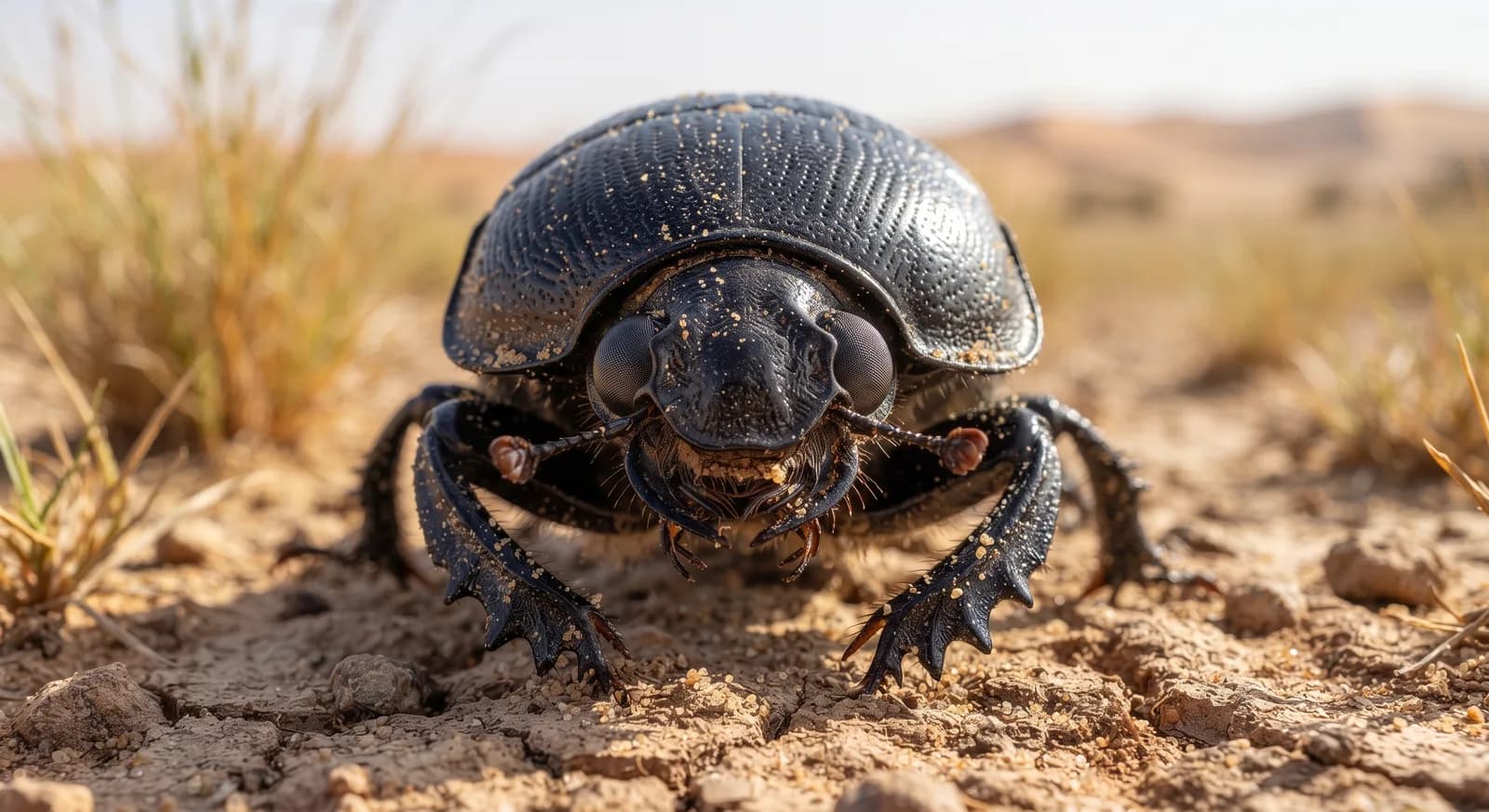
Sacred Scarab (Scarabaeus sacer)

Insects · Coleoptera · Scarabaeidae

Sacred Scarab

Scarabaeus sacer

Not Evaluated

It has not yet been assessed against the IUCN criteria.

Spotted something wrong?

The sacred scarab is a beetle of the family Scarabaeidae that lives in the coastal dunes and marshes of the Mediterranean basin. The dung beetle gathers balls of dung and rolls them to an underground nest to feed its young. That behaviour led the ancient Egyptians to compare it with the god Khepri and to regard it as a sacred animal.

Size

2 cm – 3.2 cm

Diet

Omnivore

Combines animal and plant food depending on availability.

Activity
Diurnal

Active mainly during the day.

Social structure

Solitary

Lives and hunts alone, joining others only to breed.

Grassland
62countries14parks8same family

AI-generated images: illustrations, not photographs.

Fun facts

  • sentidosAn African dung beetle of the same genus has been shown to keep a straight line while rolling its ball of dung by taking its bearings from the Milky Way at night, one of the few documented cases of stellar navigation in insects.
  • The ancient Egyptians associated it with the god Khepri and the rising sun: they saw in the ball the beetle pushes across the sand an image of the solar disc crossing the sky.
  • Dung beetles of the genus Scarabaeus steer while rolling their ball by the polarised light of the moon and, on moonless nights, by the glow of the Milky Way; navigation by the galaxy was demonstrated in the African species Scarabaeus satyrus.
  • Before setting off it climbs onto the ball and turns on top of it in a dance that lets it take a bearing and hold a straight line.
  • It is the sacred scarab of ancient Egypt. In the ball of dung it pushes the Egyptians saw the solar disc, and in the beetle the god Khepri, who rolled the sun across the sky each day; scarab amulets are among the most recognisable of Egyptian objects.
  • A close relative navigates by the Milky Way: an experiment in 2013 showed that this African beetle rolls its ball in a straight line guided by the luminous band of our galaxy, the first animal shown to use the Milky Way for orientation.
  • It rolls in a straight line on purpose: it is not heading for a destination, it is trying to get away from the dung heap as fast as possible before another beetle steals its ball.
  • Before setting off it climbs on top of the ball and performs an orientation dance, rotating on the spot to take its bearings from the sky.
  • Its front legs are toothed like spades and lack tarsi, adapted for digging and for shaping the ball.
  • The female buries a brood ball and lays a single egg inside; the larva develops by eating the dung from within.

Life cycle and biology

Skeleton type
Invertebrate - chitin exoskeleton (insect)
Habitat and environment
Mediterranean grassland, dehesa and sandy ground where livestock is present

Sources consulted: Wikipedia (es): Scarabaeus sacer

Where to find it

Best time: Spring and early summer, in grassland with livestock

Loading map…

Where to see it

Parks and dive sites where this species has been documented — showing 10 of 14.

Related species

Other species in the catalogue with the most in common with Sacred Scarab — same habitat, park, country, tags or family.

Same taxonomic family
Shares a park
Shares a park

Keep exploring

Based on what we already know about sacred scarab.

Share an experience, a fun fact or a tip for seeing the sacred scarab.
See full glossary
This page in other languages: Español · Deutsch · Français · Português · Italiano

The pins mark the parks where its presence is documented.

See its range on the interactive map→
Doñana National ParkSpain
IchkeulTunisia
Ebro DeltaSpain
Cabo de Gata-NíjarSpain
ParnithaGreece
SounionGreece
El KalaAlgeria
White DesertEgypt
Gebel ElbaEgypt
Wadi El RayanEgypt
See all 14 parks
Not Evaluated

Bull-headed Dung Beetle

Onthophagus taurus

Rose ChaferNot Evaluated

Rose Chafer

Cetonia aurata

Common CockchaferNot Evaluated

Common Cockchafer

Melolontha melolontha

European Rhinoceros BeetleNot Evaluated

European Rhinoceros Beetle

Oryctes nasicornis

Red KiteLeast Concern

Red Kite

Milvus milvus

Least Concern

Common Chaffinch

Fringilla coelebs

CountriesEgypt
ParksDoñana National ParkSpain
TagsOmnivore
Omnivore
Diurnal
Solitary
Insect
Grassland

Africa49

Asia10

Europe3

Egypt
Spain
Tunisia
Greece
Morocco
Algeria
Algeria
Angola
Benin
Botswana
Burkina Faso
Burundi
Cameroon
Central African Republic
Chad
Côte d’Ivoire
Democratic Republic of the Congo
Djibouti
Egypt
Equatorial Guinea
Eritrea
Eswatini
Ethiopia
Gabon
Gambia
Ghana
Guinea
Guinea-Bissau
Kenya
Lesotho
Liberia
Libya
Madagascar
Malawi
Mali
Mauritania
Morocco
Mozambique
Namibia
Niger
Nigeria
Republic of the Congo
Rwanda
Senegal
Sierra Leone
Somalia
South Africa
South Sudan
Sudan
Tanzania
Togo
Tunisia
Uganda
Zambia
Zimbabwe
Bahrain
Iraq
Kuwait
Mongolia
Qatar
Saudi Arabia
Türkiye
United Arab Emirates
Uzbekistan
Yemen
Greece
North Macedonia
Spain