One of the 6 flamingos on WAnimals
Birds · Phoenicopteriformes · Phoenicopteridae
Chilean Flamingo
Phoenicopterus chilensis
It could become endangered in the near future if current threats go unchecked. See full glossary
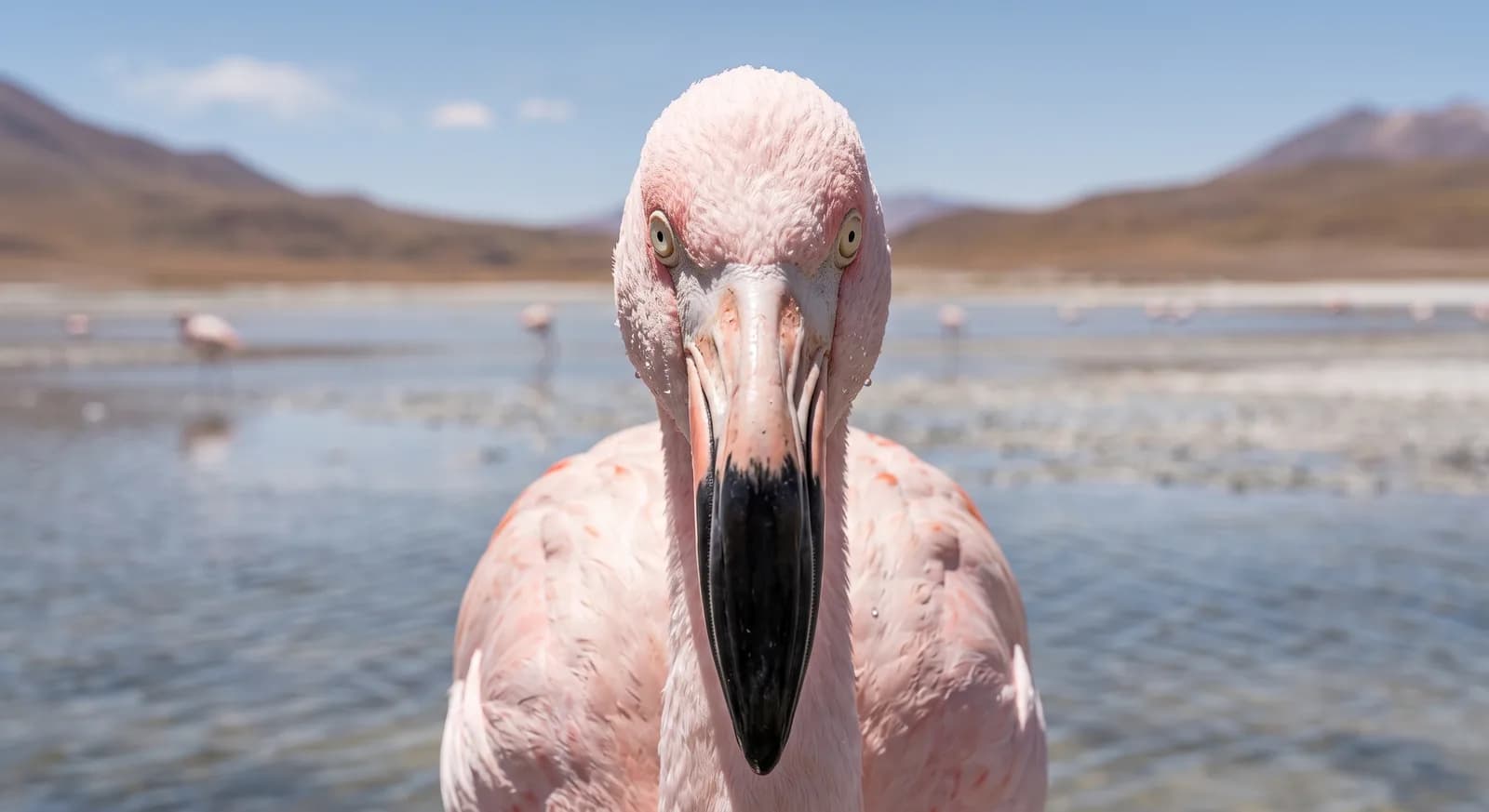
A flamingo with pale salmon-pink plumage, darker towards the tail. The bill is large and curved, pale at the base and black at the tip. Its legs are greyish with intensely red joints and webbing, a feature that identifies it at once against the Andean flamingos. The eyes are yellow.
Weight
2.5 kg – 3.5 kg
Diet
Carnivore
Feeds mainly on other animals.
Activity
Diurnal
Active mainly during the day.
Social structure
Colony
Lives in large concentrations, often for breeding reasons.
Sighting difficulty
Moderate
Estimated population
The Chilean population is thought to be around 30,000 individuals, most of them on the altiplano in the north of the country
Fun facts
- It is the flamingo species that lives and breeds furthest south in the world.
- It needs a colony of at least 15-18 individuals to breed successfully: they all mate at the same time so that the clutches coincide.
- It spends far more time preening than other flamingos, because the climate where it lives is a good deal colder than the Caribbean.
Life cycle & biology
- Skeleton type
- Vertebrate - internal bony skeleton (bird)
- Habitat & environment
- Brackish or semi-brackish lakes and lagoons, as well as coastal lagoons, intertidal marshes, lagoons behind sandbars, estuaries and shallow bays. From sea level up to 4,800 m. On freshwater lakes only temporarily or on migration
- Size at birth
- A white egg of about 93 x 52 mm
- Sexual maturity
- At around 6 years
- Gestation / incubation
- 26-31 days, with both parents incubating
- Litter / clutch size
- A single white egg. The chicks leave the nest at 5-8 days and gather in crèches. For breeding to succeed the colony needs at least 15-18 individuals, which synchronise their laying
Sources consulted: IUCN Red List; SIB - Parques Nacionales de Argentina; Ministerio del Medio Ambiente de Chile (RCE, 15.º proceso); Museo de Historia Natural de Concepción; Couve, Vidal y Ruiz 2016; Marconi et al. 2011; Molina 1782
Where to find it
See its range on the interactive mapBest time: All year round; it nests on Andean lagoons between 2,000 and 4,800 m
Where to watch it
Parks and dive sites where this species has been documented.
Related species
Other species in the catalogue with the most in common with Chilean Flamingo — same habitat, park, country, tags or family.
 Near Threatened
James's Flamingo
Phoenicoparrus jamesi
 Vulnerable
Andean Flamingo
Phoenicoparrus andinus
Guanay Cormorant
Leucocarbo bougainvilliorum
Peruvian Pelican
Pelecanus thagus
 Least Concern
American Flamingo
Phoenicopterus ruber
Lesser Rhea
Rhea pennata
Keep exploring
Based on what we already know about chilean flamingo.
Comments
Share an experience, a fun fact or a tip for seeing the chilean flamingo.
Be the first to comment.