One of the 2 mojarras on WAnimals
Bony fish · Perciformes · Sparidae
Common Two-banded Seabream
Diplodus vulgaris
The species is abundant and widely distributed; it faces no significant short-term risk. See full glossary
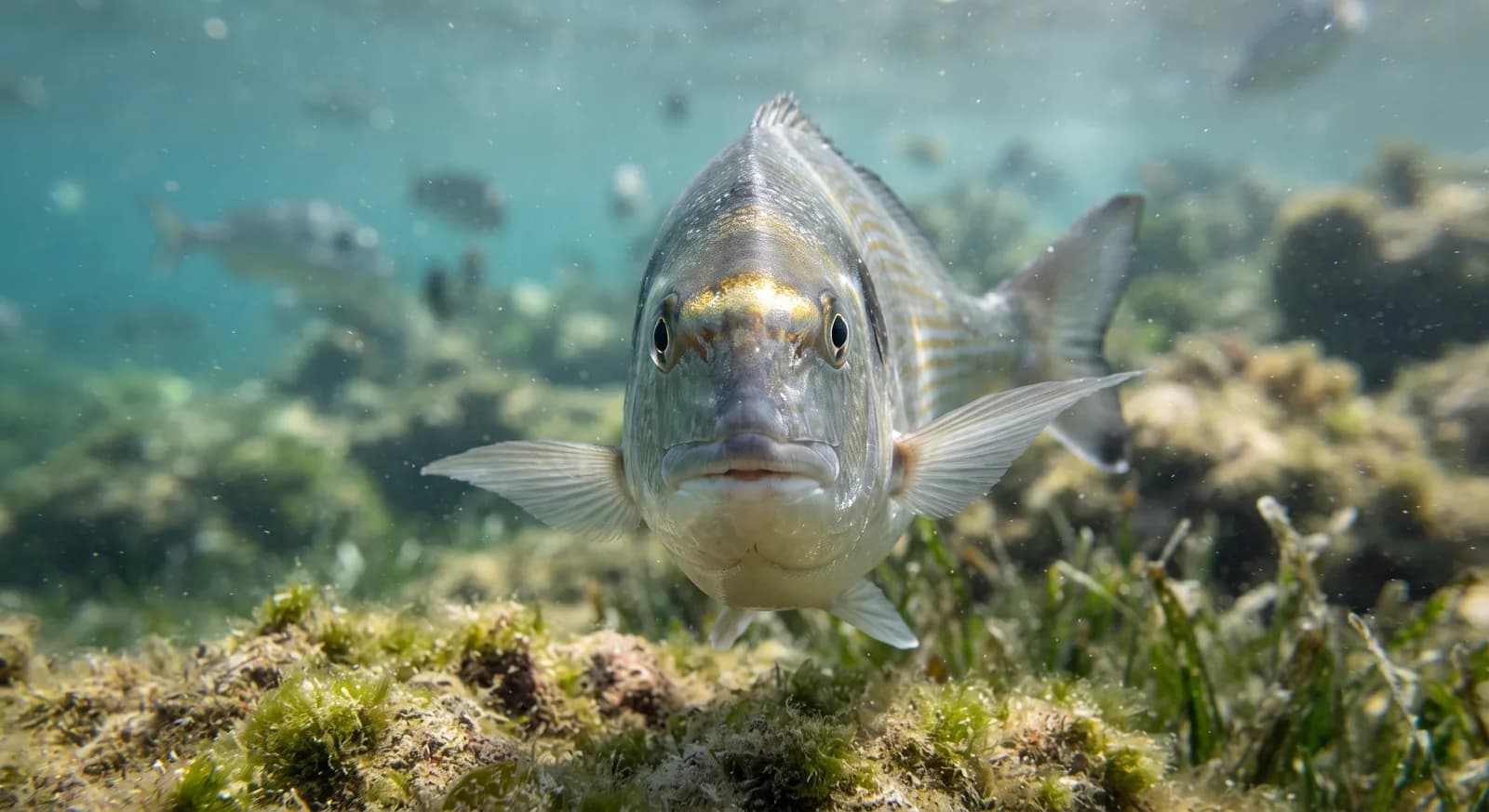
The sharpsnout seabream is an oval, silvery sparid with two broad black bands, one behind the head and one on the caudal peduncle. It lives on rocky bottoms and in Posidonia meadows of the Mediterranean and the nearby Atlantic, where it forms groups and eats invertebrates that it prises off the substrate.
Weight
up to 1.3 kg
Size
15 cm – 45 cm
Diet
Carnivore
Feeds mainly on other animals.
Social structure
School
Gathers in coordinated schools, typical of fish.
Sighting difficulty
Easy
Fun facts
- GeneralIt is known by two black bars, one on the nape and one on the tail.
- It is hermaphroditic: many individuals function first as males and later as females.
- It is one of the commonest fish on Mediterranean coastal dives and approaches divers without fear.
- It is a protandrous hermaphrodite: it matures first as a male and part of the population later changes to female.
- It spawns between October and February, peaking in December and January, the opposite of most Mediterranean sea breams.
- It is a euryhaline species that withstands large changes in salinity and reaches maturity without hormonal treatment, which makes it of interest for aquaculture.
Life cycle & biology
- Habitat & environment
- Rocky bottoms and Posidonia meadows
- Sexual maturity
- Length at first maturity 16.6 cm; in the Gulf of Gabès, 14.1 cm in females and 13.6 cm in males
Sources consulted: https://es.wikipedia.org/wiki/Diplodus_vulgaris
Where to find it
See its range on the interactive mapWhere to watch it
Parques y spots de buceo donde se ha documentado esta especie — se muestran 10 de 38 documentados.
Related species
Other species in the catalogue with the most in common with Common Two-banded Seabream — same habitat, park, country, tags or family.
White Seabream
Diplodus sargus
Pandora
Pagellus erythrinus
Saupe
Sarpa salpa
 Least Concern
Gilthead
Sparus aurata
Dentex
Dentex dentex
European Anchovy
Engraulis encrasicolus
Keep exploring
Based on what we already know about common two-banded seabream.
Comments
Share an experience, a fun fact or a tip for seeing the common two-banded seabream.
Be the first to comment.