Bony fish · Perciformes · Sparidae
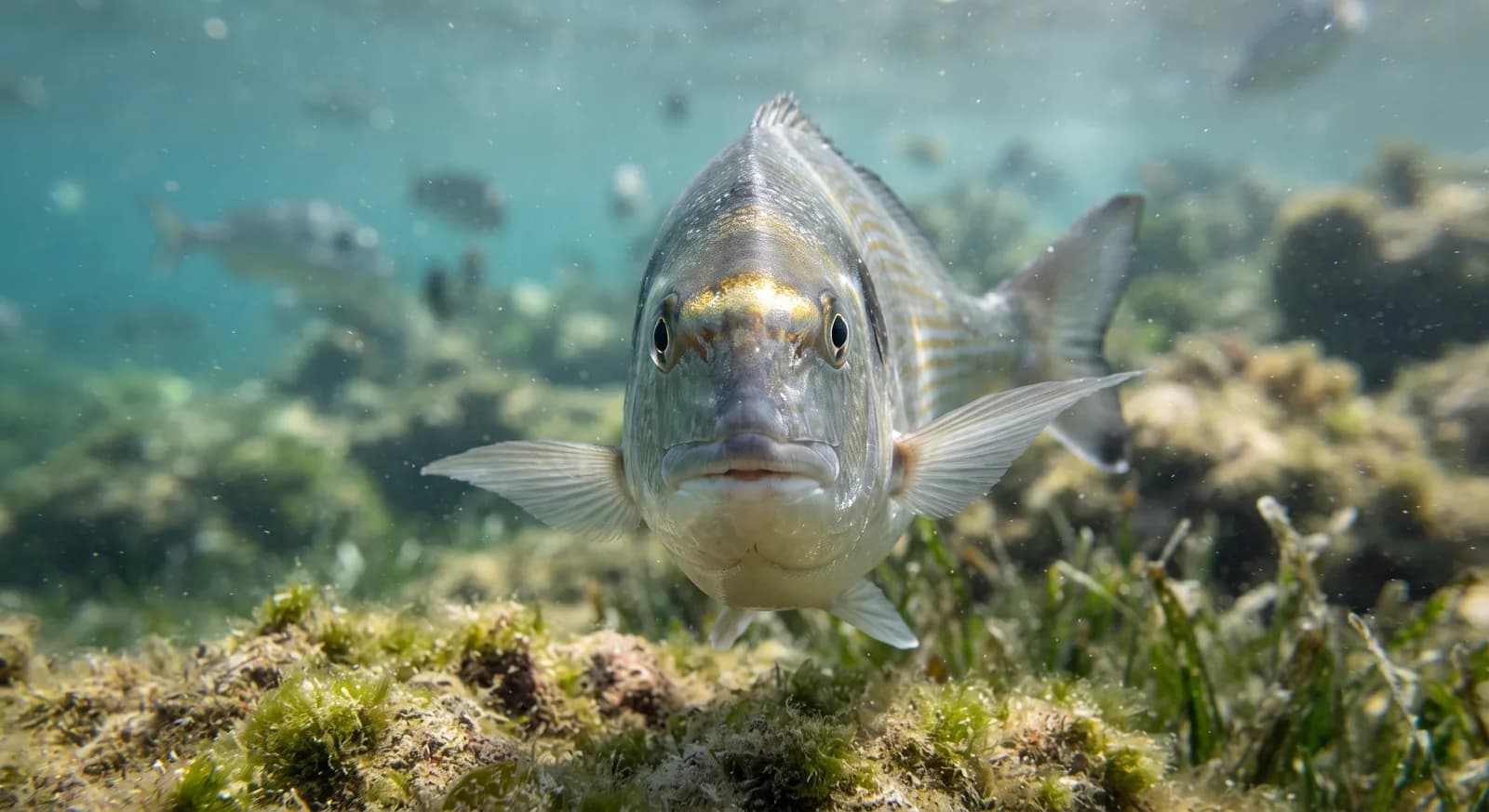
White Seabream
Diplodus sargus
The species is abundant and widely distributed; it faces no significant short-term risk. See full glossary
Weight
1 kg on average
Lifespan
11 years
Diet
Carnivore
Feeds mainly on other animals.
Social structure
School
Gathers in coordinated schools, typical of fish.
Sighting difficulty
Easy
Fun facts
- GeneralIt is hermaphroditic: it is born male, and many individuals change to female as they grow.
- It is one of the main predators of sea urchins in the Mediterranean, and where it is overfished the urchins multiply and strip the algal meadows.
- It attacks urchins with test diameters of up to 5 cm, larger than any other Mediterranean fish can manage.
Life cycle & biology
- Skeleton type
- Vertebrate - internal bony skeleton (bony fish)
- Habitat & environment
- Rocky bottoms and inshore Posidonia seagrass meadows
Sources consulted: https://es.wikipedia.org/wiki/Diplodus_sargus
Where to find it
See its range on the interactive mapWhere to watch it
Parques y spots de buceo donde se ha documentado esta especie — se muestran 20 de 110 documentados.
Related species
Other species in the catalogue with the most in common with White Seabream — same habitat, park, country, tags or family.
Pandora
Pagellus erythrinus
Saupe
Sarpa salpa
 Least Concern
Gilthead
Sparus aurata
Dentex
Dentex dentex
Common Two-banded Seabream
Diplodus vulgaris
European Anchovy
Engraulis encrasicolus
Keep exploring
Based on what we already know about white seabream.
Comments
Share an experience, a fun fact or a tip for seeing the white seabream.
Be the first to comment.