Bony fish · Perciformes · Sparidae
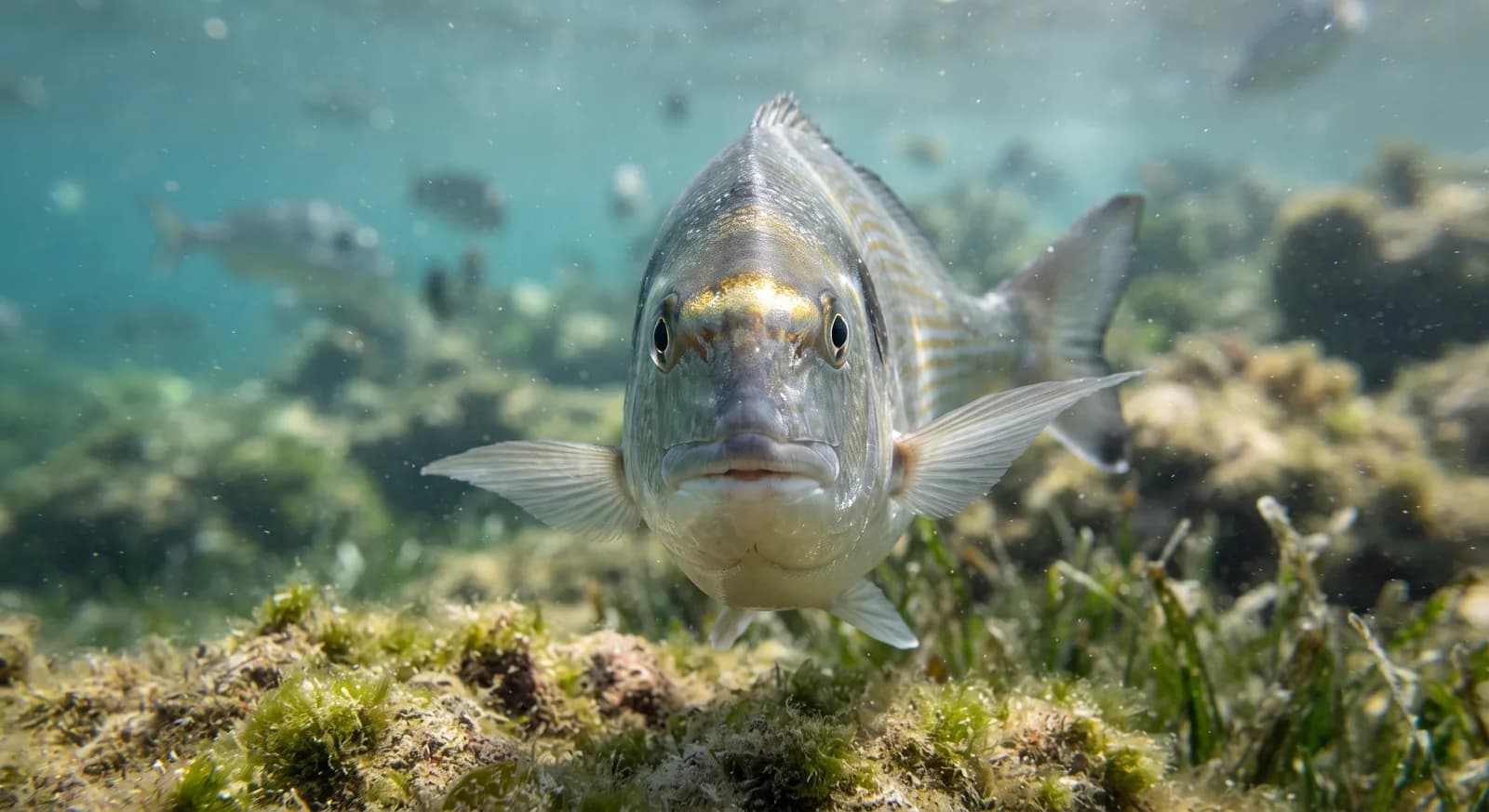
Saupe
Sarpa salpa
The species is abundant and widely distributed; it faces no significant short-term risk. See full glossary
Weight
up to 1.5 kg
Size
up to 51 cm
Diet
Herbivore
Feeds mainly on plants.
Social structure
School
Gathers in coordinated schools, typical of fish.
Sighting difficulty
Easy
Fun facts
- GeneralA plant-eater; at certain times of year its flesh can cause hallucinations if eaten.
- fisiologíaIt is a mainly plant-eating fish whose occasional consumption has historically been linked to mild, short-lived hallucinations, a phenomenon known as ichthyoallyeinotoxism.
- alimentaciónIt is one of the few Mediterranean fish that is mainly a plant-eater as an adult, living on algae and seagrass, unlike most of the carnivorous rock fish.
- It is a protandrous hermaphrodite: it matures as a male and changes to female on passing about 25 cm.
- The juveniles are carnivorous and eat crustaceans; the adults are almost entirely herbivorous and graze algae and seagrass.
- It forms very tight shoals that move in coordination over the meadows.
Life cycle & biology
- Skeleton type
- Vertebrate - internal bony skeleton (bony fish)
- Habitat & environment
- Seagrass meadows and shallow rocky bottoms
- Sexual maturity
- Length at first maturity 16.5 cm; in the Canary Islands males mature at around 22.6 cm and 2 years old and females at around 29.4 cm and 3 years old
Sources consulted: https://es.wikipedia.org/wiki/Sarpa_salpa
Where to find it
See its range on the interactive mapWhere to watch it
Parques y spots de buceo donde se ha documentado esta especie — se muestran 20 de 100 documentados.
Related species
Other species in the catalogue with the most in common with Saupe — same habitat, park, country, tags or family.
White Seabream
Diplodus sargus
Pandora
Pagellus erythrinus
 Least Concern
Gilthead
Sparus aurata
Dentex
Dentex dentex
Common Two-banded Seabream
Diplodus vulgaris
Pilchard
Sardina pilchardus
Keep exploring
Based on what we already know about saupe.
Comments
Share an experience, a fun fact or a tip for seeing the saupe.
Be the first to comment.