Bony fish · Perciformes · Carangidae
Leerfish
Lichia amia
The species is abundant and widely distributed; it faces no significant short-term risk. See full glossary
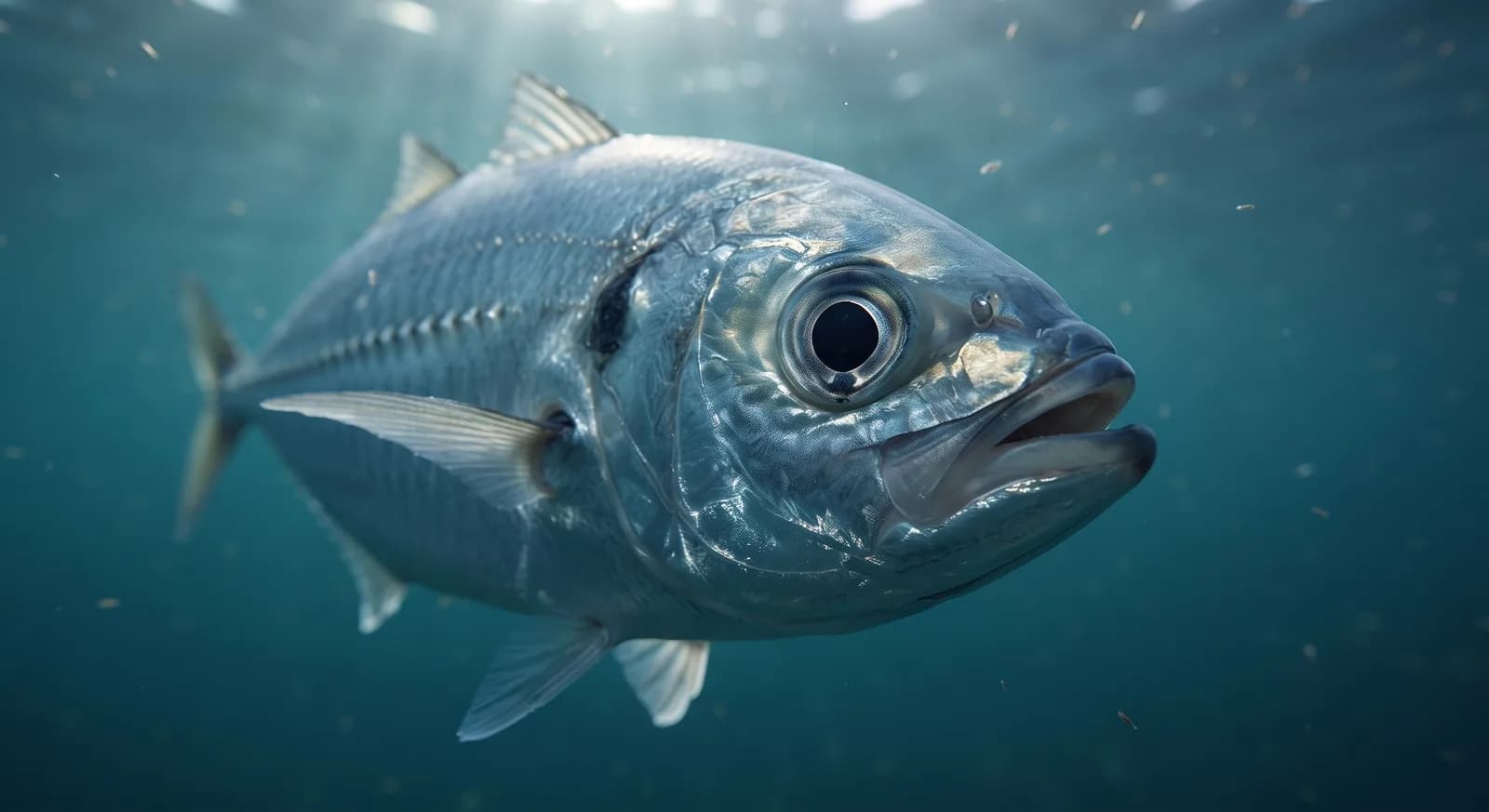
The leerfish is a large, silvery, laterally compressed jack, with a lateral line that runs in a strongly marked zigzag. It hunts in coastal waters, off beaches and at river mouths in the Mediterranean and the eastern Atlantic, chasing shoals of mullet and sardines right into the surf.
Weight
up to 50 kg
Size
60 cm – 2 m
Diet
Carnivore
Feeds mainly on other animals.
Social structure
Solitary
Lives and hunts alone, joining others only to breed.
Sighting difficulty
Easy
Fun facts
- GeneralA large inshore predator; it reaches 2 m and chases mullet through the surf.
- Its lateral line runs in a strongly marked zigzag, a feature that identifies it instantly against other jacks.
- The juveniles move into estuaries and brackish lagoons, where they grow before heading out to the open sea.
- It hunts in small groups in the surf zone, chasing mullet and anchovies.
- It is the only living representative of its genus.
- In South Africa it breeds in estuaries and moves out to sea once mature; some individuals run up the lower reaches of rivers such as the Kunene and the Orange.
Life cycle & biology
- Habitat & environment
- Coastal waters, beaches and river mouths
- Sexual maturity
- From about 60 cm
Sources consulted: FishBase (Froese & Pauly, eds.); Lista Roja de la UICN (evaluación de 2015)
Where to find it
See its range on the interactive mapWhere to watch it
Parques y spots de buceo donde se ha documentado esta especie — se muestran 10 de 40 documentados.
Related species
Other species in the catalogue with the most in common with Leerfish — same habitat, park, country, tags or family.
Crevalle Jack
Caranx hippos
Greater Amberjack
Seriola dumerili
 Vulnerable
Horse Mackerel
Trachurus trachurus
Moray Eel
Muraena helena
European Hake
Merluccius merluccius
Angler
Lophius piscatorius
Keep exploring
Based on what we already know about leerfish.
Comments
Share an experience, a fun fact or a tip for seeing the leerfish.
Be the first to comment.