Bony fish · Perciformes · Pomacentridae
Clown Anemonefish
Amphiprion ocellaris
It has not yet been assessed against the IUCN criteria. See full glossary
It is a protandrous sequential hermaphrodite: all are born male, and the dominant individual in each group turns into the one breeding female; if she dies, her male partner becomes female.
Size
up to 11 cm
Lifespan
6 years
Diet
Omnivore
Combines animal and plant food depending on availability.
Activity
Diurnal
Active mainly during the day.
Social structure
In pairs
Usually lives in pairs, sometimes for life.
Sighting difficulty
Unknown
Fun facts
- It lives in symbiosis with sea anemones, which shelter it from predators because it is immune to their stinging tentacles.
- It feeds on zooplankton, algae and scraps left by its host anemone.
- It became famous worldwide as the star of the film 'Finding Nemo'.
- comportamientoIt lives in a mutual partnership with stinging sea anemones, thanks to a special layer of mucus that protects it from their tentacles.
- All are born male. It is a protandrous hermaphrodite: the group is headed by a large female, followed by the breeding male, and the rest are non-breeding juveniles ranked by size. If the female dies, the male changes sex and takes her place, and the largest of the juveniles becomes the breeding male.
- The symbiosis with the anemone runs both ways: the anemone provides it with shelter and scraps of food, and the fish nourishes the anemone with its droppings and improves its oxygenation by stirring the water among the tentacles.
- It can occupy up to four anemone species: Heteractis magnifica, H. crispa, Stichodactyla gigantea and S. mertensii.
- The female lays her eggs on a surface next to the anemone, and the male guards them and fans them with his fins until they hatch.
- It is told apart from the true clownfish, Amphiprion percula, by having eleven dorsal spines instead of ten and thinner black edges to its bands.
- It is one of the few reef fishes bred successfully in captivity, which has greatly reduced collection pressure on wild populations.
Life cycle & biology
- Skeleton type
- Vertebrate - bony skeleton (fish)
- Habitat & environment
- Coral reefs and sheltered lagoons of the western Indo-Pacific, in symbiosis with sea anemones
- Birth weight
- An egg 3-4 mm long
- Size at birth
- A planktonic larva on hatching, which later drops down to settle in an anemone
- Sexual maturity
- Variable; it reaches maturity on becoming the dominant individual of its social group
- Gestation / incubation
- 6-10 days of egg development
- Litter / clutch size
- 100 to 1,518 eggs per spawning (~582 on average), repeated about every 2 weeks
Sources consulted: ScienceDirect (growth pattern study); Animal Diversity Web; A-Z Animals; Animalia.bio; Saltwater Aquarium Blog; Aquarium Source; PMC (egg clutch development study, lifespan evolution study)
Where to find it
See its range on the interactive mapWhere to watch it
Parques y spots de buceo donde se ha documentado esta especie — se muestran 20 de 135 documentados.
Related species
Other species in the catalogue with the most in common with Clown Anemonefish — same habitat, park, country, tags or family.
Banded Humbug
Dascyllus aruanus
Spotted Seahorse
Hippocampus kuda
Emperor Angelfish
Pomacanthus imperator
Yellow Boxfish
Ostracion cubicus
Moorish Idol
Zanclus cornutus
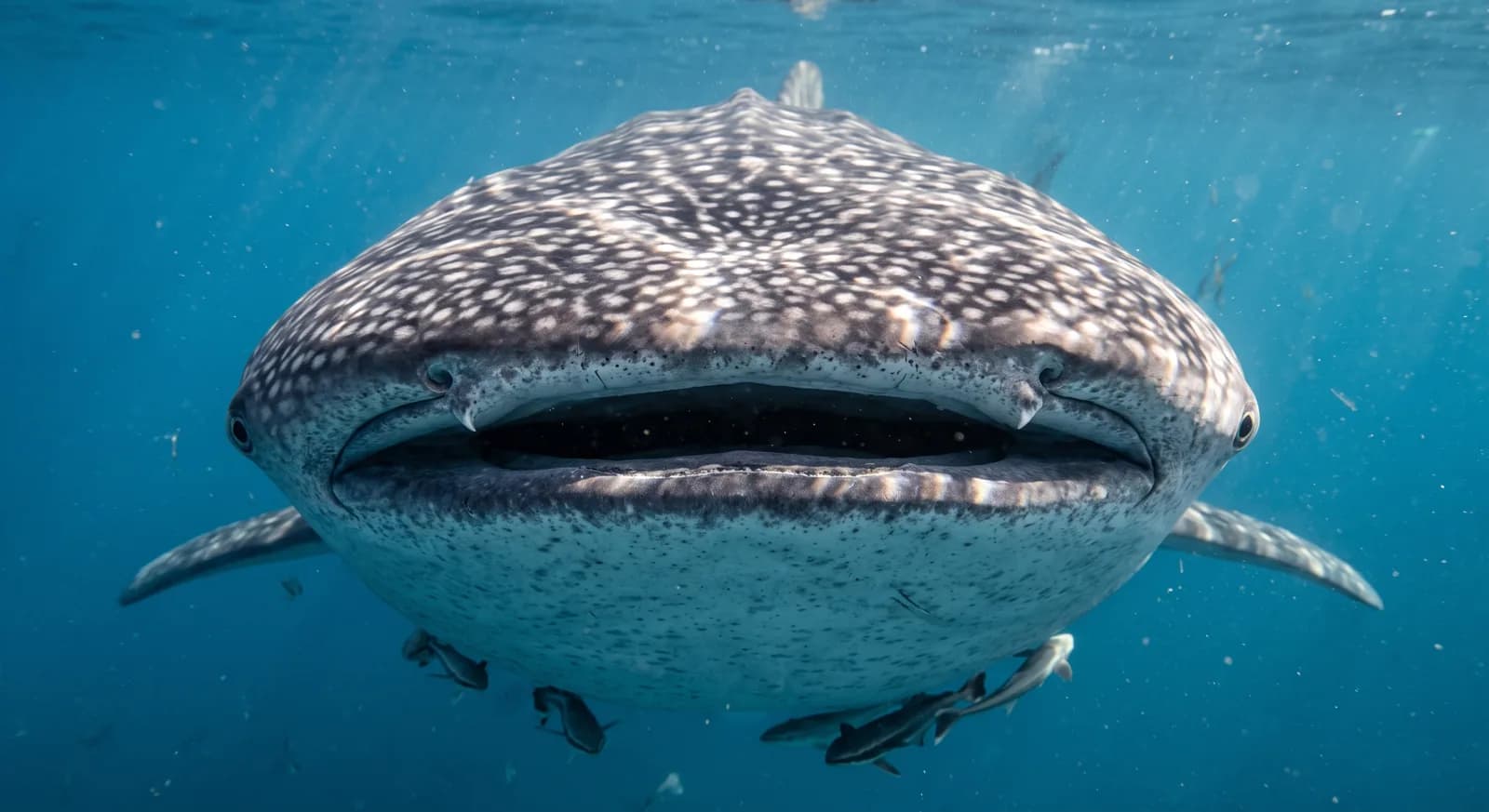 Endangered
Whale Shark
Rhincodon typus
Keep exploring
Based on what we already know about clown anemonefish.
Comments
Share an experience, a fun fact or a tip for seeing the clown anemonefish.
Be the first to comment.