Skip to content
WAnimals
  • Map
  • Species
  • Parks
  • Diving
Log inCreate account
WAnimals

The guide for travellers and animal lovers: discover, plan and share your wild adventures around the world.

Discover wildlife

  • Species
  • Ecosystems
  • Glossary
  • Tags

Explore places

  • Map
  • Countries
  • Parks
  • Diving

Plan experiences

  • Guides

Learn

  • Blog

Resources

  • About us
  • How we build our profiles
  • Help centre
  • Contact
  • Install the app

Follow us

Account

  • Log in
  • Create account

© 2026 WAnimals. All rights reserved.

Terms of servicePrivacyCookiesLegal notice
MapSpeciesParksDiving
  1. Home
  2. Species
  3. Species groups
  4. Dragonflies

Species group · Insects

Dragonflies

WAnimals has 4 species of dragonfly, spread across 3 families (Cordulegastridae, Gomphidae, Libellulidae).

4 species
3 families
118 countries
290 parks
Length
3.6 cm – 8.4 cm
Lifespan
1 – 5 years

Ranges calculated from the profiles that record the figure, not from all 4.

All 4 species of dragonflies on WAnimals

Each one has its own full profile. This group does not replace them: it brings them together.

Conservation status

3 Least Concern1 Not Evaluated

No species documented in this group is genuinely at risk according to the IUCN, with the data available today.

Where they live

Recorded in 118 countries. The ones with the most species in the group:

Where to see them

Did you know…?

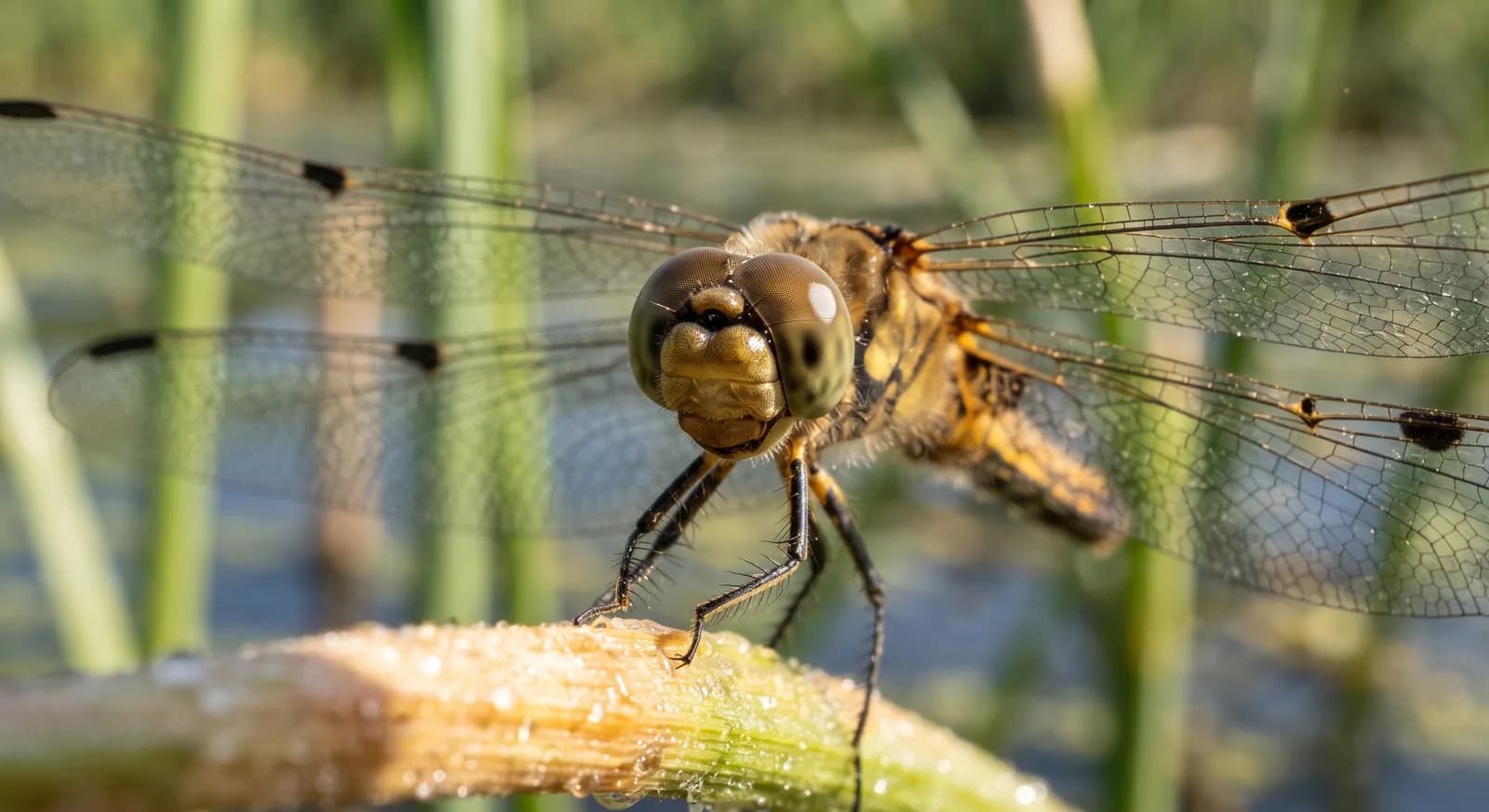
  • There is a form called praenubila with greatly exaggerated wing spots, which appears to depend on water temperature during the larval stage and is commoner in Europe than in America.

    From

  • It is the official state insect of Alaska.

    From

  • The males are markedly territorial: they post themselves on tall plants to watch the whole sheet of water and return to the same perch after every patrol.

    From

  • The female lays her eggs hanging vertically over the water and jabbing her abdomen repeatedly into the sand of the bottom, like a sewing machine.

    From

  • Its larva lives buried in the sediment of the stream for three to five years, and in cold mountain water it can take longer still.

    From

  • It needs clean, cool streams with bankside vegetation, and is an excellent indicator of headwaters in good condition.

    From

  • The clubtails are the only group of large European dragonflies whose eyes do not meet on top of the head, a feature that identifies them at a glance.

    From

Ecosystems

·

  • Its larva lives buried in the sand of the riverbed for three or four years, with only its eyes and antennae clear of the sediment.

    From

  • Four-spotted ChaserLeast Concern

    Four-spotted Chaser

    Libellula quadrimaculata

    46 countries155 parks
    Not Evaluated

    Golden-ringed Dragonfly

    Cordulegaster boltonii

    40 countries78 parks
    Least Concern

    Common Clubtail

    Gomphus vulgatissimus

    40 countries164 parks
    Least Concern

    Broad Scarlet

    Crocothemis erythraea

    109 countries112 parks
    Albania4
    Austria4
    Belarus4
    Belgium4
    Bosnia and Herzegovina4
    Bulgaria4
    Croatia4
    Czechia4
    Denmark4
    Estonia4
    Finland4
    France4
    Germany4
    Greece4
    Hungary4
    Ireland4
    Italy4
    Latvia4
    Lithuania4
    Luxembourg4
    Moldova4
    Montenegro4
    Netherlands4
    North Macedonia4
    Aiako Harria4 species
    Aigüestortes i Estany de Sant Maurici4 species
    Aizkorri-Aratz4 species
    Aralar4 species
    Armañón4 species
    Cadí-Moixeró4 species
    Fragas do Eume4 species
    Gorbeia4 species
    Montesinho4 species
    Montseny4 species
    Ordesa y Monte Perdido4 species
    Pagoeta4 species
    Four-spotted Chaser
    Four-spotted Chaser
    Four-spotted Chaser
    Golden-ringed Dragonfly
    Golden-ringed Dragonfly
    Golden-ringed Dragonfly
    Freshwater3
    Mountain1
    See every species group
    Explore the species one by one
    This page in other languages: Español · Deutsch · Français · Português · Italiano
    Common Clubtail
    Common Clubtail