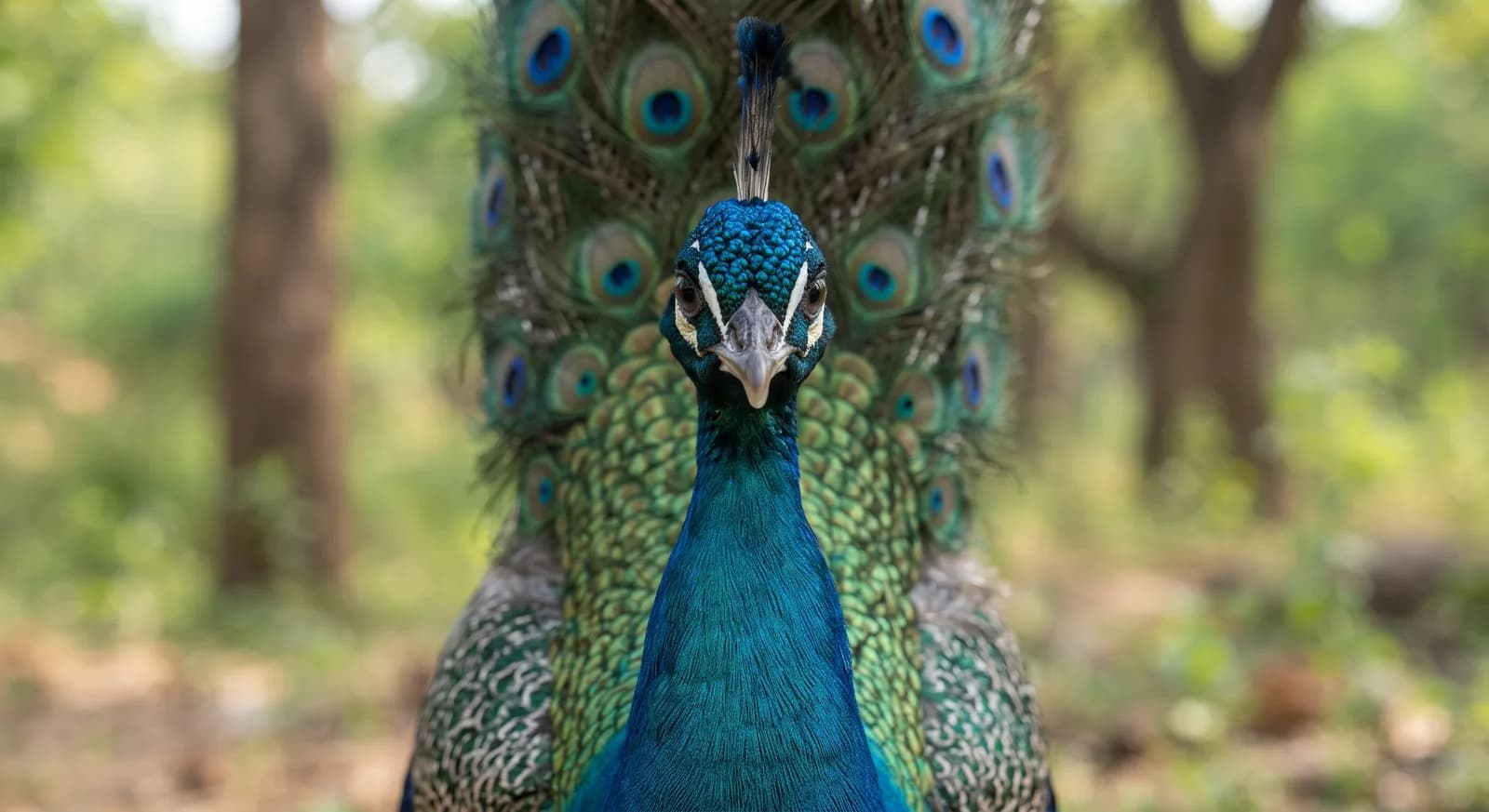
 Least Concern
Indian Peafowl
Pavo cristatus
37 countries34 parks
Species group · Birds
WAnimals has 4 species of peafowl, in the family Phasianidae.
Ranges calculated from the profiles that record the figure, not from all 4.
Each one has its own full profile. This group does not replace them: it brings them together.
2 species in this group are in a threatened category according to the IUCN.
Recorded in 52 countries. The ones with the most species in the group:
The fan is not the tail: it is made of the upper tail coverts, and the real tail is short, grey and hidden behind, holding the structure up from within.
From
The eyespots are not pigment: their colour comes from microscopic photonic crystals in the barbs of the feather, and shifts in tone with the angle of the light.
From
As the male spreads his fan he makes it vibrate, producing a low-frequency sound that females sense at a distance even when they cannot see it: the display is acoustic as well as visual.
From
Unlike the Indian peafowl, whose females are brown and unobtrusive, in this species both sexes are iridescent green: only the male grows the ornamental train.
From
The fan it spreads is not the tail but the upper tail coverts: the real tail is short and stays hidden behind, holding the structure up from within.
From
It is one of only two wild turkeys in the world, and the only one never domesticated: the turkey we eat descends from the other, the Mexican wild turkey.
From
The male does not gobble like the wild turkey: it gives a sequence of low thumps followed by a high, resonant crescendo, a sound heard at dawn among the Maya ruins of Yucatán and quite unlike its relative's.
·
From
It was discovered from two feathers: in 1913 James Chapin saw some striped feathers in a Congolese headdress that matched no known species, and in 1936 he happened to recognise two mislabelled stuffed specimens in a museum in Belgium. Only then did he travel to the Congo and find the living bird.
From

