 Least Concern
Common Vampire Bat
Desmodus rotundus
Mammals · Chiroptera · Phyllostomidae
Vampyrum spectrum
It could become threatened in the near future if current threats go unchecked.
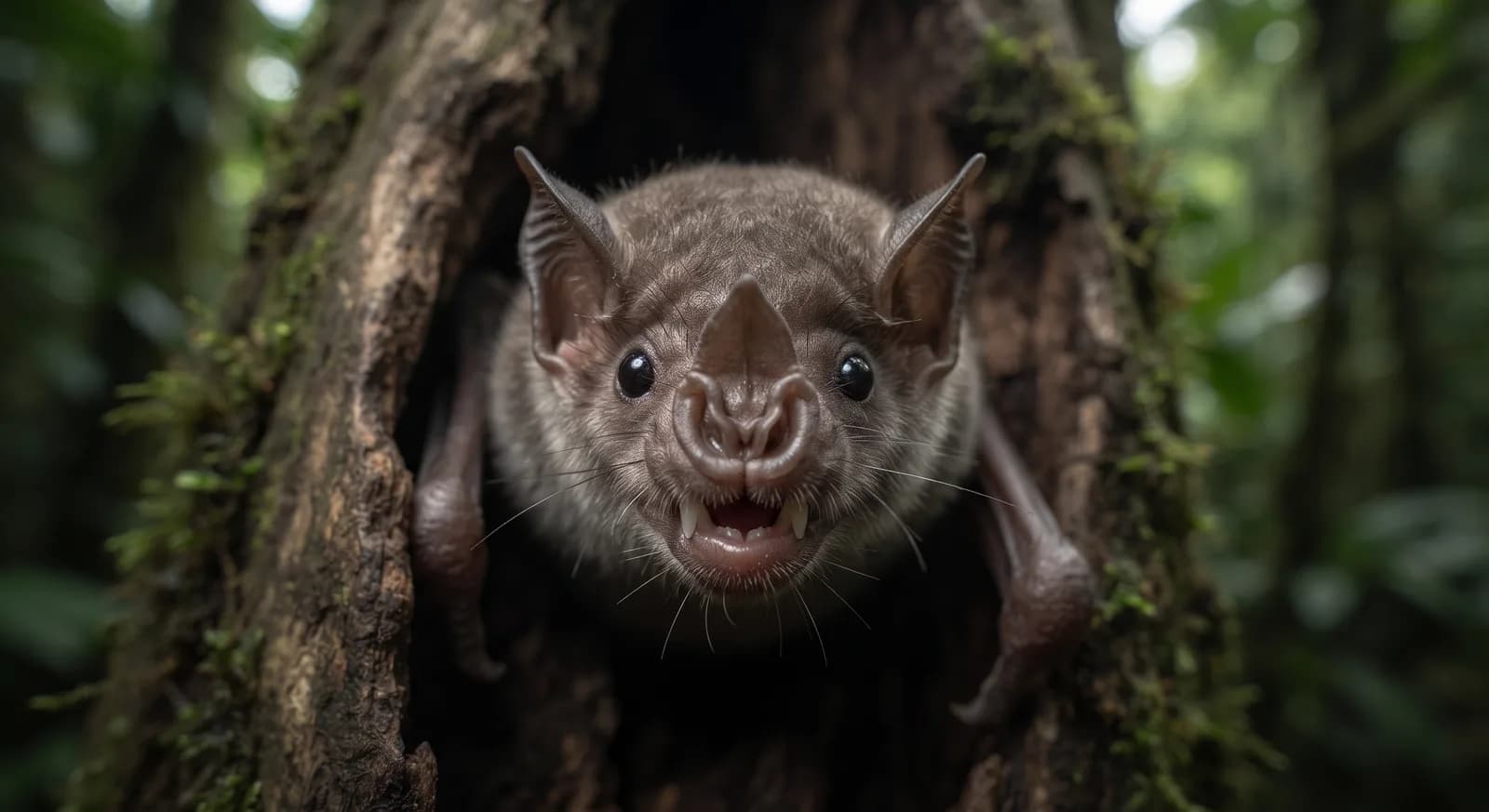
The spectral bat or false vampire bat is the largest bat in the Americas, with a wingspan that can approach a metre. Despite its name it does not drink blood: it is a predator that hunts sleeping birds, rodents, small opossums and other bats, which it locates by combining echolocation with very fine hearing. It lives in stable family groups made up of a pair and their young, which roost in the holes of large trees. It depends on mature forest and disappears when that forest is fragmented.
Weight
145 g – 190 g
Size
12.5 cm – 13.5 cm
Diet
Carnivore
Feeds mainly on other animals.
Activity
Nocturnal
Active mainly at night.
Social structure
In pairs
Usually lives in pairs, sometimes for life.
Sources consulted: IUCN Red List · Animal Diversity Web · Wikipedia (es)
Best time: All year round in the tropical forests of Central America and northern South America, at night; it roosts in tree hollows, in very small family groups.
Parks and dive sites where this species has been documented — showing 10 of 59.
Other species in the catalogue with the most in common with Spectral Bat — same habitat, park, country, tags or family.
Based on what we already know about spectral bat.
The pins mark the parks where its presence is documented.