One of the 3 black geese on WAnimals
Birds · Anseriformes · Anatidae
Barnacle Goose
Branta leucopsis
The species is abundant and widely distributed; it faces no significant short-term risk. See full glossary
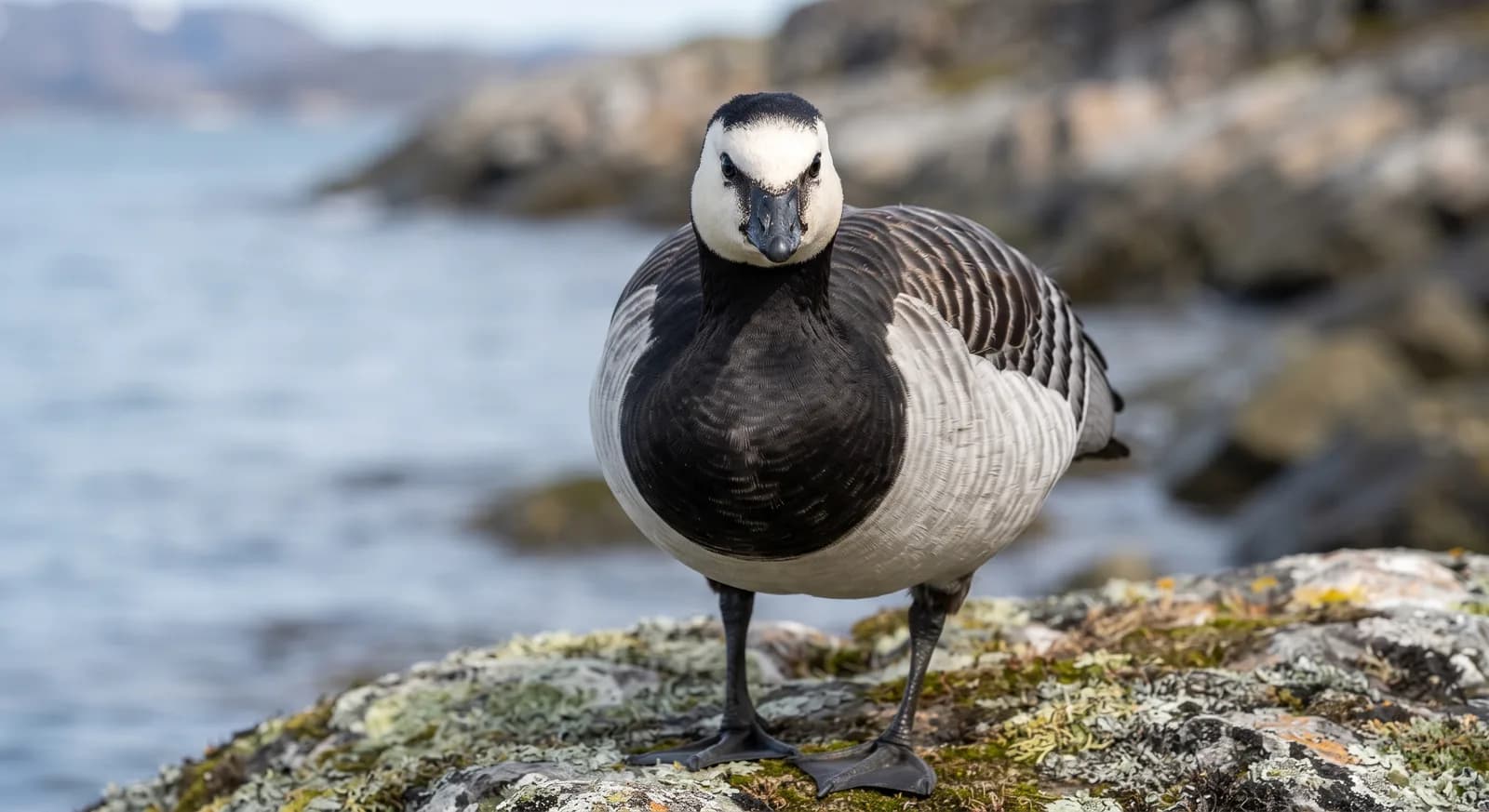
A medium-sized, compact-looking goose. Its unmistakable feature is the white face, contrasting with the rest of the head, the neck and the breast, which are black. The upperparts are pale grey with darker transverse barring, and the underparts white, separated from the black breast by a very clean line. Adults have more strongly barred flanks than young birds.
Weight
1.2 kg – 2.2 kg
Size
55 cm – 70 cm
Diet
Herbivore
Feeds mainly on plants.
Activity
Diurnal
Active mainly during the day.
Sighting difficulty
Easy
Estimated population
18,600-38,000 breeding pairs in the EU-27 and 633,000-804,000 wintering individuals
Fun facts
- GeneralIts chicks throw themselves off cliffs up to 100 m high within days of hatching, to reach the grass below.
- In Greenland it nests high on inaccessible cliffs to escape the Arctic fox and the polar bear, but that leaves the goslings far from food: since the adults do not feed them, three-day-old goslings throw themselves off the cliff and survive the fall thanks to their tiny weight and their down.
- Its name comes from a medieval belief: they were thought to be born from goose barnacle shells, because nobody knew they bred in the Arctic. The myth is documented from at least the 12th century.
- Despite closely resembling the brent goose, genetic analysis has shown that its nearest relative is the cackling goose.
Life cycle & biology
- Skeleton type
- Vertebrate - internal bony skeleton (bird)
- Habitat & environment
- Arctic tundra with cliffs, and coastal saltmarsh in winter
- Sexual maturity
- 2 years
- Litter / clutch size
- The nest is a shallow scrape on the ground, among the vegetation of rocky terrain, reused year after year and often near the nests of other seabirds
Sources consulted: IUCN Red List; SEO/BirdLife; Informe Art. 12 de la Directiva Aves (Agencia Europea de Medio Ambiente); European Red List of Birds 2015; Ottenburghs et al.; Asturnatura; Bechstein 1803; Scopoli 1769
Where to find it
See its range on the interactive mapBest time: In winter, when it occasionally reaches the wetlands of Galicia, the Villafáfila lagoons and the Guadalquivir marshes
Where to watch it
Parques y spots de buceo donde se ha documentado esta especie — se muestran 10 de 25 documentados.
Related species
Other species in the catalogue with the most in common with Barnacle Goose — same habitat, park, country, tags or family.
Eurasian Wigeon
Mareca penelope
Gadwall
Mareca strepera
Whooper Swan
Cygnus cygnus
Canada Goose
Branta canadensis
Red-crested Pochard
Netta rufina
 Least Concern
Mute Swan
Cygnus olor
Keep exploring
Based on what we already know about barnacle goose.
Comments
Share an experience, a fun fact or a tip for seeing the barnacle goose.
Be the first to comment.