One of the 9 guenons on WAnimals
Mammals · Primates · Cercopithecidae
Mona Monkey
Cercopithecus mona
It could become endangered in the near future if current threats go unchecked. See full glossary
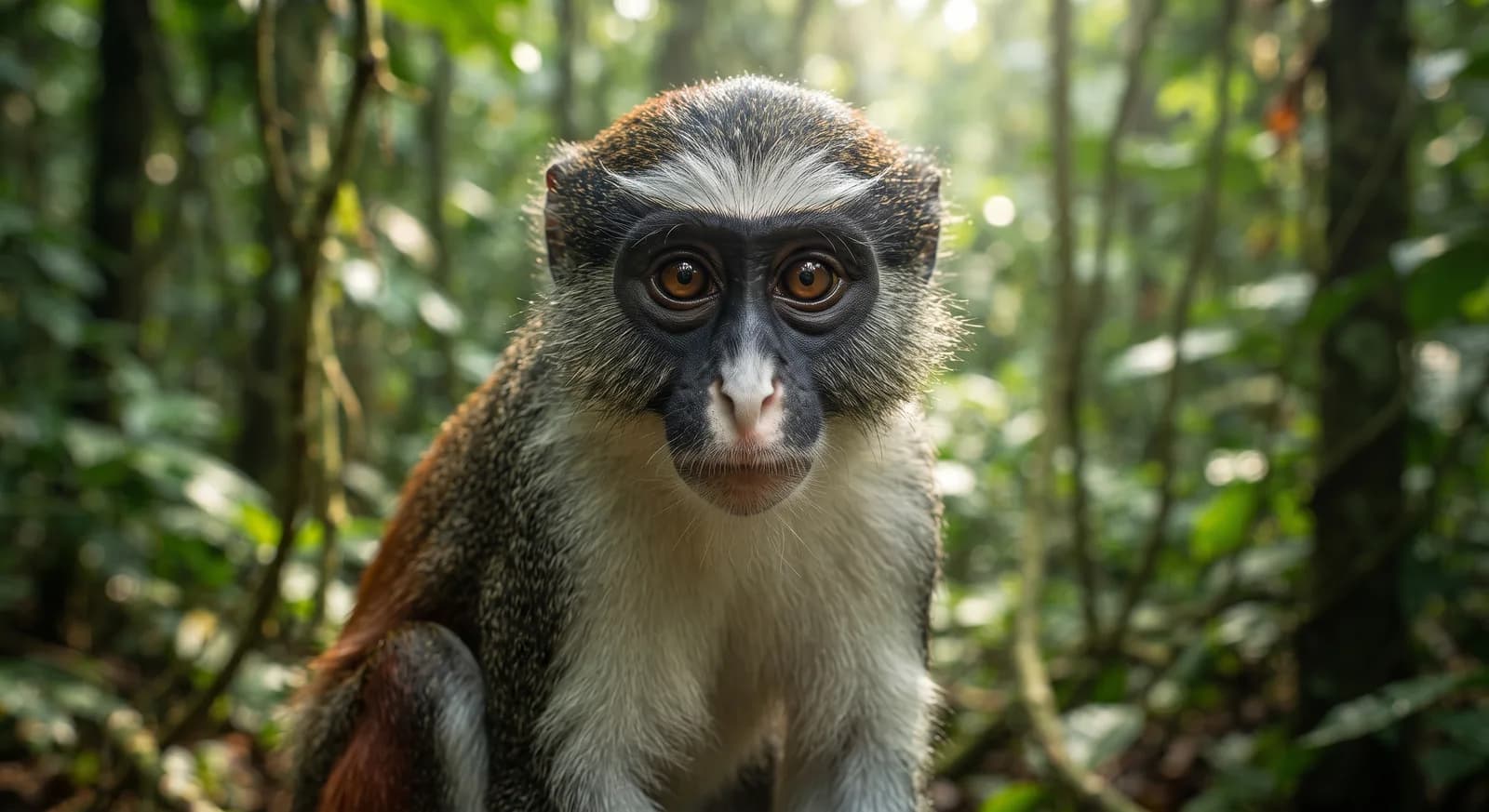
The mona monkey is a primate of the West African forests, with a reddish-chestnut back, black legs and tail and two very visible white patches on either side of the rump. It lives in groups in the canopy and eats fruit, leaves and insects. It was carried on the slave ships to the Antilles, and on the Caribbean island of Grenada there has been a feral population descended from those animals for centuries.
Weight
3 kg – 6 kg
Size
40 cm – 63 cm
Lifespan
30 years
Diet
Omnivore
Combines animal and plant food depending on availability.
Activity
Diurnal
Active mainly during the day.
Sighting difficulty
Moderate
Fun facts
- There is a feral population on the island of Grenada, in the Caribbean, descended from animals carried on slave ships from West Africa more than three hundred years ago.
- Its cheek pouches can hold as much fruit as its stomach, and it is often seen with its cheeks bulging with the haul as it flees a contested tree.
Life cycle & biology
- Skeleton type
- Vertebrate - internal bony skeleton (mammal)
- Habitat & environment
- Rainforest, gallery forest, mangrove and secondary forest of West Africa
- Sexual maturity
- 4 years
- Gestation / incubation
- 5.5 months
- Litter / clutch size
- 1
Sources consulted: https://es.wikipedia.org/wiki/Cercopithecus_mona
Where to find it
See its range on the interactive mapWhere to watch it
Parques y spots de buceo donde se ha documentado esta especie — se muestran 10 de 11 documentados.
Related species
Other species in the catalogue with the most in common with Mona Monkey — same habitat, park, country, tags or family.
Drill
Mandrillus leucophaeus
Putty-nosed Monkey
Cercopithecus nictitans
Preuss’s Monkey
Allochrocebus preussi
Red-capped Mangabey
Cercocebus torquatus
Campbell’s Monkey
Cercopithecus campbelli
 Vulnerable
Diana Monkey
Cercopithecus diana
Keep exploring
Based on what we already know about mona monkey.
Comments
Share an experience, a fun fact or a tip for seeing the mona monkey.
Be the first to comment.