Skip to content
WAnimals
  • Map
  • Species
  • Parks
  • Diving
Log inCreate account
WAnimals

The guide for travellers and animal lovers: discover, plan and share your wild adventures around the world.

Discover wildlife

  • Species
  • Ecosystems
  • Glossary
  • Tags

Explore places

  • Map
  • Countries
  • Parks
  • Diving

Plan experiences

  • Guides

Learn

  • Blog

Resources

  • About us
  • How we build our profiles
  • Help centre
  • Contact
  • Install the app

Follow us

Account

  • Log in
  • Create account

© 2026 WAnimals. All rights reserved.

Terms of servicePrivacyCookiesLegal notice
MapSpeciesParksDiving
  1. Home
  2. Species
  3. Olive Chiton
Olive Chiton (Chiton olivaceus)

Chitons · Chitonida · Chitonidae

Olive Chiton

Chiton olivaceus

Not Evaluated

It has not yet been assessed against the IUCN criteria.

Spotted something wrong?

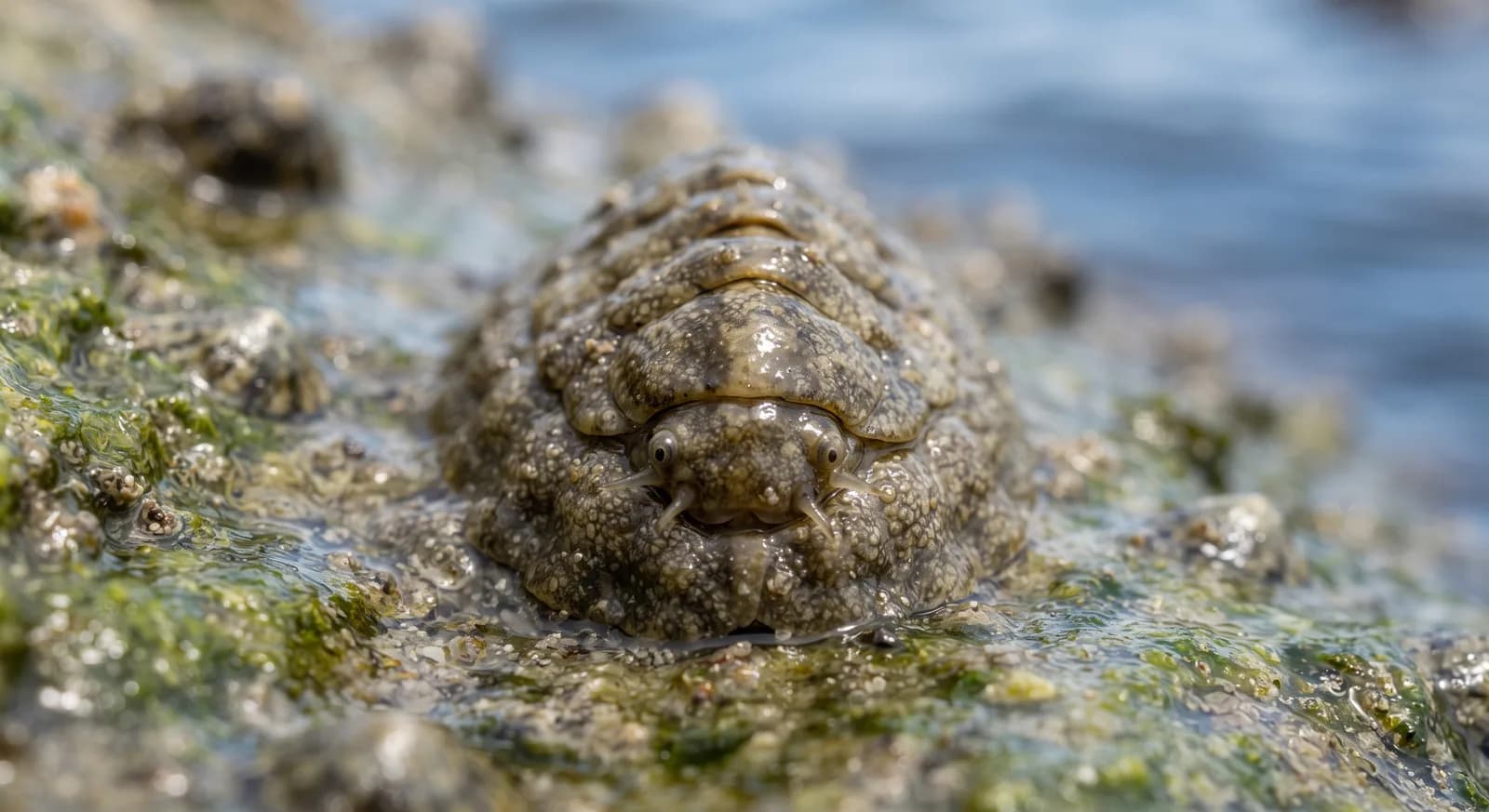
A Mediterranean chiton with an oval body protected by eight articulated calcareous plates ringed by a leathery girdle. It clings to the rock with enormous force and comes out at night to rasp algae with its radula. The articulated plates let it roll up on itself if it is dislodged.

Size

3 cm – 6 cm

Diet

Herbivore

Feeds mainly on plants.

Activity

Nocturnal

Active mainly at night.
Social structure

Solitary

Lives and hunts alone, joining others only to breed.

Ocean
21countries26parks62dive sites

AI-generated images: illustrations, not photographs.

Fun facts

  • The teeth of its radula are coated in magnetite, an iron mineral that makes them one of the hardest biological structures known and lets them scrape the rock.
  • It has light-sensitive organs distributed across the plates of the shell themselves.
  • Its shell is not one piece: it is eight articulated, overlapping calcareous plates joined by a muscular girdle. That structure lets it bend and mould itself to irregular surfaces without losing its grip, and roll into a ball if it is dislodged.
  • It has eyes in its shell. Chitons possess aesthetes, sensory organs that pass through the plates, and in some species these include complete eyes with aragonite lenses — that is, lenses made of mineral. It is the only known case of eyes with calcium-carbonate lenses.
  • The teeth of its radula are reinforced with magnetite, an iron mineral, which makes them the hardest teeth known alongside those of the limpet. With them it rasps the rock directly.
  • It returns to its spot as limpets do: it goes out to graze at night and comes back to the same position on the rock.
  • Chitons are an ancient, conservative lineage, with fossils from the Cambrian, and their anatomy is considered close to that of the earliest molluscs.

Life cycle and biology

Skeleton type
Invertebrate - shell of eight calcareous plates (mollusc)
Habitat and environment
Intertidal and shallow subtidal rocks of the Mediterranean

Sources consulted: Speiser, Eernisse y Johnsen (2011), Current Biology, sobre los ojos de aragonito · Marine Life Information Network · Fauna Ibérica

Where to find it

Loading map…

Where to see it

Parks and dive sites where this species has been documented — showing 20 of 88.

Related species

Other species in the catalogue with the most in common with Olive Chiton — same habitat, park, country, tags or family.

Shares a park
Shares a park
Shares a park
Shares a park
Shares a park
Shares a park

Keep exploring

Based on what we already know about olive chiton.

Share an experience, a fun fact or a tip for seeing the olive chiton.
See full glossary
This page in other languages: Español · Deutsch · Français · Português · Italiano

The pins mark the parks and dive sites where its presence is documented.

See its range on the interactive map→
Doñana National ParkSpain
CalanquesFrance
Cinque TerreItaly
Alonissos and the Northern SporadesGreece
Majjistral ParkMalta
Port-CrosFrance
Cabrera ArchipelagoSpain
Ebro DeltaSpain
Cíes IslandsSpain
BeydağlarıTürkiye
Zenobia WreckCyprus
Medes IslandsSpain
Cap de CreusSpain
Zakynthos (loggerhead turtle)Greece
Kastellorizo (Blue Cave)Greece
Malta (Blue Hole Gozo / Um El Faroud)Malta
Tavolara (Sardinia)Italy
Plemmirio Marine Reserve (Sicily)Italy
Vis Island (wrecks)Croatia
Kornati IslandsCroatia
See all 26 parks
See all 62 dive sites
Edible Sea UrchinNear Threatened

Edible Sea Urchin

Echinus esculentus

Atlantic Bobtail SquidNot Evaluated

Atlantic Bobtail Squid

Sepiola atlantica

Near Threatened

Thornback Ray

Raja clavata

Near Threatened

Common Stingray

Dasyatis pastinaca

Mediterranean MorayLeast Concern

Mediterranean Moray

Muraena helena

European HakeLeast Concern

European Hake

Merluccius merluccius

CountriesItaly
ParksDoñana National ParkSpain
TagsHerbivore
Herbivore
Nocturnal
Solitary
Ocean
Mollusc

Europe12

Africa5

Asia4

Italy
Spain
Greece
Croatia
France
Türkiye
Albania
Bosnia and Herzegovina
Croatia
Cyprus
France
Greece
Italy
Malta
Monaco
Montenegro
Slovenia
Spain
Algeria
Egypt
Libya
Morocco
Tunisia
Israel
Lebanon
Syria
Türkiye