Skip to content
WAnimals
  • Map
  • Species
  • Parks
  • Diving
Log inCreate account
WAnimals

The guide for travellers and animal lovers: discover, plan and share your wild adventures around the world.

Discover wildlife

  • Species
  • Ecosystems
  • Glossary
  • Tags

Explore places

  • Map
  • Countries
  • Parks
  • Diving

Plan experiences

  • Guides

Learn

  • Blog

Resources

  • Help centre
  • Contact
  • Install the app

Follow us

Account

  • Log in
  • Create account

© 2026 WAnimals. All rights reserved.

About usHow we build our profilesTerms of servicePrivacyLegal notice
MapSpeciesParksDiving
  1. Home
  2. Species
  3. Blue Mussel

One of the 3 mussels on WAnimals
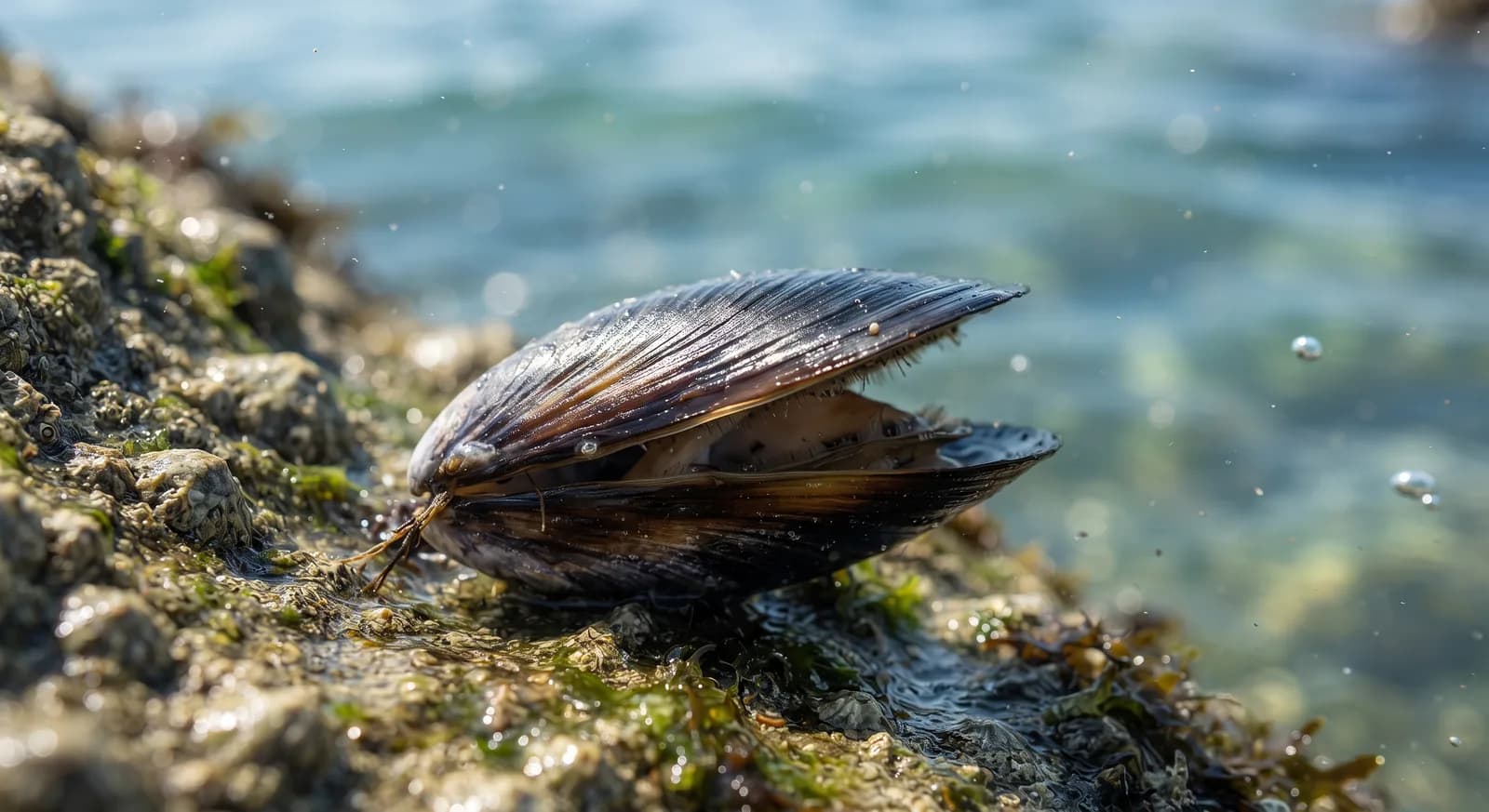
Blue Mussel (Mytilus edulis)

Bivalves · Mytilida · Mytilidae

Blue Mussel

Mytilus edulis

Not Evaluated

It has not yet been assessed against the IUCN criteria.

Spotted something wrong?

It can chemically detect the release of gametes by other mussels nearby, through specialised chemoreceptors. Younger mussels settle literally on top of older ones in the same bed.

Size

5 cm – 11 cm

Life expectancy

15 years

Diet

Herbivore

Feeds mainly on plants.
Activity

Irregular activity

Active at irregular times, by day or night depending on circumstances.

Social structure

Colony

Lives in large concentrations, often for breeding reasons.

Sighting difficulty

Unknown

Ocean
19countries21parks23dive sites1same family

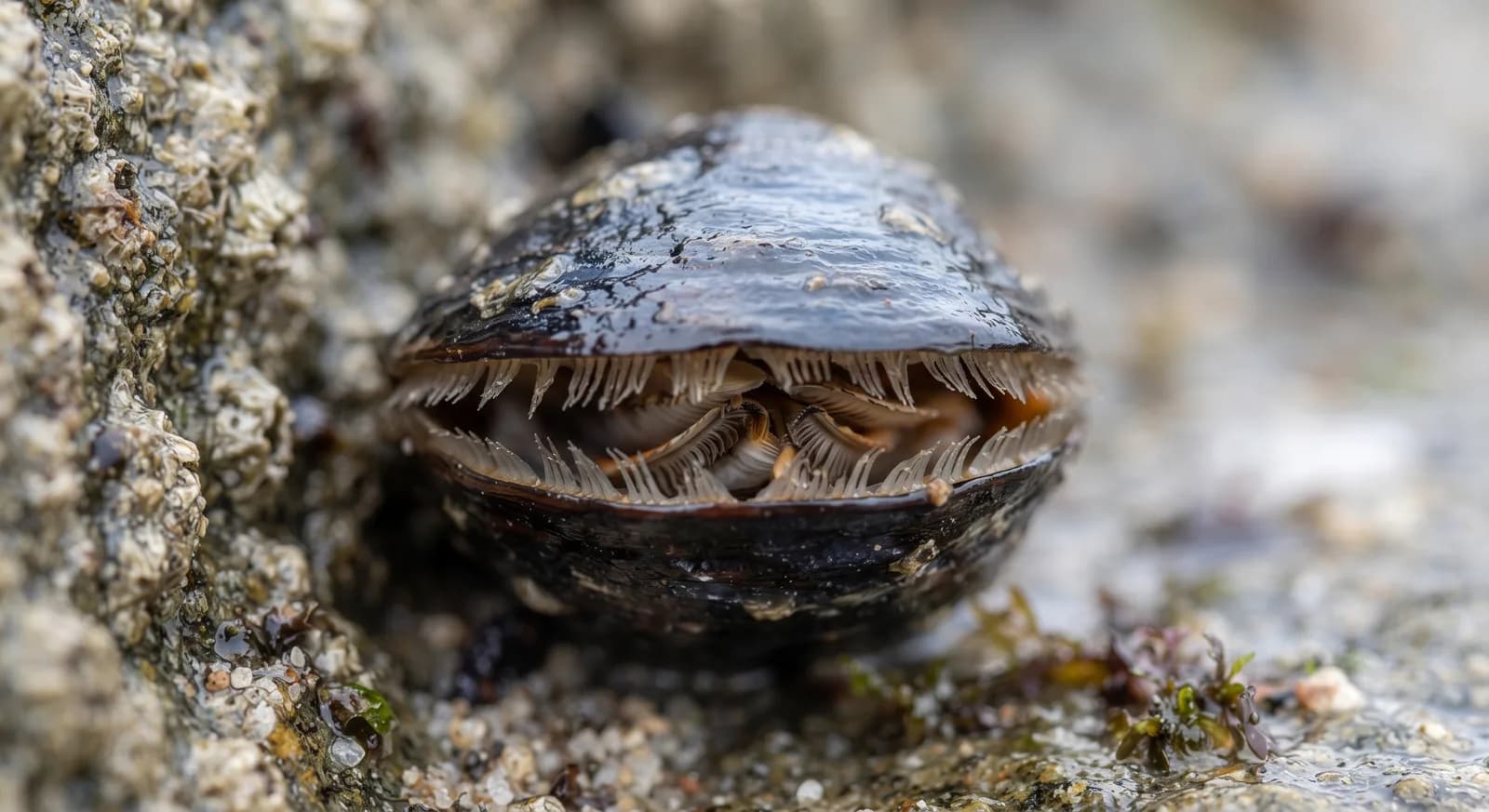
AI-generated images: illustrations, not photographs.

Fun facts

  • It chemically detects the release of gametes by other mussels nearby.
  • It forms dense beds anchored to the rocks by byssus threads.
  • It can live up to 24 years in good conditions.
  • Its byssus is an extraordinary and much-studied material: it sticks underwater, on wet, dirty surfaces, something no synthetic adhesive manages well. The key is a set of proteins carrying a modified amino acid, DOPA, which displaces water from the surface and forms strong bonds.
  • That mechanism has inspired surgical adhesives and sealants for wet tissue.
  • It forms beds that are habitats in themselves: dozens of species live among the shells, and the beds damp the waves and stabilise the sediment.
  • It hybridises with the Mediterranean mussel, Mytilus galloprovincialis, wherever the two meet, which greatly complicates the identification of populations and of farmed mussels.
  • As a filter feeder it accumulates red-tide toxins and heavy metals, and it is the classic sentinel species of marine water quality monitoring programmes, the so-called Mussel Watch.
  • It can detach from its byssus and relocate, so a mussel bed is a structure that slowly reorganises itself.

Life cycle and biology

Skeleton type
Invertebrate - external calcareous bivalve shell (mollusc)
Habitat and environment
Rocky intertidal zones of temperate and cold seas across the northern hemisphere, forming dense beds anchored by byssus threads
Birth weight
A tiny egg released into the water, developing into a ciliated trochophore larva
Size at birth
A ciliated trochophore larva after fertilisation, turning into a veliger larva over 1-1.5 months
Sexual maturity
1-2 years
Gestation / incubation
Roughly 1-1.5 months of planktonic larval development before it settles
Litter / clutch size
No precise figure for fecundity in this species

Sources consulted: ScienceDirect (Mytilus genus overview); SeaLifeBase; NOAA Fisheries; AnAge (genomics.senescence.info); Animal Diversity Web; genomics.senescence.info (lifespan bivalvia latitude study)

Where to find it

Loading map…

Where to see it

Parks and dive sites where this species has been documented — showing 20 of 44.

Related species

Other species in the catalogue with the most in common with Blue Mussel — same habitat, park, country, tags or family.

Same taxonomic family
Shares a park
Shares a park
Shares a park
Shares a park
Shares a park

Keep exploring

Based on what we already know about blue mussel.

Comments

Share an experience, a fun fact or a tip for seeing the blue mussel.

Be the first to comment.

See full glossary
This page in other languages: Español · Deutsch · Français · Português · Italiano

The pins mark the parks and dive sites where its presence is documented.

See its range on the interactive map→
Doñana National ParkSpain
Gros MorneCanada
Pembrokeshire CoastUnited Kingdom
NorthumberlandUnited Kingdom
Cíes IslandsSpain
Ria FormosaPortugal
KosterhavetSweden
Terra NovaCanada
Fragas do EumeSpain
UrdaibaiSpain
Scapa FlowUnited Kingdom
Farne IslandsUnited Kingdom
Lofoten (orcas)Norway
SaltstraumenNorway
Berlengas IslandsPortugal
St AbbsUnited Kingdom
Malin HeadIreland
Block Island (Mohawk wreck)United States
Strýtan (hydrothermal chimney)Iceland
Andrea DoriaUnited States
See all 21 parks
See all 23 dive sites
Mediterranean MusselNot Evaluated

Mediterranean Mussel

Mytilus galloprovincialis

Not Evaluated

Common Periwinkle

Littorina littorea

Common OysterNot Evaluated

Common Oyster

Ostrea edulis

Not Evaluated

Flat Top Shell

Gibbula umbilicalis

Not Evaluated

Acorn Barnacle

Semibalanus balanoides

Not Evaluated

Common Limpet

Patella vulgata

CountriesUnited Kingdom
ParksDoñana National ParkSpain
TagsHerbivore
Herbivore
Variable activity
Colonial
Ocean
Mollusc

Europe15

North America3

Africa1

United Kingdom
Portugal
Canada
Spain
Ireland
Norway
Belgium
Denmark
Estonia
France
Iceland
Ireland
Latvia
Lithuania
Netherlands
Norway
Poland
Portugal
Spain
Sweden
United Kingdom
Canada
Greenland
United States
Morocco