Skip to content
WAnimals
  • Map
  • Species
  • Parks
  • Diving
Log inCreate account
WAnimals

The guide for travellers and animal lovers: discover, plan and share your wild adventures around the world.

Discover wildlife

  • Species
  • Ecosystems
  • Glossary
  • Tags

Explore places

  • Map
  • Countries
  • Parks
  • Diving

Plan experiences

  • Guides

Learn

  • Blog

Resources

  • Help centre
  • Contact
  • Install the app

Follow us

Account

  • Log in
  • Create account

© 2026 WAnimals. All rights reserved.

About usHow we build our profilesTerms of servicePrivacyLegal notice
MapSpeciesParksDiving
  1. Home
  2. Species
  3. Common Oyster

One of the 4 oysters on WAnimals
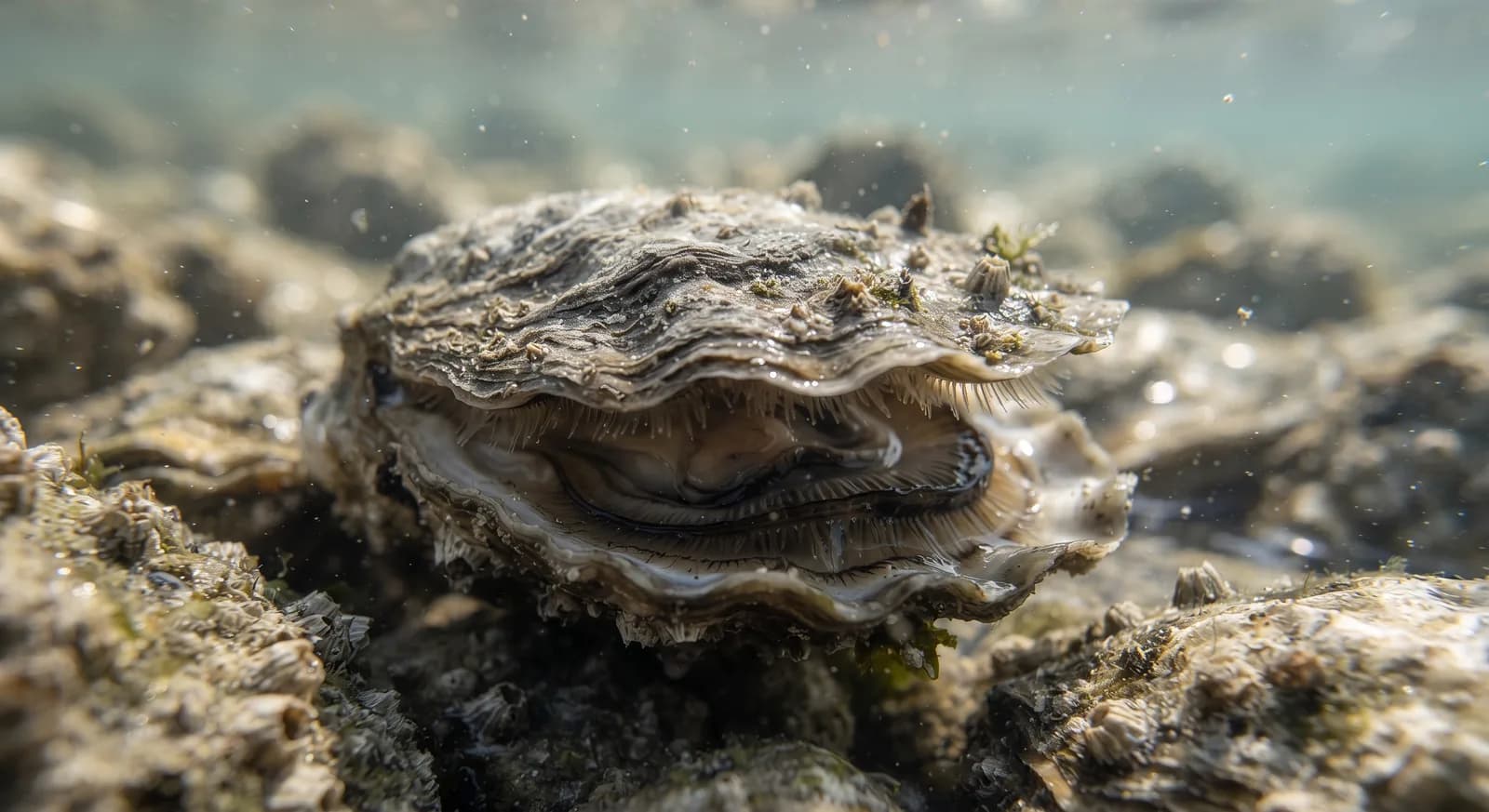
Common Oyster (Ostrea edulis)

Bivalves · Ostreida · Ostreidae

Common Oyster

Ostrea edulis

Not Evaluated

It has not yet been assessed against the IUCN criteria.

Spotted something wrong?

It is a protandrous sequential hermaphrodite: every oyster is born male and can change sex repeatedly with the water temperature. It broods its larvae inside its own mantle cavity before releasing them.

Size

3.8 cm – 11 cm

Life expectancy

8 years

Diet

Herbivore

Feeds mainly on plants.
Activity

Irregular activity

Active at irregular times, by day or night depending on circumstances.

Social structure

Colony

Lives in large concentrations, often for breeding reasons.

Sighting difficulty

Unknown

Ocean
37countries49parks83dive sites1same family

AI-generated images: illustrations, not photographs.

Fun facts

  • Every oyster is born male and can change sex several times in its life.
  • It broods its larvae for 7 to 10 days inside its own mantle cavity before releasing them.
  • Its European populations have been in steep historical decline.
  • It is the European flat oyster, the native oyster, and its reefs once covered enormous areas of Europe's coasts. Today they have disappeared from more than 85% of their historical area and are considered one of the most degraded marine habitats in Europe.
  • The cause is a combination of historical overfishing, the parasitic disease bonamiosis and competition from the introduced Pacific oyster.
  • It is an alternating hermaphrodite and broods its larvae inside the mantle cavity for a few days before releasing them, something the Pacific oyster does not do: it sheds its larvae straight into the water.
  • Its reefs were ecosystem engineers: they filtered the water, created three-dimensional structure and harboured a biodiversity comparable to that of a temperate coral reef.
  • Today it is the object of major restoration projects in the United Kingdom, the Netherlands, Germany and Spain, with reintroduction of oysters and of shell substrate.
  • In the 19th century it was food for the poor in London and Paris, so abundant was it; its status as a luxury is a direct consequence of its collapse.

Life cycle and biology

Skeleton type
Invertebrate - external calcareous bivalve shell (mollusc)
Habitat and environment
Estuaries and shallow coastal waters with hard mud and rock substrates, from Norway to Morocco, the Mediterranean included
Birth weight
A veliger larva brooded inside the mother's mantle cavity before release
Size at birth
A veliger larva released after 7-10 days brooded by the mother, settling 8-26 days later
Sexual maturity
8-10 months (though field studies put full maturity as late as 3-5 years)
Gestation / incubation
7-10 days brooded in the mother's mantle cavity before the larvae are released
Litter / clutch size
Up to 2,000,000 eggs in a large female

Sources consulted: JungleDragon; GBIF; Animalia.bio; Earthpedia; MarLIN; Smithsonian NEMESIS; PMC (genomic prediction growth traits study); Wikipedia (Ostrea edulis)

Where to find it

Loading map…

Where to see it

Parks and dive sites where this species has been documented — showing 20 of 132.

Related species

Other species in the catalogue with the most in common with Common Oyster — same habitat, park, country, tags or family.

Shares a park
Shares a park
Shares a park
Same taxonomic family
Shares a park
Shares a park

Keep exploring

Based on what we already know about common oyster.

Comments

Share an experience, a fun fact or a tip for seeing the common oyster.

Be the first to comment.

See full glossary
This page in other languages: Español · Deutsch · Français · Português · Italiano

The pins mark the parks and dive sites where its presence is documented.

See its range on the interactive map→
Doñana National ParkSpain
CalanquesFrance
Cinque TerreItaly
Alonissos and the Northern SporadesGreece
Gros MorneCanada
IchkeulTunisia
Majjistral ParkMalta
Port-CrosFrance
Pembrokeshire CoastUnited Kingdom
NorthumberlandUnited Kingdom
Scapa FlowUnited Kingdom
Zenobia WreckCyprus
Medes IslandsSpain
Cap de CreusSpain
El Hierro / La RestingaSpain
Museo Atlántico (Lanzarote)Spain
Zakynthos (loggerhead turtle)Greece
Kastellorizo (Blue Cave)Greece
Malta (Blue Hole Gozo / Um El Faroud)Malta
Tavolara (Sardinia)Italy
See all 49 parks
See all 83 dive sites
Not Evaluated

Common Periwinkle

Littorina littorea

Blue MusselNot Evaluated

Blue Mussel

Mytilus edulis

Not Evaluated

Flat Top Shell

Gibbula umbilicalis

Not Evaluated

Pacific Oyster

Crassostrea gigas

Not Evaluated

Acorn Barnacle

Semibalanus balanoides

Not Evaluated

Common Limpet

Patella vulgata

CountriesSpain
ParksDoñana National ParkSpain
TagsHerbivore
Herbivore
Variable activity
Colonial
Ocean
Mollusc

Europe22

Africa10

Asia3

North America2

Spain
Italy
Greece
United Kingdom
Croatia
Portugal
Albania
Belgium
Croatia
Cyprus
Denmark
France
Germany
Gibraltar
Greece
Iceland
Ireland
Italy
Malta
Monaco
Montenegro
Netherlands
Norway
Portugal
Slovenia
Spain
Sweden
United Kingdom
Algeria
Cabo Verde
Egypt
Gambia
Guinea-Bissau
Libya
Mauritania
Morocco
Senegal
Tunisia
Israel
Lebanon
Türkiye
Canada
United States