Skip to content
WAnimals
  • Map
  • Species
  • Parks
  • Diving
Log inCreate account
WAnimals

The guide for travellers and animal lovers: discover, plan and share your wild adventures around the world.

Discover wildlife

  • Species
  • Ecosystems
  • Glossary
  • Tags

Explore places

  • Map
  • Countries
  • Parks
  • Diving

Plan experiences

  • Guides

Learn

  • Blog

Resources

  • Help centre
  • Contact
  • Install the app

Follow us

Account

  • Log in
  • Create account

© 2026 WAnimals. All rights reserved.

About usHow we build our profilesTerms of servicePrivacyLegal notice
MapSpeciesParksDiving
  1. Home
  2. Species
  3. Hagfish

One of the 2 hagfishes on WAnimals
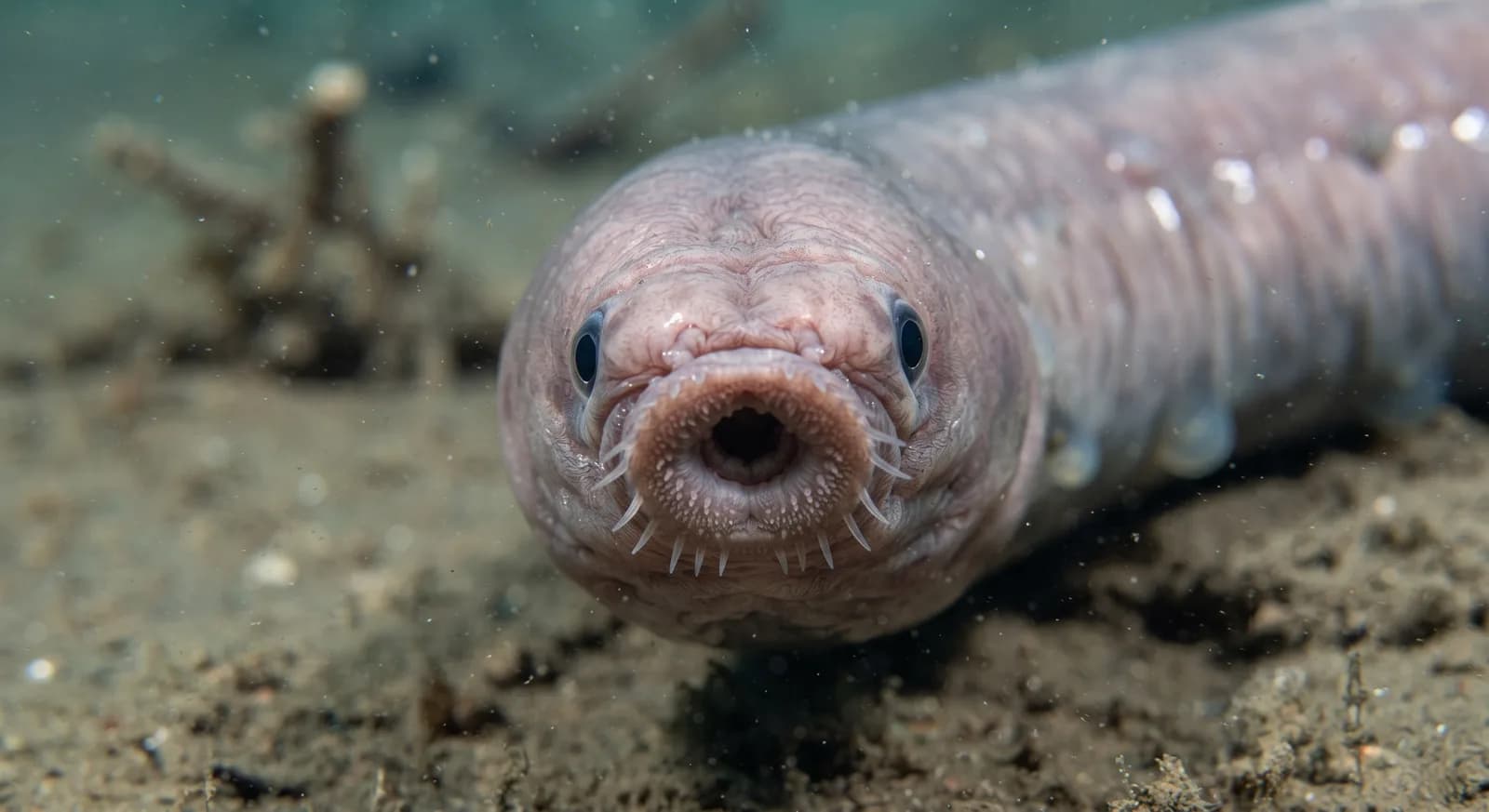
Hagfish (Myxine glutinosa)

Hagfish · Myxiniformes · Myxinidae

Hagfish

Myxine glutinosa

Least Concern

The species is abundant and widely distributed; it faces no significant short-term risk.

Spotted something wrong?

The Atlantic hagfish is an agnathan fish of the family Myxinidae that lives off the coasts of the northern half of the Atlantic Ocean and in certain very localised regions away from the coast. It can also be found in the Black Sea, but such cases are rarer.

Size

35 cm – 80 cm

Diet

Carnivore

Feeds mainly on other animals.

Activity

Nocturnal

Active mainly at night.
Social structure

Colony

Lives in large concentrations, often for breeding reasons.

Sighting difficulty

Easy

Ocean
17countries36parks6dive sites1same family

AI-generated images: illustrations, not photographs.

Fun facts

  • Faced with a threat it releases a secretion that, on contact with water, expands within seconds, turning several litres into a dense gel that clogs the attacker's gills; its fibres are being studied for making technical textiles.
  • To rid itself of its own slime and to tear off mouthfuls it ties its body in a knot and runs the knot from head to tail.
  • It has no jaws and no true vertebrae, though it does have a skull, and its position in the vertebrate tree makes it a key piece in understanding our own origins.
  • It produces the most extraordinary slime in the animal kingdom: when attacked it releases a secretion that, on contact with seawater, expands up to 10,000 times its volume in fractions of a second, generating litres of a gelatinous mass that chokes and clogs the gills of the predator.
  • That slime is no simple mucus: it contains protein threads of up to 15 cm coiled inside specialised cells, which unfurl and form a three-dimensional network. It is being investigated as a model for strong, biodegradable synthetic fibres, and also for anti-ballistic materials.
  • And it knows how to rid itself of its own slime: it ties itself into a knot and slides the loop along its body to wipe itself clean.
  • It eats carrion from the inside: it slips into the carcass of a fish or a whale through any opening and consumes it from within. It also absorbs nutrients directly through its skin and gills, something unique among vertebrates.
  • It has no vertebrae, no jaws and no paired fins. It is one of the two surviving lineages of jawless vertebrates, alongside the lampreys, and its anatomy is key to understanding the origin of vertebrates.
  • It has four hearts and can survive for hours with almost no oxygen.

Life cycle and biology

Skeleton type
Vertebrate - cartilaginous skeleton without vertebrae (hagfish)
Habitat and environment
Muddy bottoms of the North Atlantic, between 20 and 1,000 m

Sources consulted: https://es.wikipedia.org/wiki/Myxine_glutinosa

Where to find it

Loading map…

Where to see it

Parks and dive sites where this species has been documented — showing 16 of 42.

Related species

Other species in the catalogue with the most in common with Hagfish — same habitat, park, country, tags or family.

Shares a park
Shares a park
Shares a park
Same taxonomic family
Shares a park
Shares a park

Keep exploring

Based on what we already know about hagfish.

Comments

Share an experience, a fun fact or a tip for seeing the hagfish.

Be the first to comment.

See full glossary
This page in other languages: Español · Deutsch · Français · Português · Italiano

The pins mark the parks and dive sites where its presence is documented.

See its range on the interactive map→
AcadiaUnited States
Gros MorneCanada
FundyCanada
Wadden Sea National ParkDenmark
Wadden SeaGermany
Pembrokeshire CoastUnited Kingdom
NorthumberlandUnited Kingdom
Cíes IslandsSpain
Ria FormosaPortugal
KosterhavetSweden
SaltstraumenNorway
Block Island (Mohawk wreck)United States
Andrea DoriaUnited States
Bay of FundyCanada
Bell Island WrecksCanada
Trondheimsfjord (cold-water corals)Norway
See all 36 parks
European HakeLeast Concern

European Hake

Merluccius merluccius

Least Concern

Plaice

Pleuronectes platessa

Least Concern

Skipper

Scomberesox saurus

Data Deficient

Pacific Hagfish

Eptatretus stoutii

Near Threatened

Thornback Ray

Raja clavata

RabbitfishNear Threatened

Rabbitfish

Chimaera monstrosa

CountriesCanada
ParksAcadiaUnited States
TagsCarnivore
Carnivore
Nocturnal
Colonial
Fish
Ocean

Europe13

North America3

Asia1

Canada
United Kingdom
United States
Portugal
Denmark
Germany
Belgium
Denmark
Finland
France
Germany
Iceland
Ireland
Netherlands
Norway
Portugal
Spain
Sweden
United Kingdom
Canada
Greenland
United States
Russia