Skip to content
WAnimals
  • Map
  • Species
  • Parks
  • Diving
Log inCreate account
WAnimals

The guide for travellers and animal lovers: discover, plan and share your wild adventures around the world.

Discover wildlife

  • Species
  • Ecosystems
  • Glossary
  • Tags

Explore places

  • Map
  • Countries
  • Parks
  • Diving

Plan experiences

  • Guides

Learn

  • Blog

Resources

  • Help centre
  • Contact
  • Install the app

Follow us

Account

  • Log in
  • Create account

© 2026 WAnimals. All rights reserved.

About usHow we build our profilesTerms of servicePrivacyLegal notice
MapSpeciesParksDiving
  1. Home
  2. Species
  3. Queen Parrotfish
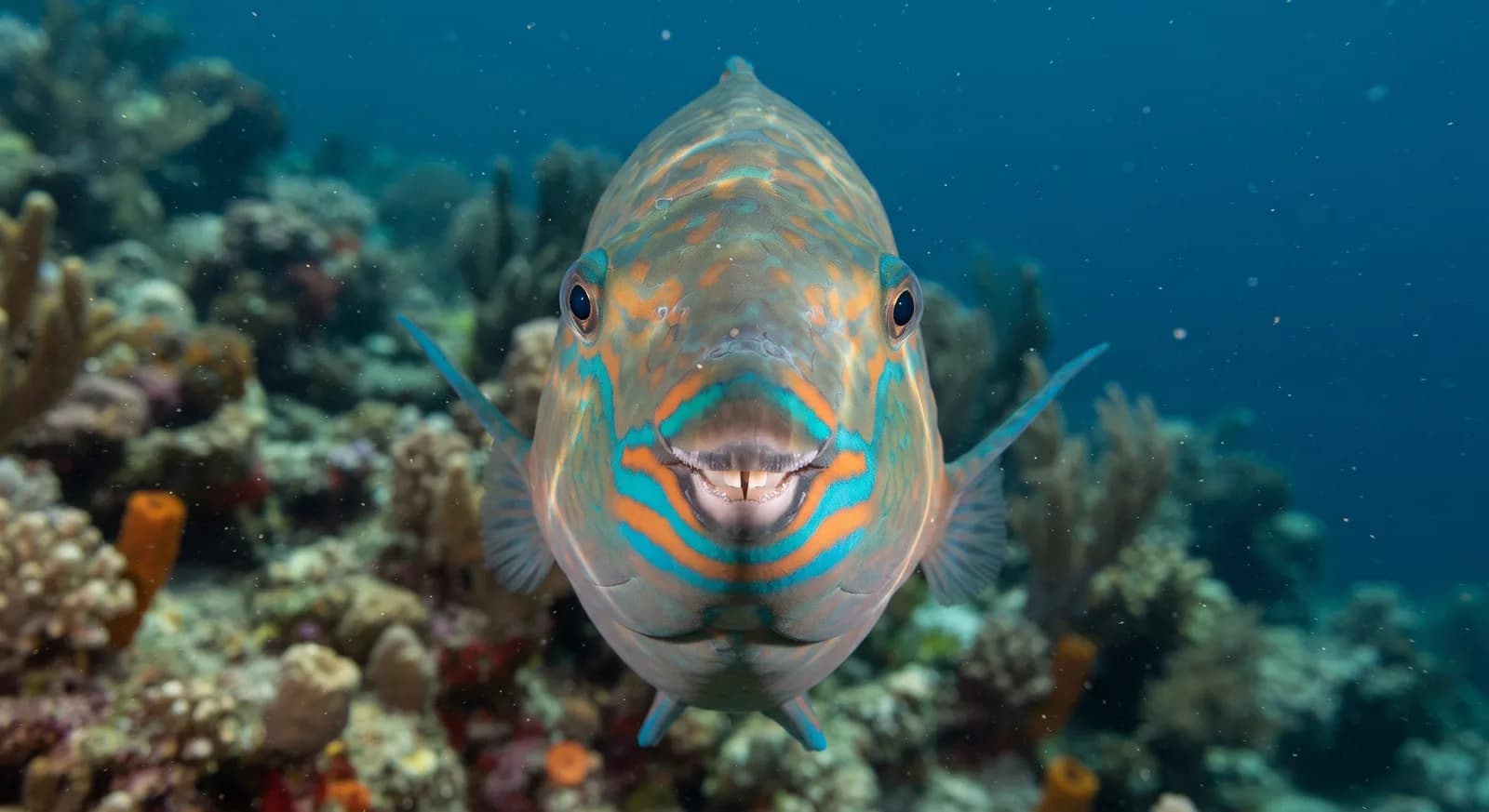
Queen Parrotfish (Scarus vetula)

Bony fish · Perciformes · Scaridae

Queen Parrotfish

Scarus vetula

Least Concern

The species is abundant and widely distributed; it faces no significant short-term risk.

Spotted something wrong?

Scarus vetula is a fish of the family Scaridae in the order Perciformes. Its teeth are fused into a dental plate.

Size

30 cm – 61 cm

Diet

Herbivore

Feeds mainly on plants.

Activity

Diurnal

Active mainly during the day.
Social structure

Colony

Lives in large concentrations, often for breeding reasons.

Sighting difficulty

Easy

Ocean
33countries21parks85dive sites

AI-generated images: illustrations, not photographs.

Fun facts

  • By grinding up the coral skeleton to digest the algae it produces sand: a single large parrotfish can generate hundreds of kilos of beach sand a year.
  • At night it wraps itself in a cocoon of mucus secreted from its mouth, which masks its scent from predators and parasites.
  • It is a protogynous hermaphrodite: all are born female, and the dominant individuals turn into males, changing colour completely in the process.
  • It sleeps inside a sac of slime. At dusk it slips into a crevice and secretes, from glands behind its gills, a bubble of mucus that envelops it completely within half an hour.
  • That cocoon is not just a blanket: it carries antibiotics that kill pathogens specific to parrotfishes and physically blocks blood-sucking parasites. It is built from a mesh of glycoproteins linked by disulphide bridges.
  • It makes sand. It scrapes algae and coral with its beak of dental plates, grinds the mixture in its pharyngeal mill and expels the indigestible carbonate: a single parrotfish can produce close to a hundred kilos of sand a year.
  • By eating sponges it indirectly protects the corals, which would otherwise be smothered by fast-growing sponge species.
  • It is a sequential hermaphrodite: it starts out as a primary-phase female, and some individuals change into terminal-phase males, with a completely different colouration.
  • It lives in small, stable groups of three or four females and one dominant supermale.
  • It spends up to 90% of the day feeding, and it is not a strong swimmer: it propels itself by rowing with its pectoral fins.

Life cycle and biology

Skeleton type
Vertebrate - internal bony skeleton (fish)
Habitat and environment
Coral reefs of the Caribbean and the tropical western Atlantic

Sources consulted: https://es.wikipedia.org/wiki/Scarus_vetula

Where to find it

Loading map…

Where to see it

Parks and dive sites where this species has been documented — showing 20 of 106.

Related species

Other species in the catalogue with the most in common with Queen Parrotfish — same habitat, park, country, tags or family.

Shares a park
Shares a park
Shares a park
Shares a park
Shares a park
Shares a park

Keep exploring

Based on what we already know about queen parrotfish.

Comments

Share an experience, a fun fact or a tip for seeing the queen parrotfish.

Be the first to comment.

See full glossary
This page in other languages: Español · Deutsch · Français · Português · Italiano

The pins mark the parks and dive sites where its presence is documented.

See its range on the interactive map→
Sian Ka'anMexico
Bacalar ChicoBelize
GuanicaPuerto Rico
JaraguaDominican Republic
Virgin Islands (St John)U.S. Virgin Islands
Tobago Main RidgeTrinidad and Tobago
Exuma Cays Land and Sea ParkBahamas
TayronaColombia
Los RoquesVenezuela
CahuitaCosta Rica
Great Blue HoleBelize
Half Moon Caye WallBelize
Turneffe AtollBelize
Palancar ReefMexico
Isla Mujeres (whale shark)Mexico
Bloody Bay WallCayman Islands
USS Kittiwake wreckCayman Islands
Stingray CityCayman Islands
Tiger BeachBahamas
Jardines de la ReinaCuba
See all 21 parks
See all 85 dive sites
Atlantic SpadefishLeast Concern

Atlantic Spadefish

Chaetodipterus faber

Magnificent FrigatebirdLeast Concern

Magnificent Frigatebird

Fregata magnificens

Grey SnapperLeast Concern

Grey Snapper

Lutjanus griseus

Man-of-war FishLeast Concern

Man-of-war Fish

Nomeus gronovii

Foureye ButterflyfishLeast Concern

Foureye Butterflyfish

Chaetodon capistratus

Red-footed BoobyLeast Concern

Red-footed Booby

Sula sula

CountriesMexico
ParksSian Ka'anMexico
TagsHerbivore
Herbivore
Diurnal
Colonial
Fish
Ocean

North America31

South America2

Mexico
Belize
Cayman Islands
Bahamas
Colombia
Dominican Republic
Anguilla
Antigua and Barbuda
Aruba
Bahamas
Barbados
Belize
Bermuda
British Virgin Islands
Cayman Islands
Costa Rica
Cuba
Curaçao
Dominica
Dominican Republic
Grenada
Guadeloupe
Guatemala
Haiti
Honduras
Jamaica
Martinique
Mexico
Nicaragua
Panama
Puerto Rico
Saint Kitts and Nevis
Saint Lucia
Saint Vincent and Grenadines
Trinidad and Tobago
Turks and Caicos Islands
U.S. Virgin Islands
Colombia
Venezuela