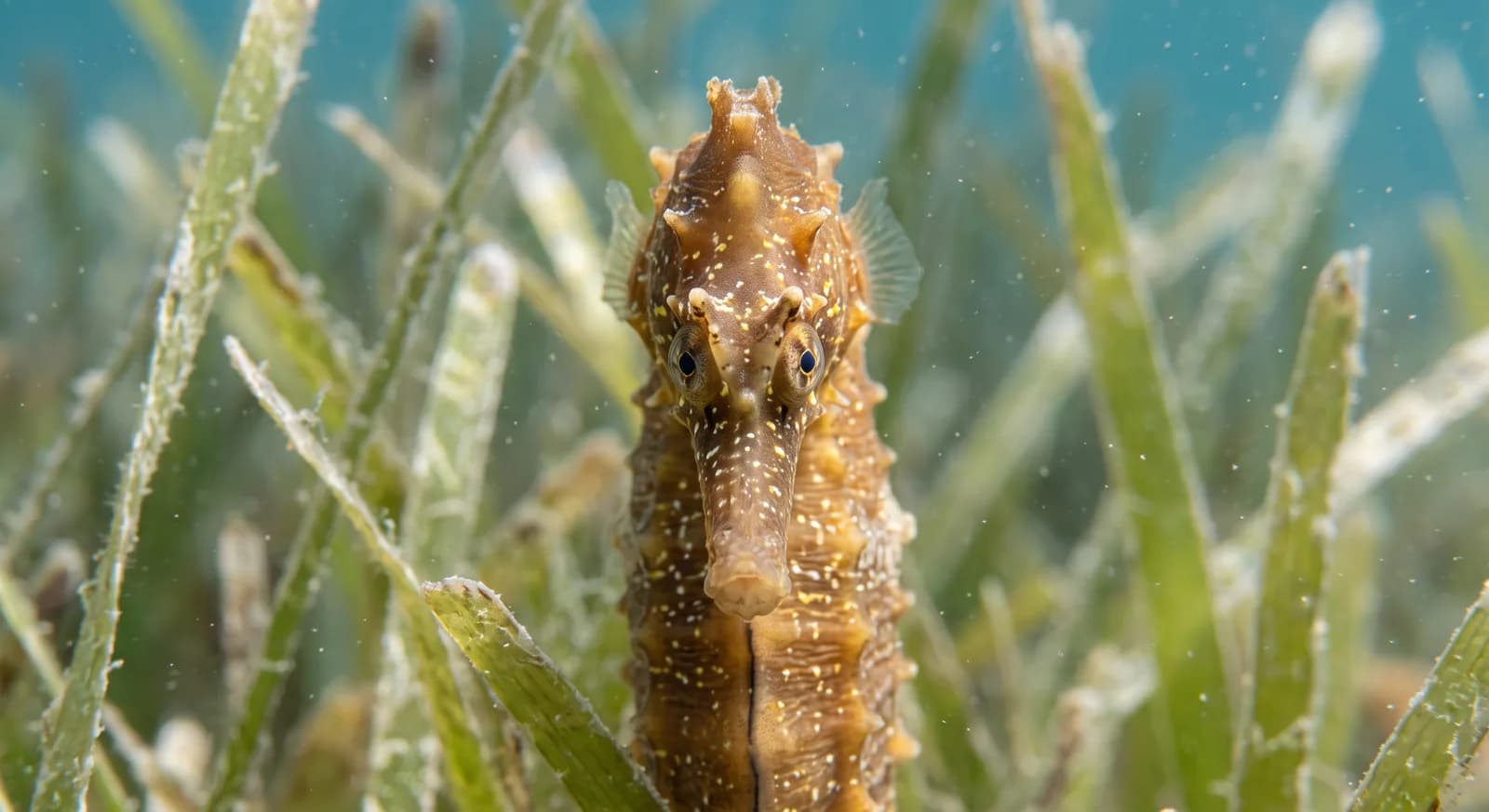
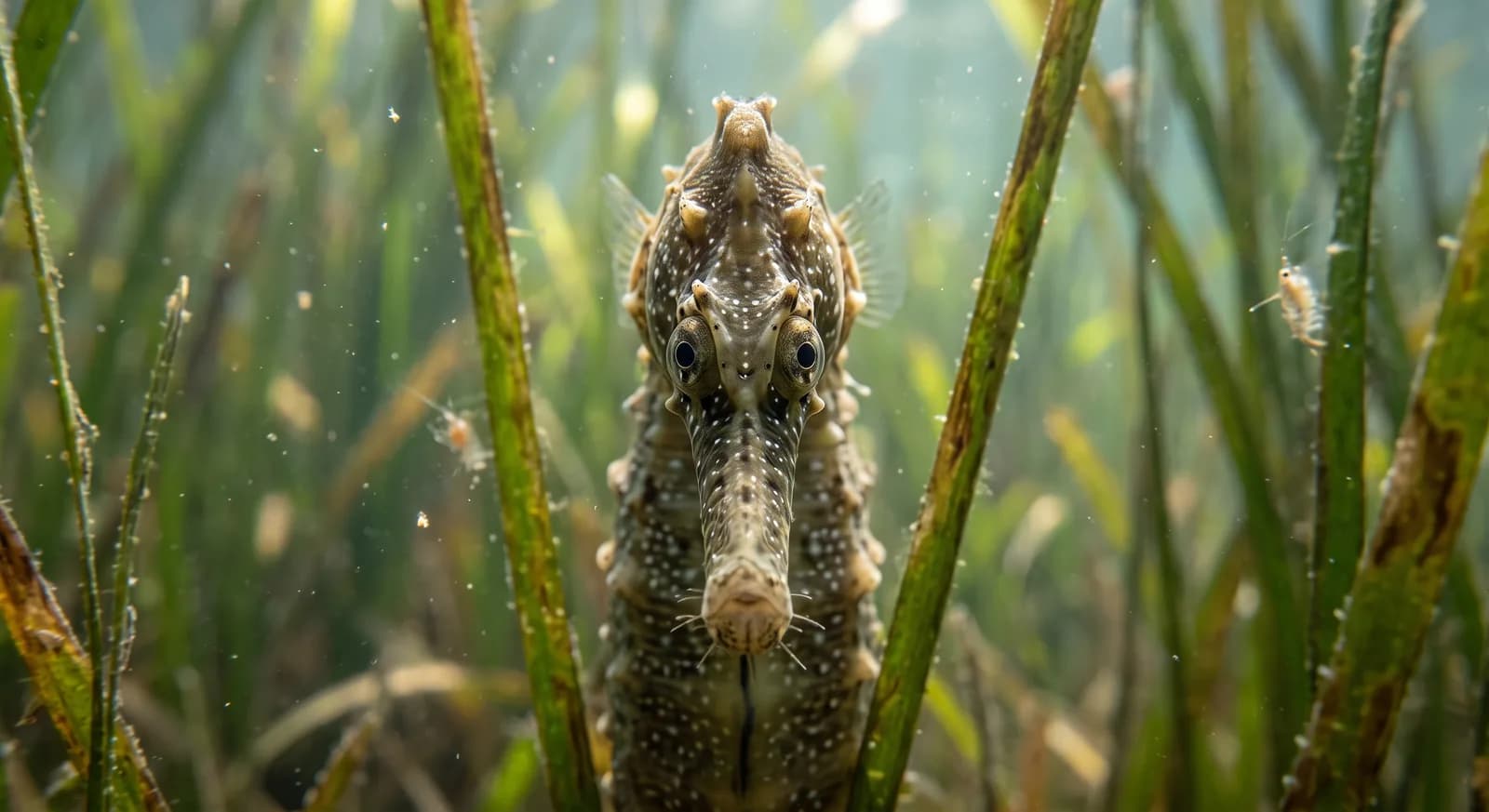
It is one of the few animals in the world in which the male, not the female, carries the fertilised eggs through gestation, in a specialised brood pouch.
Size
up to 15 cm
Life expectancy
3 years
Diet
Carnivore
Feeds mainly on other animals.
Activity
Irregular activity
Active at irregular times, by day or night depending on circumstances.
AI-generated images: illustrations, not photographs.
Fun facts
It is the male, not the female, that carries the fertilised eggs in a specialised brood pouch.
For all its slowness it is an extremely effective predator, with a strike success rate close to 90%.
Hard data on this species is limited; many figures come from comparisons across the genus Hippocampus.
The pregnancy is the male's, and that is no metaphor: the female deposits her eggs in a brood pouch on the male, where they are fertilised and where he nourishes and oxygenates them until he gives birth to fully formed young.
That pouch changes its structure during gestation to ease the exchange of gases and nutrients between father and embryos, working in a way comparable to a placenta.
It forms pairs that last through the breeding season and greet each other every morning with a ritual courtship.
It swims poorly and slowly, propelling itself with a dorsal fin that beats up to 35 times per second, and spends most of its time clinging to a stem with its prehensile tail.
It has no stomach: food passes through its digestive tract very quickly, so it must eat almost continuously.
The entire genus Hippocampus is on Appendix II of CITES, which regulates its international trade.
Seagrass meadows and vegetated bottoms of the Mediterranean and the eastern Atlantic
Birth weight
A tiny young released from the male's brood pouch; no precise size found for this particular species
Size at birth
Tiny at birth (across the genus Hippocampus, from 2 mm to 16 mm depending on the species)
Sexual maturity
4 months to a year, depending on which species in the genus is taken as reference
Gestation / incubation
14-28 days of gestation in the male's brood pouch (a figure for the genus)
Litter / clutch size
Up to several hundred young per litter (a figure for the genus; it varies greatly by species)
Sources consulted: MarineBio (Pacific seahorse, datos comparativos de género); Animal Diversity Web (género Hippocampus); Florida Museum of Natural History; nota: datos específicos de H. hippocampus limitados en fuentes consultadas, complementados con referencias de género
Where to find it
Loading map…
Where to see it
Parks and dive sites where this species has been documented — showing 20 of 101.
Related species
Other species in the catalogue with the most in common with Short-snouted Seahorse — same habitat, park, country, tags or family.
Same taxonomic family
Shares a park
Shares a park
Shares a park
Shares a park
Shares a park
How to help
The short-snouted seahorse is classified as vulnerable. Organisations such as the IUCN, WWF and the Wildlife Conservation Society work specifically on its conservation and that of its habitat; looking into their programmes is a good starting point if you want to get involved.
It's documented in 17 protected areas — one reason why protecting these places matters for its conservation.
Keep exploring
Based on what we already know about short-snouted seahorse.
Comments
Share an experience, a fun fact or a tip for seeing the short-snouted seahorse.