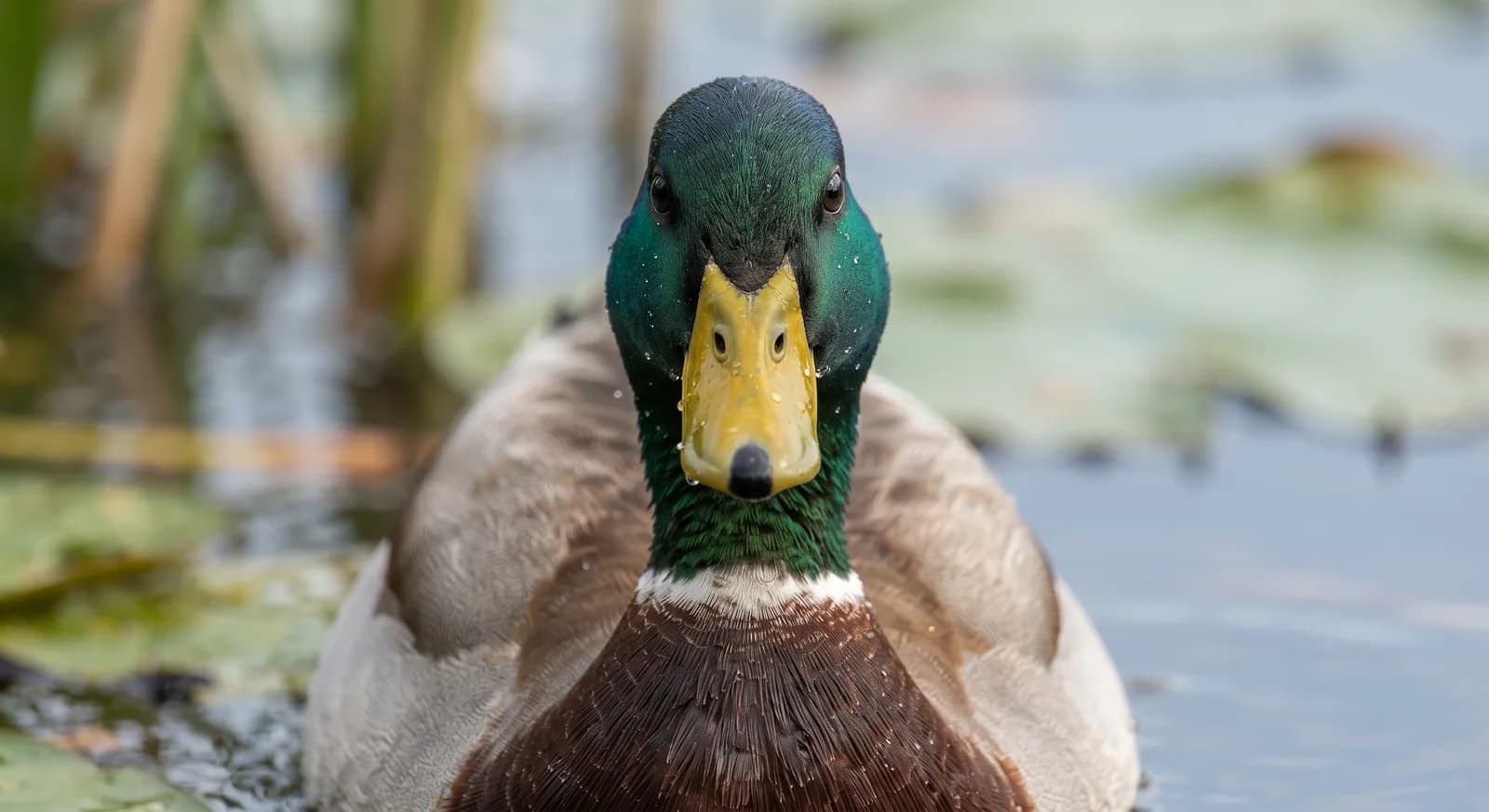
One of the 10 ducks on WAnimals
Birds · Anseriformes · Anatidae
Muscovy Duck
Cairina moschata
The species is abundant and widely distributed; it faces no significant short-term risk. See full glossary
A large, robust duck, with white patches or bars on the wings that are more visible in flight. Both sexes have pink or red caruncles around the bill, larger and brighter in the male. All Muscovy ducks have long claws on their feet and a broad, flat tail. Domestic birds are heavier, fly less well and have far more variable plumage than wild ones.
Weight
1.3 kg – 3 kg
Size
up to 86 cm
Lifespan
8 years
Diet
Omnivore
Combines animal and plant food depending on availability.
Activity
Diurnal
Active mainly during the day.
Social structure
Colony
Lives in large concentrations, often for breeding reasons.
Sighting difficulty
Easy
Estimated population
Between 50,000 and 499,999 individuals
Fun facts
- GeneralIts domestic form, the Muscovy duck, is kept throughout Latin America.
- It is the only domestic duck in the world that does not descend from the mallard: every other one does.
- Indigenous American peoples were already keeping it in pre-Columbian times, long before the Europeans arrived.
- Crossed with the domestic duck it produces the mulard, a sterile hybrid between two different genera that is used on a huge scale in meat and foie gras production.
- It is one of the few ducks that perches and nests in trees, and for that it has strong claws on its toes.
- It was domesticated by the indigenous peoples of the Americas long before the arrival of the Europeans, and it is one of the world's only two domestic ducks, alongside the mallard. In Spain it is known as pato criollo or pato mudo.
- The 'mute' of its Spanish name pato mudo is literal: it does not quack. The male gives a hiss and the female a soft coo, very different from the quacking of other ducks.
- The red, warty caruncles on the face belong to the domestic form and to adult males; wild birds are black with a greenish sheen and white patches on the wing.
- The size dimorphism is enormous: the male can weigh twice as much as the female.
- Wild and feral populations mix, so many records outside its range correspond to escaped domestic birds.
Life cycle & biology
- Skeleton type
- Vertebrate - internal bony skeleton (bird)
- Habitat & environment
- Wooded wetlands, rivers and tropical lagoons
- Size at birth
- Precocial yellow ducklings with brown markings on tail and wings, which stay with the mother for 60 to 70 days
- Sexual maturity
- About 28 weeks in females and 29 in males (figures from captive birds)
- Gestation / incubation
- About 35 days of incubation, by the female
- Litter / clutch size
- 8-16 eggs, laid in a tree hollow
Sources consulted: EFSA 2023, Welfare of ducks, geese and quail on farm (Scientific Opinion); secuenciación de genoma completo de anátidas domésticas; Wikipedia (Domestic duck, Domestic Muscovy duck, Mulard); Universidad de Córdoba (Colombia), caracterización morfométrica de Cairina moschata domestica; IUCN Red List; Eikelberg et al. 2025, Acta Veterinaria Scandinavica; Linnaeus 1758
Where to find it
See its range on the interactive mapBest time: All year round; the domestic form is present in rural areas and parks across half the world
Where to watch it
Parques y spots de buceo donde se ha documentado esta especie — se muestran 10 de 76 documentados.
Related species
Other species in the catalogue with the most in common with Muscovy Duck — same habitat, park, country, tags or family.
Knob-billed Duck
Sarkidiornis melanotos
Black-necked Swan
Cygnus melancoryphus
White-faced Whistling-Duck
Dendrocygna viduata
 Least Concern
Mallard
Anas platyrhynchos
Northern Pintail
Anas acuta
Snow Goose
Anser caerulescens
Keep exploring
Based on what we already know about muscovy duck.
Comments
Share an experience, a fun fact or a tip for seeing the muscovy duck.
Be the first to comment.